


Long Yellow Gold Chain
A long yellow gold chain is a versatile necklace designed for continuous wear, offering rich historical craftsmanship and practical length.
Long Yellow Gold Chain
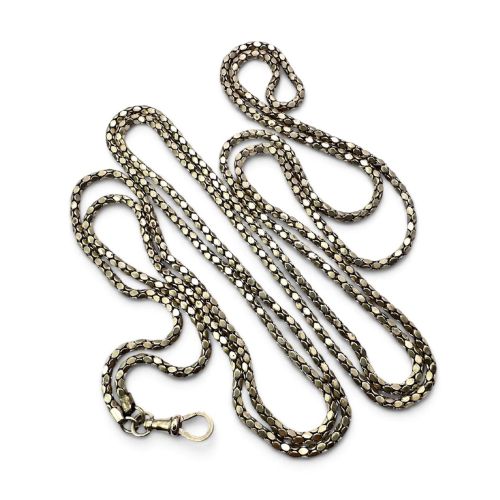
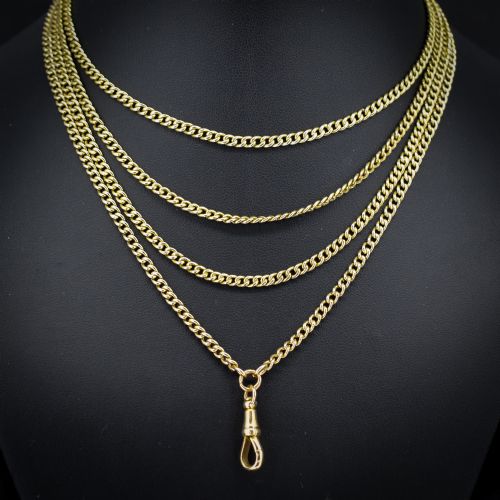
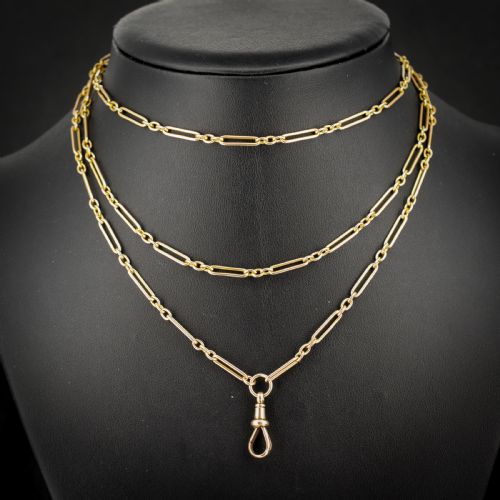
A long yellow gold chain provides a continuous sweep of precious metal, often spanning several dozen inches to permit looping or doubling around the neck. Buyers seeking a long yellow gold chain frequently encounter substantial guard chains, muff chains, and longuards originating from the Victorian and Edwardian eras. These pieces often feature integrated dog clips or spring rings designed originally to secure pocket watches, pendants, or eyeglasses.
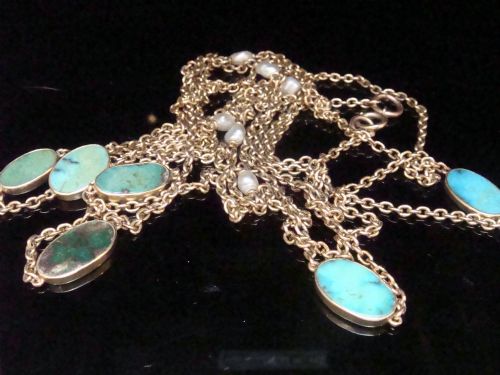
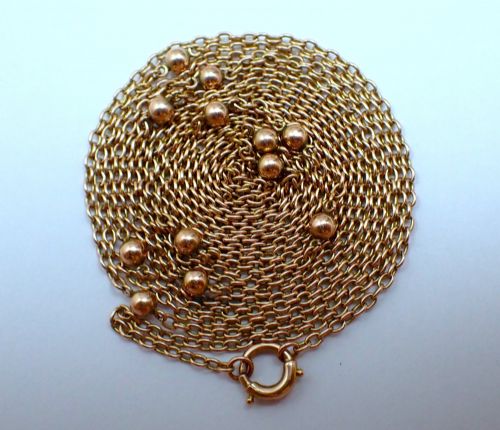
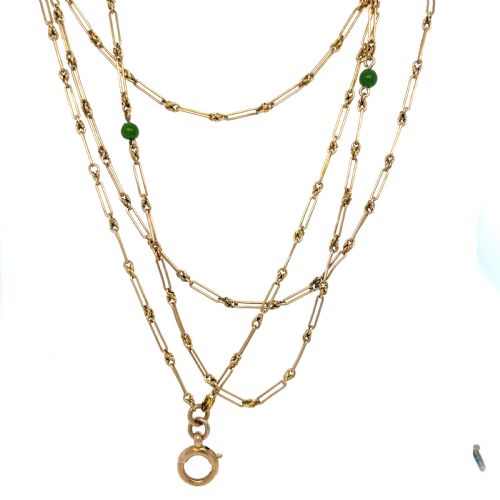
The evidence shows forms ranging from short twenty-inch iterations up to dramatic lengths exceeding sixty inches. Construction includes distinctive link geometries such as belcher, curb, trombone, and paper links, sometimes interspersed with gems like turquoise, natural pearls, and garnets. French antique variations and mid-century examples also appear within the selection.
Originating predominantly across the nineteenth and early twentieth centuries, these items served practical daily functions for Victorian and Edwardian wearers. Today they function as statement necklaces that carry genuine antique character and substantial gold weight. Their robust construction suits modern layering and independent wear alike.
Materials and Construction
Goldsmiths utilised varying purities of gold, predominantly nine carat, fifteen carat, and eighteen carat yellow gold, alongside occasional platinum accents. Links were formed individually by hand or utilising early mechanical wire-drawing techniques, then soldered together to create fluid, flexible ropes and chains. Substantial pieces incorporate solid gold links, while specific variations employ rolled gold over a base metal core.
Designers incorporated decorative stations, slide mechanisms, and gemstone accents including turquoise cabochons and natural pearls threaded onto core chains. Secure fastenings such as dog clips and bolt rings were attached using swivel loops to prevent the long chain from twisting during wear. Hallmarks and maker marks were frequently stamped directly onto the terminal rings or dog clips.
Listings feature yellow gold chains spanning the Victorian, Edwardian, and mid-century periods, utilising nine, fifteen, and eighteen carat gold alongside turquoise and natural pearls.
Evaluating Quality
Quality rests upon the structural integrity of the individual links and the original condition of the swivel dog clips or spring rings. Chains retaining their full original length, crisp link profiles, and secure, functional clasps demonstrate superior preservation. Substantial gram weight and higher gold karat marks, such as fifteen or eighteen carat, distinguish the finest examples from lighter nine carat or rolled gold counterparts.
The presence of undamaged gemstone embellishments, such as matched natural pearls or securely bezel-set turquoise, elevates the standard of a piece. Finesse in the assembly of complex link patterns, such as trombone or faceted belcher formations, indicates high-level bench work by the original goldsmith.
The Long Yellow Gold Chain Glossary
- Longuard chain
- A very long necklace designed during the Georgian and Victorian periods to secure pocket watches or eyeglasses. These pieces measure upwards of thirty inches and loop multiple times around the neck.
- Dog clip
- A spring-loaded snap hook attached to the end of a chain, permitting the swift attachment of charms, pendants, or watches. It remains a hallmark feature of antique guard chains.
- Belcher link
- A form of chain link made from wide, uniform wire that is round on the outside and flat on the inside. It forms a durable and classic profile.
- Trombone link
- An elongated rectangular link alternating with smaller round or oval links, reminiscent of musical instrument tubing. This style was popular during the Victorian era.
- Slide
- A movable decorative ornament positioned on a chain, frequently set with gems or enamel, that can be shifted along the length. It often includes an internal mechanism to hold its position.
Long Yellow Gold Chain: Frequently Asked Questions
How were long gold chains originally worn?
Victorian and Edwardian wearers draped these long chains around the neck, often doubling them or looping them through a waist-mounted watch hook. The terminal dog clip secured a pocket watch, locket, or keys tucked into a pocket or waistband.
Today, the same length allows the wearer to double the chain for a layered necklace effect or let it hang loose as a single uninterrupted line.
What is the difference between a guard chain and a standard necklace?
Guard chains were engineered with utility in mind, carrying functional items rather than acting purely as decorative neckwear. They incorporate heavy-duty swivel dog clips and substantial links capable of supporting suspended pocket watches.
Standard necklaces of the period were generally shorter and focused entirely on ornamentation around the collarbone without utilitarian terminal clips.
How do I care for an antique gold chain?
Maintenance requires gentle cleaning using warm water and mild soap, avoiding harsh chemical dips that can damage natural pearls or turquoise set into the links. Storing the chain flat or hung carefully prevents kinks in delicate paper or belcher links.
Regularly check the spring mechanism on the dog clip to ensure the gate closes securely.
How can I tell the period of a gold chain?
Dating relies on hallmarks stamped onto the dog clips or terminal rings, indicating gold fineness such as nine carat, fifteen carat, or eighteen carat. Stylistic markers like trombone links, integrated slides, and specific gemstone pairings point directly toward Victorian or Edwardian manufacturing techniques.
Archival comparisons with documented French antique and British guard chains provide further chronological context.