

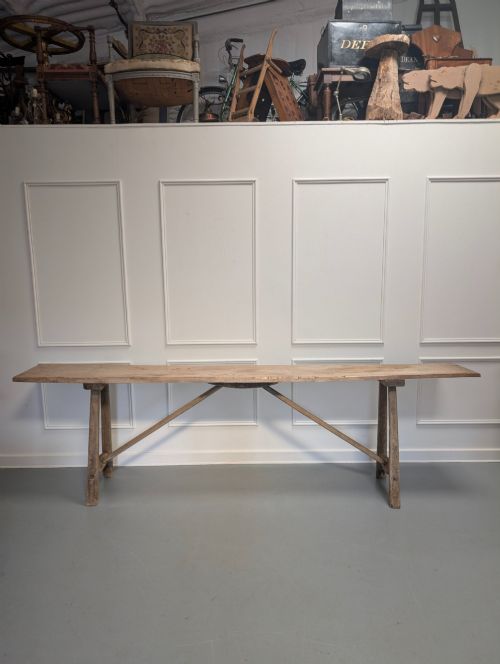
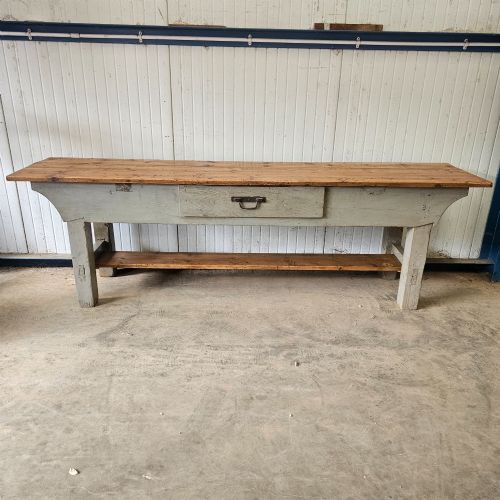


Long Work Table
A long work table brings honest utility to a room, offering generous timber surfaces shaped by generations of practical tasks.
Long Work Table
A long work table represents the robust functional furniture of past domestic and commercial spaces, built to endure heavy daily labour. These pieces primarily manifest as drapers tables, farmhouse tables, and kitchen preparation tables spanning from the Georgian era through the nineteenth century to the early twentieth century.
The forms encompass console tables, trestle tables, and tavern tables alongside traditional worktables. Each piece serves modern interiors as a substantial centrepiece for dining or food preparation, retaining the character of its original workspace.
How they were made
These tables rely on solid timbers like pine, oak, walnut, fruitwood, and mahogany for their primary construction, selected for strength and resilience. Carpenters utilised robust joints to support extended lengths, sometimes incorporating additional pine shelving beneath the main surface.
Surface finishes include aged natural wood patinas and remnants of original paint, occasionally accented with brass or iron hardware. Construction techniques prioritise practical endurance, resulting in sturdy trestle frames and heavy four-legged bases designed to withstand constant pressure.
Long Work Table Retail Price Guide 2026
Typical asking prices for long work table among the pieces listed under this phrase on Sellingantiques today, from the lower quarter to the upper quarter. They describe what is for sale here now, not the wider market.
One extraordinary nineteenth century French oak drapers table stretches to a monumental four metres in length.
What varies in quality
Quality in a long work table rests upon the integrity of the timber and the honesty of its wear, where deep patinas earned through genuine utility distinguish superior examples. Finer pieces display well-proportioned framing that maintains structural stability across expansive lengths without excessive sagging.
The choice of secondary woods and the subtlety of original painted finishes or polished surfaces also indicate finer craftsmanship. Tables retaining their authentic structural elements and uncompromised proportions command greater appreciation among collectors.
The Long Work Table Glossary
- Drapers table
- A long, narrow table historically utilised in fabric shops for measuring and displaying textiles, typically featuring lower shelves. These tables offer exceptional length and narrow proportions suited for modern hallways or dining rooms.
- Farmhouse table
- A heavy, utilitarian wooden table designed for communal dining and kitchen labour in rural homes. They often exhibit robust timber construction and generous dimensions.
- Fruitwood
- Timber derived from fruit-bearing trees such as cherry, pear, or apple, known for a warm tone and fine grain. Cabinet makers selected it for its smooth finish and pleasing decorative qualities.
- Trestle table
- A table comprising two or more supports connected by a horizontal beam, holding a long top. This design allows for maximum legroom along the length of the table.
Long Work Table: Frequently Asked Questions
What is a drapers table?
A drapers table is an extended utilitarian table originally used in textile shops to fold and measure cloth. They are distinguished by their notable length and narrow proportions.
Many examples include a lower shelf for storing bolts of fabric or tools. Today, these proportions make them popular for narrow dining spaces or hallways.
How were these tables used?
These tables served as heavy-duty surfaces for domestic labour, food preparation, dairy work, and commercial trade. They were built to withstand continuous daily handling in kitchens, taverns, and shops.
As a result, their surfaces often bear the marks and stains of past utility. This history of work gives each piece its distinct character.
What woods are commonly found?
Construction materials include domestic and continental timbers such as pine, oak, walnut, fruitwood, and mahogany. Pine and fruitwood appear frequently in French provincial pieces.
Hardwoods like oak and walnut provide greater structural rigidity for the largest formats. Iron and brass elements occasionally appear in structural braces or hardware.
How do I style a long work table?
A long work table suits large kitchens, open-plan dining rooms, or spacious hallways where its length can be fully appreciated. Pairing the table with simple benches or mismatched chairs enhances its rustic origins.
The expansive wooden top benefits from minimal ornamentation to let the grain and historic patination remain the focal point.