

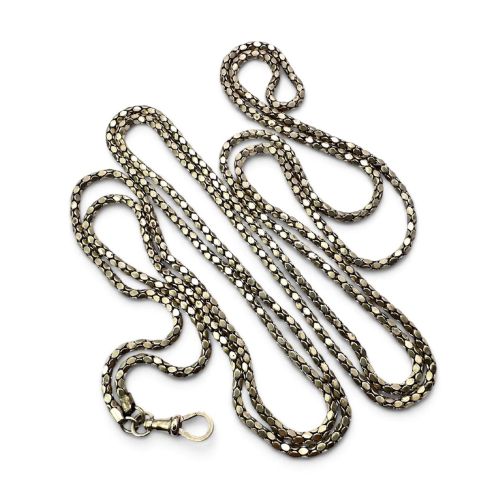
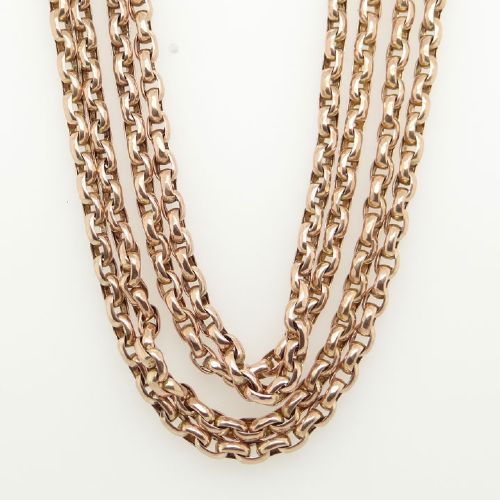
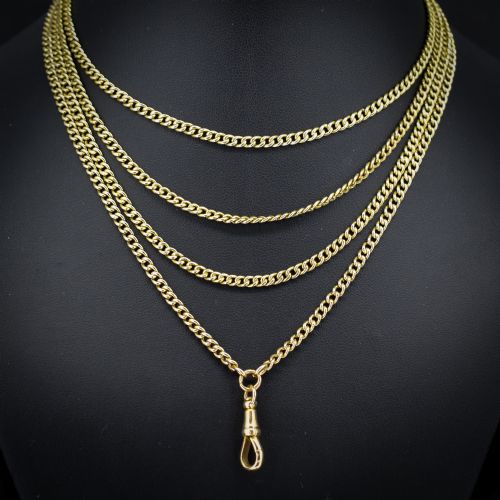
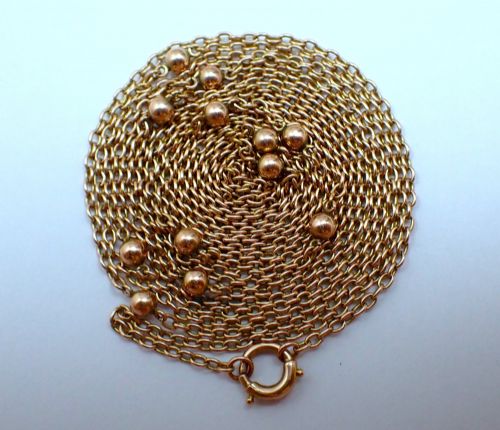



Long Gold Chain
A long gold chain offers versatility and historical presence, often worn doubled or looped to showcase craftsmanship from the Victorian and Edwardian eras.
Long Gold Chain
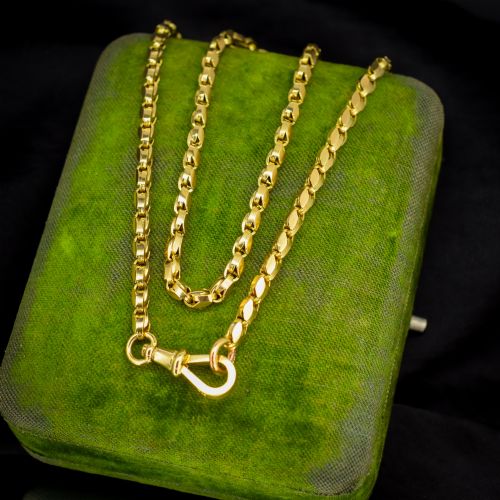
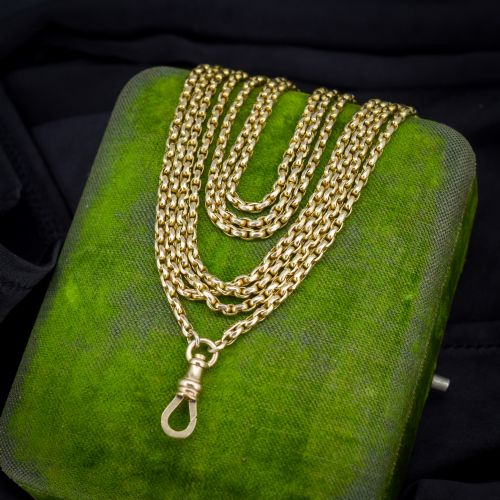
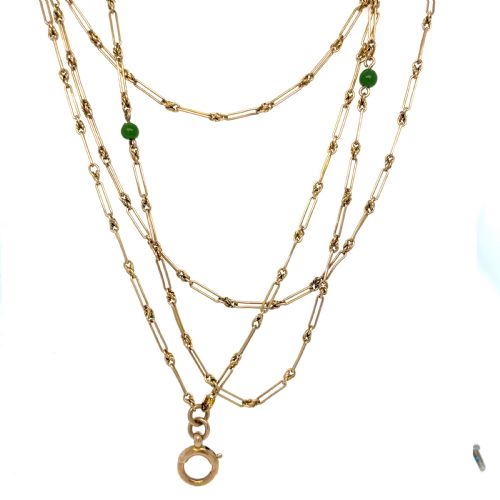
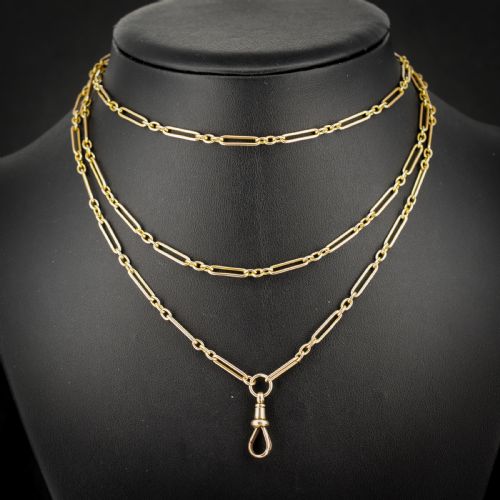
When you search for a long gold chain, you encounter substantial pieces designed to be worn draped, doubled, or looped around the neck. These items include Victorian and Edwardian longuard chains, muff chains, and sautoirs that often measure well over thirty inches in length.
The versions most commonly met on this page originate from the nineteenth and early twentieth centuries, featuring functional elements like dog clips and Albert clips. Makers constructed these items to secure pocket watches, pendants, or slides, resulting in wearable lengths that span from forty to over sixty inches.
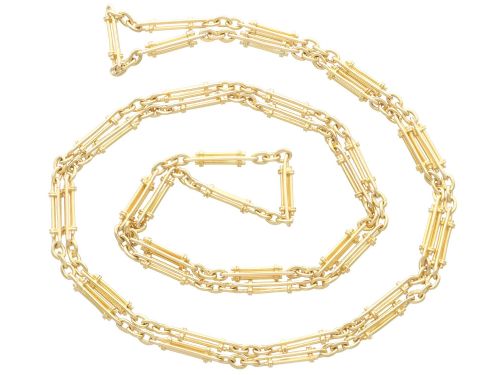
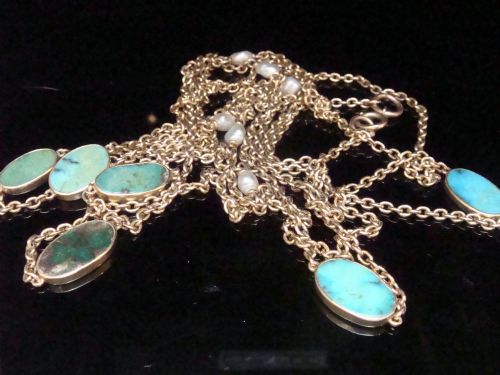
Many examples incorporate decorative stations such as turquoise beads, natural pearls, or geometric links interspersed along the metal strand. These variations reflect the utilitarian origins of guard chains transformed into decorative jewellery over successive decades.
How they were made
Goldsmiths utilised various purities of yellow and rose gold, predominantly nine-carat and fifteen-carat variants, alongside higher-purity eighteen-carat components. Links were hand-assembled into curb, belcher, paper, or fancy configurations, creating fluid strands with considerable tensile strength.
Makers integrated gemstones like diamonds, garnets, citrines, and turquoise directly into the chain links or suspended them via slides and fobs. Working closely with metal, artisans formed secure clasps, swivel dog clips, and bolt rings to withstand daily wear.
Long Gold Chain Retail Price Guide 2026
Typical asking prices for long gold chain among the pieces listed under this phrase on Sellingantiques today, from the lower quarter to the upper quarter. They describe what is for sale here now, not the wider market.
Listings feature yellow and rose gold variants alongside white gold, spanning purities from nine-carat up to eighteen-carat.
What varies in quality
The calibre of a long gold chain depends heavily on the integrity of its links and the robustness of its swivel mechanisms. Pieces displaying heavy gauge wire and solid construction command greater appreciation than lighter hollow alternatives.
Artisanal detail dictates the distinction between standard production and exceptional examples, particularly where hand-chased ornamentation, matched gemstone slides, or original dog clips remain intact. The uniformity of link connections and the absence of solder repairs preserve the structural harmony of the piece.
Connell
The Long Gold Chain Glossary
- Longuard chain
- A very long necklace designed to be doubled around the neck, originating in the nineteenth century for securing pocket watches or lorgnettes. These pieces frequently incorporate swivel clips for attaching charms or fobs.
- Dog clip
- A spring-loaded clasp shaped like a small hound's muzzle, commonly found on Victorian and Edwardian watch chains. This mechanism allowed wearers to securely attach and detach pendants or pocket watches.
- Muff chain
- An extra-long chain traditionally passed through a fur muff to keep hands warm while securing a timepiece or keys. They share similarities with guard chains but often feature lighter, decorative link patterns.
- Slide
- A movable decorative element mounted on a chain, frequently set with gems or enamel, used originally to adjust tension or position on a cord. Slides often feature small drop pendants hanging beneath them.
- Albert clip
- A specific fastening swivel or T-bar assembly designed for pocket watch attachments, occasionally repurposed on longer neckchains. It provides a secure, heavy-duty closure characteristic of nineteenth-century tailoring.
Long Gold Chain: Frequently Asked Questions
How were long gold chains worn historically?
Victorian and Edwardian wearers draped these long chains around the neck either as a single continuous strand or doubled over to rest on the chest. They frequently attached pocket watches, keys, or lorgnettes to the integrated dog clips.
As fashions shifted, the functional timepieces were often replaced by decorative pendants, slides, or fobs. This allowed the practical guard chains to function primarily as prominent decorative adornments.
What is the difference between a guard chain and a sautoir?
Guard chains generally originated as functional accessories for securing pocket watches or muffs during the nineteenth century. They prioritize sturdy link construction and reliable swivel clips.
Sautoirs tend to lean toward decorative French styling from the late nineteenth and early twentieth centuries, frequently ending in tassels or ornamental drops. Both share substantial lengths requiring overhead placement.
Can I attach modern pendants to these chains?
Most antique chains feature original dog clips or bolt rings that readily accommodate modern pendants, lockets, or charms. The scale of the links provides a secure anchor for various attachment loops.
Care should be taken to match the weight of the pendant to the gauge of the chain to maintain visual and structural balance. Lighter hollow links require lighter additions than solid fifteen-carat curbs.
How do I identify the gold purity on antique chains?
British pieces from the Victorian and Edwardian periods often bear small hallmarking stamps indicating the gold carat, such as nine carat or fifteen carat. These stamps usually appear near the clasp or on individual links.
Continental European pieces, particularly from France, frequently utilise different hallmark symbols like eagle heads for higher purity gold. Unmarked examples require professional testing to determine precise metal composition.