


Light Oak Library Table
A light oak library table brings warmth and utility to a room, offering sturdy work surfaces in pale timbers.
Light Oak Library Table
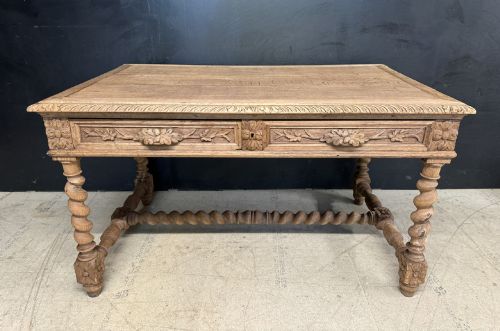
When you search for a light oak library table, you are looking at substantial writing and work furniture produced across the nineteenth and early twentieth centuries. These tables provide large flat surfaces supported by robust timber frames, suited to reading, writing, and study.
The versions you are most likely to meet on this page date from the nineteenth century up to nineteen ten. They appear in styles ranging from Victorian Gothic and Renaissance Revival to Arts and Crafts and French Provincial, often constructed in plain or bleached oak.
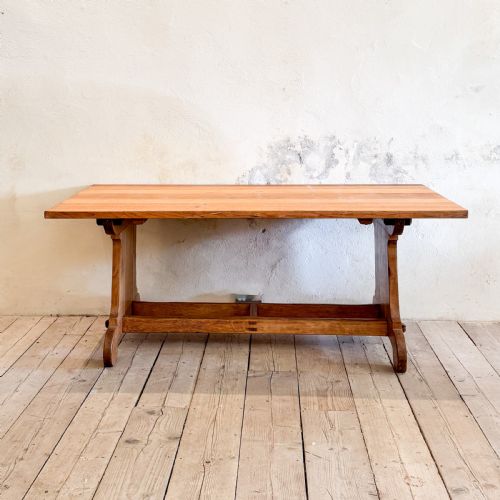
Forms span centre tables, writing tables, pedestal desks, and dining hybrids. Their light timber tones distinguish them from darker Victorian walnut and mahogany, offering a brighter aesthetic for contemporary and traditional interiors alike.
How they were made
Makers utilised solid oak and bleached oak for the primary framework and tabletops, sometimes incorporating brass hardware for handles or mounts. Leather inserts occasionally provide writing surfaces on desk variants.
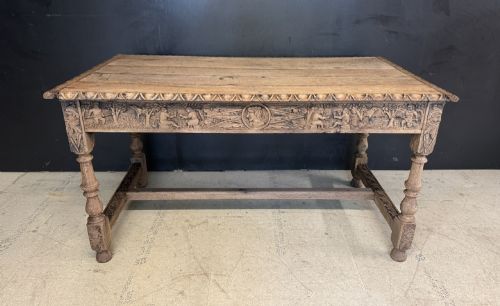
Construction methods rely on traditional joinery to support heavy use. Carved ornamentation appears on select pieces, drawing on Gothic Revival and Renaissance motifs executed directly into the timber.
Listings feature pieces spanning from eighteen sixty to nineteen ten, executed in oak, bleached oak, brass, and leather.
What varies in quality
Quality rests in the selection of the oak timber and the crispness of any carved detail. Pieces displaying deliberate stylistic ambition, such as Gothic or Renaissance Revival elements, show greater sculptural care than plain utilitarian forms.
The integrity of the construction and the harmonious ageing of the bleached or natural oak surfaces dictate the standing of a piece. Finer examples maintain structural balance while exhibiting the natural grain and colour variation of the wood.
The Light Oak Library Table Glossary
- Centre table
- A freestanding table finished on all sides so it can sit in the middle of a room rather than against a wall. These pieces function independently of architectural boundaries.
- Bleached oak
- Oak timber treated to lighten its natural colour, creating a paler finish. This treatment alters the visual weight of the wood.
- Pedestal desk
- A heavy desk supported by two pedestals or stacks of drawers on either side. These provide substantial storage beneath the main writing surface.
- Gothic Revival
- A nineteenth-century design style drawing inspiration from medieval architecture and ornament. It manifests in pointed arches, trefoils, and heavy carved details.
Light Oak Library Table: Frequently Asked Questions
What is a light oak library table used for?
These tables serve primarily as sturdy writing desks, study surfaces, or central display tables in a room. Their expansive timber tops accommodate books, papers, and daily working materials.
Historically placed in libraries or studies, they function equally well in modern living spaces as large desks or occasional tables.
How do I date a light oak library table?
Dating relies on observing stylistic markers such as Victorian Gothic carvings, Arts and Crafts simplicity, or Renaissance Revival motifs. Construction joints and material treatments also offer clues to the era of production.
Most examples date from the nineteenth century through to the early twentieth century, aligning with Victorian and Edwardian manufacturing periods.
Are bleached oak tables original?
Bleaching oak occurs both historically and through later conservation work to achieve a pale, uniform finish. Examining the depth of the tone and the condition of the timber helps determine the nature of the surface.
French bleached oak variations appear frequently in nineteenth-century production, valued for their lighter visual presence.
How do I care for a light oak library table?
Maintain the timber by dusting regularly with a dry cloth and avoiding harsh chemical cleaning agents. Keep the table away from direct heat sources and strong sunlight to prevent the oak from drying or splitting.
Leather inserts, where present, require specific leather conditioner to keep the material supple and prevent cracking over time.