






Library Table Lamp
These library table lamp pieces bring steady, directional task light and period gravitas to a desk, drawing on brass, bronze, and toleware.
Library Table Lamp
A library table lamp provides focused illumination suited to reading, writing, and consulting volumes at a desk or table. When you search for library table lamp, you encounter varied forms ranging from adjustable brass bankers designs and twin or triple bouillotte lamps in green toleware to column standards and student lamps.
The evidence shows these pieces span the nineteenth century, the Edwardian era, and the nineteen-twenties, incorporating both domestic work and Continental output from France. Alongside dedicated lighting, the record includes occasional tables, side tables, and centre tables that share the room name and serve as the surface upon which such lamps sit.
Brass and bronze dominate the surviving lighting, often paired with opaline or cranberry glass shades, while toleware brings painted metal colour to French bouillotte forms. Oak, walnut, mahogany, and fruitwood form the timber tables noted in the archive, connecting the lighting directly to the furniture of the study.
Materials and Construction
Makers utilised cast and spun brass, bronze, and plated metals to build articulated arms, swan necks, and weighted bases that could withstand daily adjustment. Toleware components introduce painted sheet metal into bouillotte lamps, frequently accented with contrasting metallic finishes.
Glass production played an essential role, supplying opaline and cranberry shades designed to soften the glare of early bulbs or candles. Timber tables in the record employ traditional joinery in oak, walnut, and mahogany, occasionally incorporating leather top inserts for a proper writing surface.
Library Table Lamp Retail Price Guide 2026
Typical asking prices for library table lamp among the pieces listed under this phrase on Sellingantiques today, from the lower quarter to the upper quarter. They describe what is for sale here now, not the wider market.
One clever nineteenth-century student lamp arrived complete with all its original writing implements still accounted for.
Markers of Quality
Quality rests in the weight of the metal castings, the smoothness of mechanical adjustments, and the crispness of detail on components like Doric columns or swan neck arms. Superior examples retain original surface patination across brass and bronze without losing structural rigidity in their joints.
In fitted pieces, the integration of materials - such as the seating of glass shades within brass mounts or the union of leather and timber on a desk surface - distinguishes standard workshop output from finer production.
Messenger·Faraday and Sons·Wild and Wessel·Gillows
The Library Table Lamp Glossary
- Bouillotte lamp
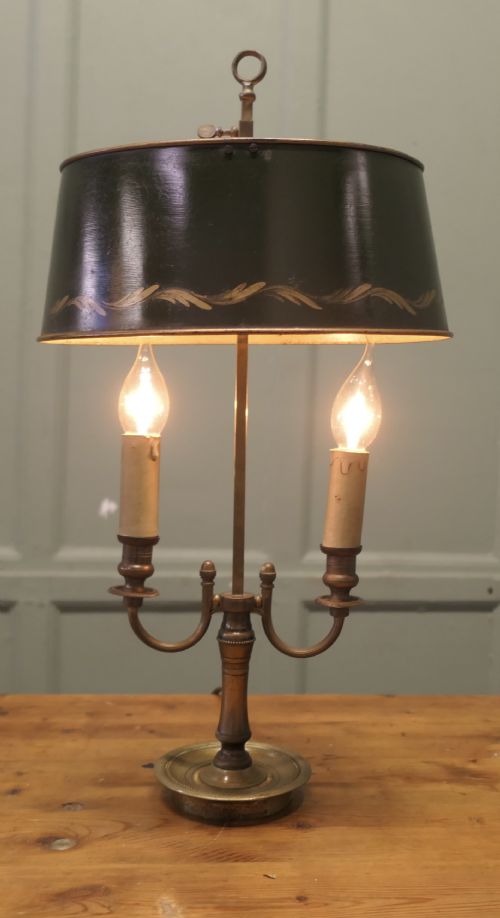
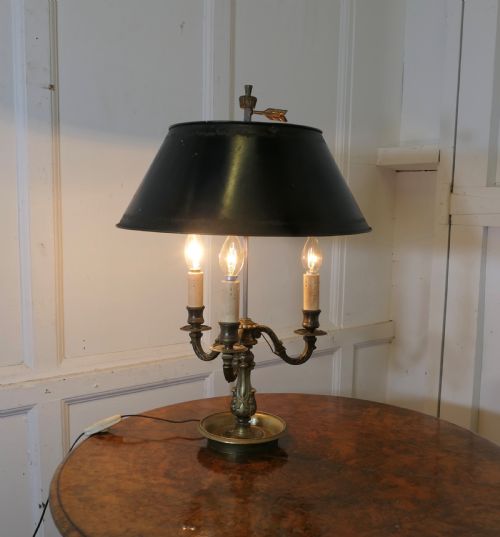
- A traditional French desk or card table light featuring multiple candle branches or bulb sockets rising from a central shaft through a painted toleware shade. The shade can usually be adjusted in height to direct the light downward.
- Opaline glass
- A dense, milk-white translucent glass often moulded into shades for desk and library lighting to diffuse glare evenly. It appears frequently on Edwardian and nineteenth-century brass fittings.
- Toleware
- Painted and lacquered sheet metal, most commonly seen in deep greens on French bouillotte lamps in this category. The material offers both colour and durability in a domestic study setting.
- Student lamp
- A nineteenth-century brass lighting fixture featuring an asymmetric arm designed to swing clear of inkwells and writing implements. These pieces prioritized functional workspace illumination.
- Pullman lamp
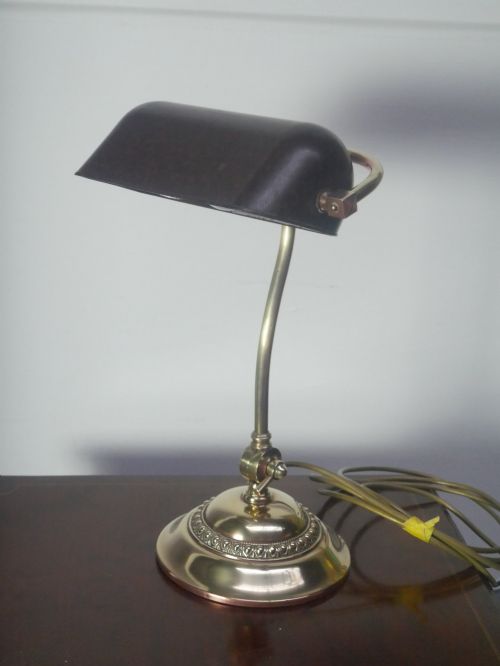
- A distinctive style of adjustable brass table or desk lamp, often associated with makers like Faraday and Sons, built for focused illumination. They utilise articulating arms for directional control.
Library Table Lamp: Frequently Asked Questions
What is a bouillotte lamp?
A bouillotte lamp is a traditional French desk light featuring multiple candle or bulb branches rising through an adjustable painted toleware shade. It was originally designed to illuminate card games before finding a permanent home on library desks.
The metal shade moves up and down on a central upright rod, allowing the user to control the pool of light cast over the writing surface below.
How do I adjust a bankers lamp?
A bankers lamp typically utilises a pivoting brass shade or an articulated frame that tilts to angle the light exactly where needed. The heavy metal base keeps the fixture stable during these adjustments.
Most nineteenth-century and Edwardian examples rely on threaded joints or friction hinges rather than modern internal springs.
What materials were used for these lamps?
The primary materials recorded are brass, bronze, and painted toleware, frequently paired with glass shades in opaline or cranberry hues. Some designs incorporate silver plate or leather elements.
Foundations and heavy bases provide the necessary weight to support extending arms and adjustable shades without tipping over.
Are these lamps suitable for modern desks?
These pieces provide focused, directional task lighting that suits contemporary workspaces just as well as nineteenth-century studies. Their compact footprints fit neatly beside modern monitors and keyboards.
Many period examples have been rewired to meet current electrical standards while retaining their patinated brass and bronze exteriors.