

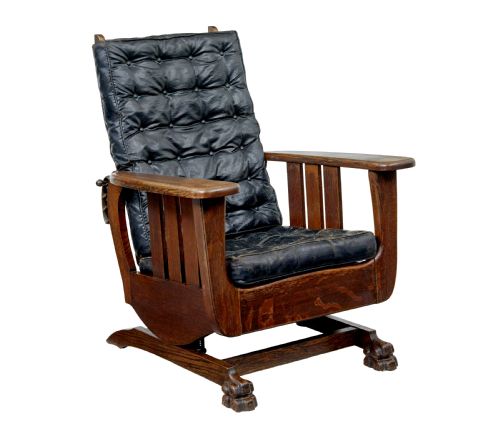
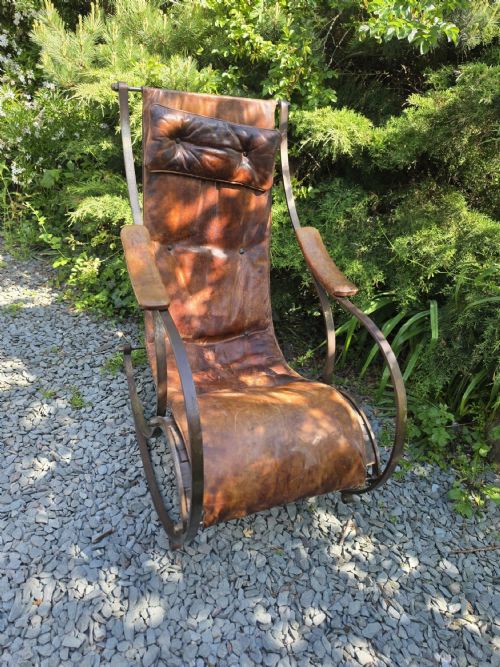


Leather Rocking Chair
A leather rocking chair brings solid oak, mahogany or beech together with aged hide for a seat that offers proper suspension and deep comfort.
Leather Rocking Chair
A leather rocking chair combines a timber frame with a hide seat or back, offering a sturdy seat designed for gentle movement. The pieces found here span the seventeenth century through the Edwardian period and the early twentieth century.
Most examples you meet on this page date from the nineteenth century or the Edwardian era, constructed in oak, mahogany, beech or birch. Styles range from plain Victorian armchairs to Arts and Crafts designs with bobbin backs.
How they were made
Frames rely on solid hardwoods such as oak, mahogany, beech and birch, joined to curved wooden rockers that form the base of the movement. Selected chairs incorporate iron or brass elements to reinforce the structural points.
Upholstery involves plain or embossed leather fitted directly to the wooden frame, sometimes secured with decorative metal tacks. Carved wooden details appear on specific period examples, particularly seventeenth-century and Victorian pieces.
Leather Rocking Chair Retail Price Guide 2026
Typical asking prices for leather rocking chair among the pieces listed under this phrase on Sellingantiques today, from the lower quarter to the upper quarter. They describe what is for sale here now, not the wider market.
Some chairs incorporate turned bobbin details that make the wooden back look like a string of wooden beads.
What varies in quality
The choice of timber defines the foundation of each piece, with dense hardwoods like oak and mahogany offering greater weight and stability than softer woods. Frame construction dictates how well the chair handles the continuous stress of the rocking motion.
The treatment of the leather determines visual depth, from simple smooth hide to elaborate embossed finishes and hand-carved wooden accents. The integrity of the original joints and the precision of the carved or turned woodwork set superior examples apart.
R W Wingfield·Thonet
The Leather Rocking Chair Glossary
- Rocking Chair
- A chair mounted on curved wooden rockers that permit the sitter to sway back and forth. These items appear across multiple centuries in various timber and hide combinations.
- Embossed Leather
- Leather decorated with raised patterns pressed into the surface. This technique adds texture and visual detail to the upholstery of period chairs.
- Bobbin Back
- A chair back formed of turned wooden pieces resembling bobbins stacked end to end. This specific decorative turning appears on Arts and Crafts examples.
- Armchair
- A comfortable seat fitted with side supports for the arms. Versions on this page integrate leather upholstery with wooden frames.
Leather Rocking Chair: Frequently Asked Questions
What periods do these chairs come from?
The pieces span from a seventeenth-century style piece through nineteenth-century Victorian designs to Edwardian and early twentieth-century examples.
Craftsmanship and materials shift across these eras, moving from carved brown leather armchairs to lighter beech and mahogany framed chairs.
How do I identify an Edwardian rocking chair?
Edwardian examples often feature mahogany or beech frames combined with floral or standard leather upholstery.
They tend to display lighter proportions than their heavy Victorian predecessors while retaining functional wooden rockers.
What woods were used for the frames?
Framing materials include oak, mahogany, beech and birch, selected for their structural strength and ability to support movement.
Certain pieces also integrate iron and brass components alongside the primary timber structure.
Are child's rocking chairs available?
Smaller scaled versions exist within the nineteenth-century group, specifically built as child's rocking chairs.
These retain the same wooden construction and leather seating arrangements as full-sized armchairs.