


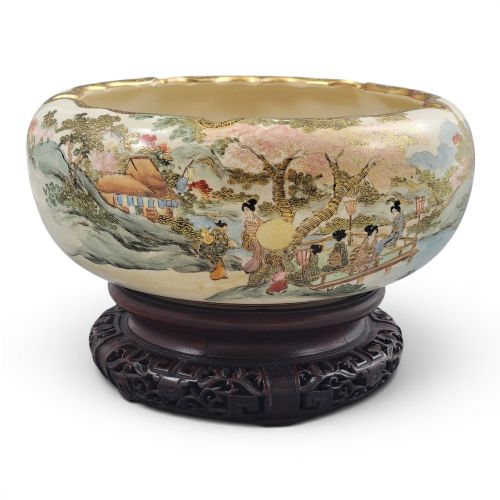


Large Satsuma Ware
Large satsuma ware pieces are substantial Japanese ceramic vessels and decorative objects finished in rich enamel and gold leaf.
Large Satsuma Ware
Large satsuma ware encompasses substantial earthenware vessels and sculptural forms created during the late nineteenth and early twentieth centuries. When searching for large satsuma ware, buyers encounter impressive floor vases, decorative bowls, lidded urns, table lamps, and figural okimono.
The objects originate primarily from the Meiji period, representing a distinct aesthetic of intricate surface decoration. Makers utilise earthenware bodies as canvases for dense figural scenes, floral motifs, and mythological subjects enhanced with enamel and gold leaf.
Forms span from monumental Kyoto satsuma vases to hexagonal vessels and elephant okimono. These substantial pieces serve as focal points in interiors, combining functional ceramic shapes with elaborate artistic narrative.
Materials and construction
Makers construct large satsuma ware using a porous earthenware ceramic body that absorbs glazes effectively. This clay base provides the foundational structure for substantial vessels, bowls, and sculptural forms.
Artisans apply colourful enamel and gold gilt over the ceramic surface to build up complex pictorial scenes. Detail work often incorporates fine gold leaf highlights alongside wood or fabric components found in mounted table lamps.
Large Satsuma Ware Retail Price Guide 2026
Typical asking prices for large satsuma ware among the pieces listed under this phrase on Sellingantiques today, from the lower quarter to the upper quarter. They describe what is for sale here now, not the wider market.
Materials recorded across the inventory include ceramic, earthenware, enamel, gold leaf, gold gilt, wood, fabric, and brass.
Distinctions in quality
Quality in large satsuma ware rests upon the precision and complexity of the enamel and gold leaf decoration. Master painters execute microscopic figures and intricate borders with immense control, whereas lesser examples show hurried brushwork and repetitive motifs.
Signatures by renowned makers such as Hotoda, Shizan, Kizan, Seiko-en Chokei, or attributions to Hattori elevate the standing of a piece. The crispness of the earthenware moulding and the richness of the gilding further separate standard production items from exceptional workshop output.
Hotoda·Shizan·Kizan·Seiko-en Chokei·Hattori
The Large Satsuma Ware Glossary
- Satsuma ware
- Japanese pottery traditionally featuring a crackle glaze decorated with enamel and gold leaf. The style developed significantly during the Meiji period for both domestic use and export.
- Okimono
- A Japanese standalone decorative sculpture designed for display in an alcove or on a cabinet. These carved or modelled figures depict animals, deities, and subjects from daily life.
- Meiji period
- The era in Japanese history spanning from eighteen sixty-eight to nineteen twelve. This period marked a surge in elaborate decorative arts produced for international markets.
- Enamel
- Vitreous material fused to the ceramic surface through firing to create vibrant colours. It forms the primary medium for detailed pictorial scenes on these vessels.
- Gold gilt
- A thin layer of gold applied to surface details and borders to catch the light. Artisans utilise this technique to accentuate key narrative elements across the ceramic body.
Large Satsuma Ware: Frequently Asked Questions
What is large satsuma ware?
Large satsuma ware comprises substantial nineteenth and early twentieth-century Japanese earthenware vessels and decorative objects. These pieces feature characteristic enamel and gold leaf decoration.
Items range from monumental vases and decorative bowls to table lamps and figural sculptures. They represent a key aesthetic of the Meiji period export market.
How do I identify a Meiji period piece?
Meiji period pieces often display dense, multicoloured enamel painting combined with extensive gold leaf work. The forms are typically substantial earthenware ceramics.
Many finer examples bear artist signatures or workshop marks from notable makers. The style focuses on intricate narrative scenes, landscapes, and traditional motifs.
Where were these ceramics made?
These decorative ceramics were produced in Japan, with specific regional centres such as Kyoto creating monumental export pieces. Workshops adapted traditional earthenware techniques to satisfy international demand.
Master artisans signed their work to denote quality and workshop origin. The resulting vessels combined Japanese iconography with forms suited to Western interiors.
How do I care for large satsuma ware?
Large satsuma ware requires gentle handling due to the delicate enamel and gold leaf surface decoration. Dusting with a soft, dry cloth preserves the fragile pigments.
Keep these ceramic vessels away from direct sunlight and moisture to protect the earthenware body and surface gilding. Stable indoor environments prevent stress on the antique materials.