

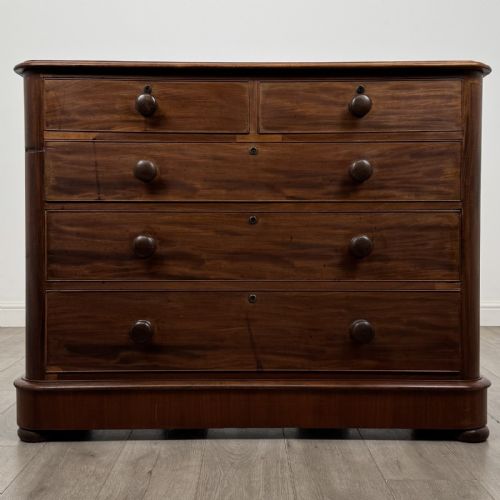
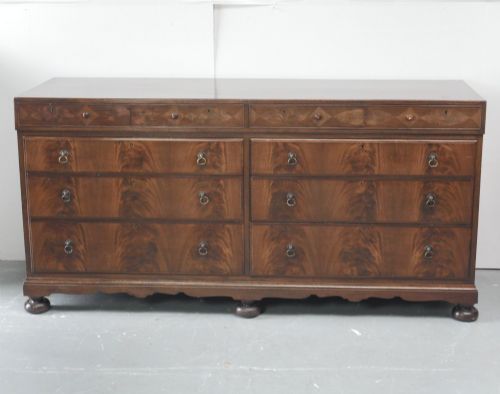
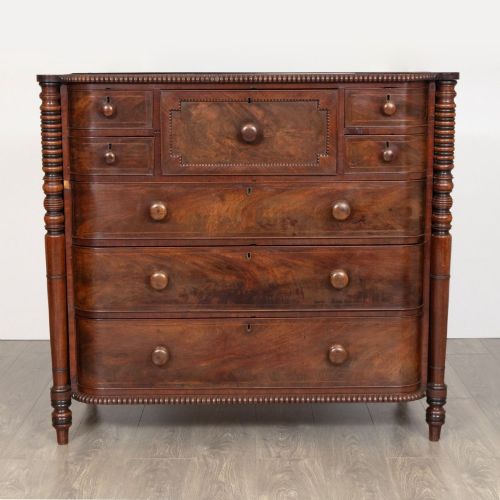
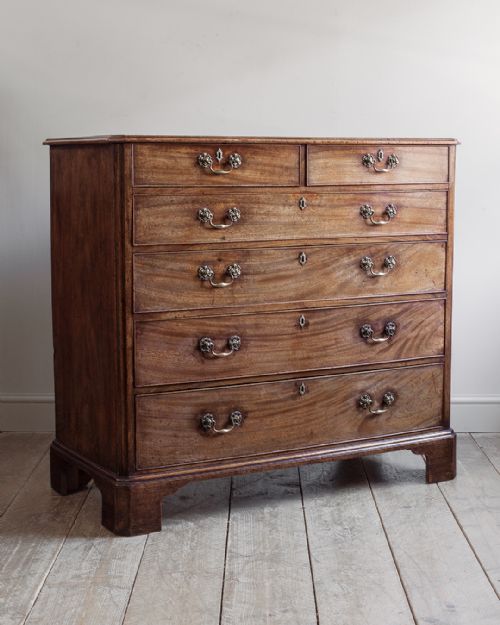


Large Mahogany Tallboy Drawers
Large mahogany tallboy drawers are substantial storage pieces offering deep capacity and traditional presence, ideal for grounding a bedroom.
Large Mahogany Tallboy Drawers
Large mahogany tallboy drawers combine vertical presence with extensive storage, appearing across periods from the eighteenth century through the Victorian era. These pieces generally take the form of tall chests, chests on chests, or Wellington chests designed to maximise storage capacity without dominating floor space.
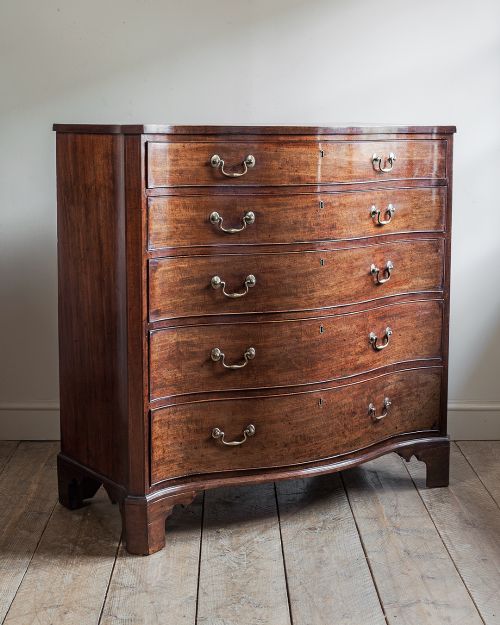
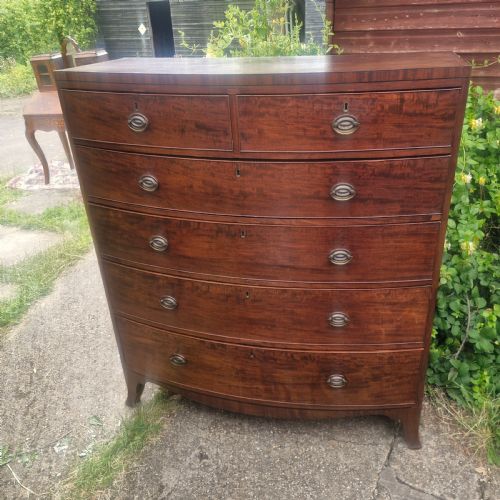
Buyers encountering this selection will find examples ranging from serpentine and bow front configurations to Scottish designs and campaign pieces. The predominant materials and styles reflect Georgian and Victorian workmanship, executed in solid timbers and veneers.
How they were made
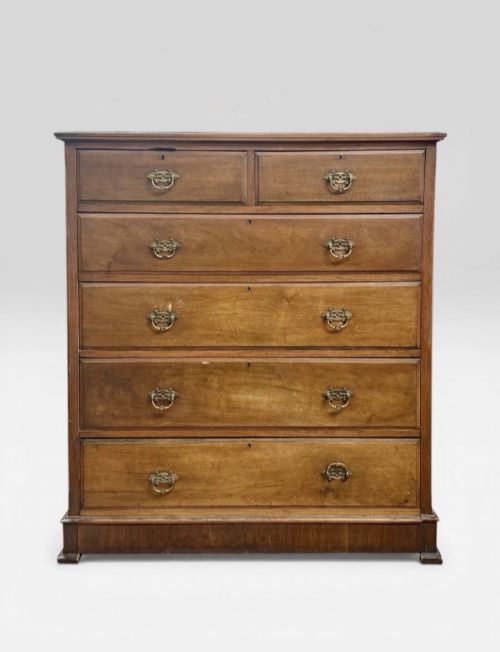
Cabinet makers built these pieces using solid mahogany and flame mahogany veneers applied over secondary woods such as pine and oak. Brass hardware, including handles and escutcheons, provides functional contrast to the dark timber.
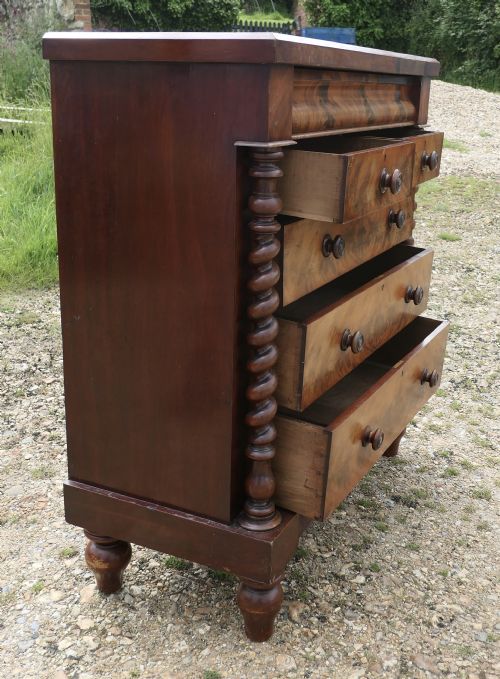
Construction techniques involve traditional joinery for drawer boxes and carcass frames, often complemented by turned wood elements and inlaid details.
Large Mahogany Tallboy Drawers Retail Price Guide 2026
Typical asking prices for large mahogany tallboy drawers among the pieces listed under this phrase on Sellingantiques today, from the lower quarter to the upper quarter. They describe what is for sale here now, not the wider market.
Some Victorian tallboys include hidden locking mechanisms designed to keep private correspondence safe from wandering eyes.
What varies in quality
Quality depends upon the choice of timber and the handling of veneers, with figured flame mahogany and matched grain patterns representing higher standards of design. The crispness of carved details, the integration of brass fittings, and the structural integrity of the internal drawer construction further distinguish individual pieces.
Proportion and architectural balance dictate the visual weight of the tallboy, separating standard utility items from more refined examples produced during the Georgian and Victorian periods.
Whytock & Reid
The Large Mahogany Tallboy Drawers Glossary
- Tallboy
- A tall chest of drawers, often constructed as a chest on chest where a smaller upper section sits atop a larger base.
- Flame mahogany
- A veneer cut from timber fork joints that produces a distinctive flame-like pattern across the surface of the wood.
- Bow front
- A cabinet front that curves outward in a convex arc, softening the linear geometry of the piece.
- Wellington chest
- A tall, narrow chest of drawers secured by a hinged locking side pilaster bar that fastens over the drawer edges.
Large Mahogany Tallboy Drawers: Frequently Asked Questions
How do I care for mahogany?
Keep mahogany furniture away from direct sunlight and heat sources to prevent the timber and veneers from drying out or fading over time. Dust regularly with a soft, dry cloth and apply occasional wax polishing to maintain the finish.
Avoid using silicone-based sprays or harsh chemical cleaners, which can damage the traditional polish and finish of antique wood.
Where should I place a tallboy?
A tallboy requires adequate wall space and clearance for drawers to open fully, making bedrooms and dressing rooms traditional locations. Because of their height and weight, secure tall pieces to the wall to ensure stability.
Consider the lighting in the room to highlight the grain pattern and finish of the mahogany timber.
How do I distinguish Georgian from Victorian pieces?
Georgian furniture typically displays restrained classical proportions, subtle bracket feet, and refined cockbeaded drawer edges dating from the eighteenth century. Victorian examples often feature bolder scales, turned feet, applied mouldings, and darker finishes.
Examining the secondary woods inside the drawers, such as oak for earlier pieces and pine for later ones, helps confirm the period.
What is a Wellington chest?
A Wellington chest is a tall, narrow chest of drawers characterised by a hinged locking stile on one side that secures all the drawers simultaneously. This form originated in the nineteenth century to provide secure storage for documents and valuables.
These pieces are distinct for their compact footprint combined with numerous shallow drawers.