







Large Country Sofa
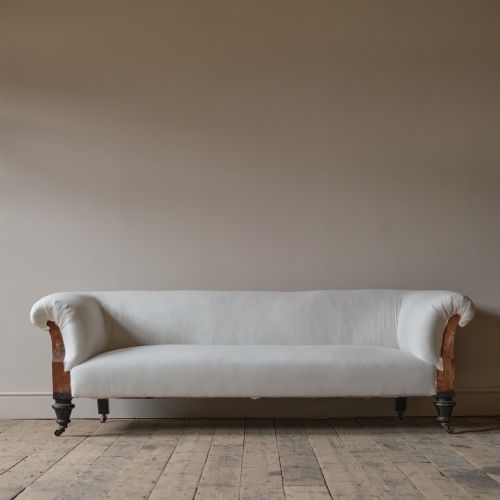
A large country sofa brings deep seating and relaxed proportions to a room, offering a seat made for long hours of reading or conversation.
Large Country Sofa
When you search for a large country sofa, you are looking at substantial seating designed for comfort, often upholstered in heavy fabrics or original ticking. These pieces range from early Georgian frames to Edwardian country house examples.
The most common versions on this page are nineteenth-century pieces built with generous proportions, solid mahogany or walnut frames, and deep seats meant for domestic ease rather than formal reception rooms.
How they were made
Makers constructed these frames from hardwoods such as mahogany, walnut, and pine, joining them securely to support heavy padding and deep springs. Giltwood and painted finishes appear on continental pieces, while British frames rely on exposed timber or fully upholstered forms.
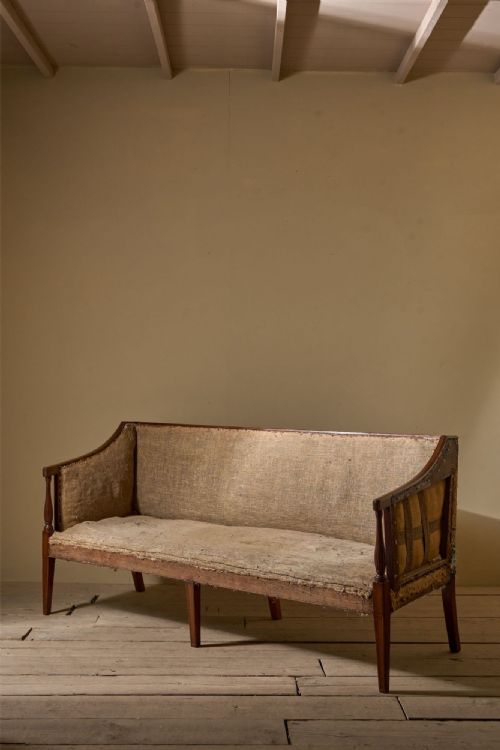
Internal stuffing used traditional materials held together with hessian and horsehair, often finished with brass castors on the feet to allow movement across heavy carpets.
Large Country Sofa Retail Price Guide 2026
Typical asking prices for large country sofa among the pieces listed under this phrase on Sellingantiques today, from the lower quarter to the upper quarter. They describe what is for sale here now, not the wider market.
Several sofas retain their original nineteenth-century ticking, meaning they spent generations under heavy linen before ever seeing a decorative top cover.
What varies in quality
The distinction between ordinary and exceptional pieces lies in the integrity of the wooden frame and the purity of the original lines. A well-proportioned carved mahogany or walnut structure retains its balance even when heavily upholstered.
Makers' marks or stamps elevate a piece significantly, indicating workshop provenance and superior joinery that survives centuries of domestic use.
Miles and Edwards·Howard and Sons·William Birch
The Large Country Sofa Glossary
- Hessian
- A coarse woven fabric typically made from jute or hemp fibres, used historically as the foundational webbing and inner lining beneath top upholstery. It provides stable support for horsehair and stuffing.
- Giltwood
- Timber that has been coated with a thin layer of gold leaf or gilt powder over a prepared gesso base. It appears most frequently on eighteenth-century and nineteenth-century formal European frames.
- Ticking
- A tightly woven, durable cotton or linen fabric traditionally used to contain feathers and down within cushions or mattresses. Original ticking on country house seating indicates that the piece retains its early internal layers.
- Drop arm sofa
- A seating form featuring one or both arms designed to lower via a mechanical ratchet or hinge. This mechanism allows the user to recline flat.
Large Country Sofa: Frequently Asked Questions
How do I choose the right large country sofa?
Consider the depth of the seat and the height of the back in relation to your room's proportions. Measure your doorways carefully, as these substantial frames often present clearance challenges upon delivery.
Look closely at the underlying timber and frame stability rather than the current fabric, since upholstery can easily be replaced to match your interior.
Are these sofas comfortable for daily use?
Most examples were built for relaxed domestic lounging, featuring deep seats and generous padding designed for extended sitting. Edwardian and Victorian country house models prioritised domestic ease above formal posture.
Keep in mind that older internal webbing may feel firmer or softer than modern foam, depending on when the piece was last restored.
How do I identify the period of a sofa?
Examine the timber species, leg turning, and joinery methods visible beneath or behind the upholstery. Georgian and early nineteenth-century frames often feature hand-carved mahogany details, whereas later Victorian and Edwardian versions utilise heavier sprung constructions.
Stamps, maker labels, or written inscriptions on the underside of the frame provide the most reliable dating evidence.
Can I reupholster a large antique sofa?
Reupholstering is common practice for antique seating, allowing you to preserve a sturdy historic frame while updating the outer fabric. Traditional materials like hessian, bridle ties, and horsehair should be used during restoration to maintain the correct sit.
Consult an upholsterer experienced with nineteenth-century frame construction to ensure the internal springs and padding are properly supported.