

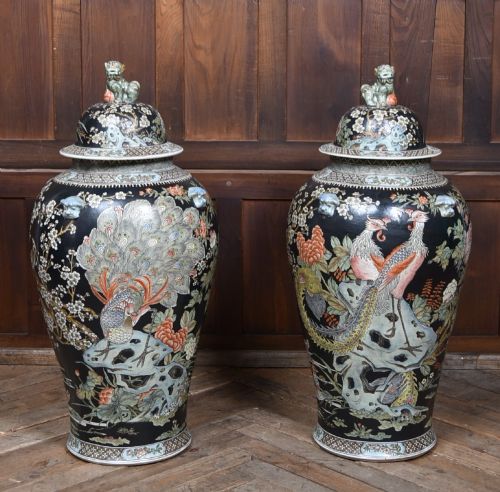
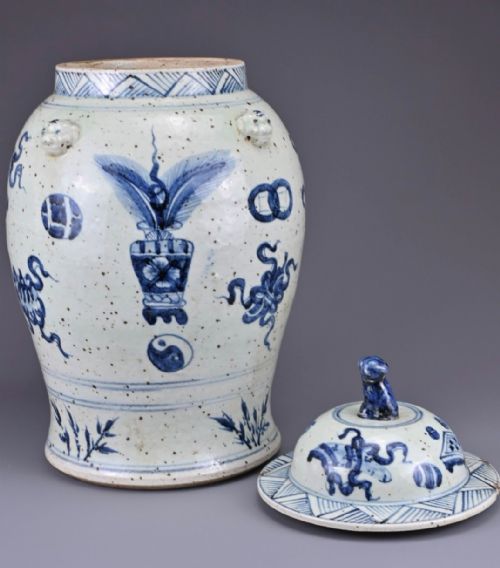
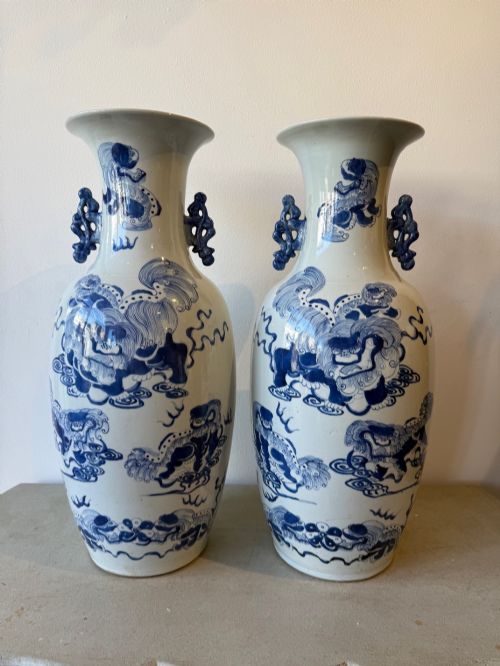



Large Chinese Temple Urns
Large chinese temple urns are commanding ceramic and bronze vessels that bring immediate presence and historical weight to a room.
Large Chinese Temple Urns
When you search for large chinese temple urns, you encounter substantial floor vases, palace jars, and covered vessels spanning the nineteenth century through the early decades of the twentieth century. These pieces encompass blue and white porcelain, Canton or Rose Medallion wares, cloisonné, and heavy bronze altar pieces.
The selection ranges from traditional Qing Dynasty style works and export creations to later twentieth-century interpretations and Chinoiserie lacquer pieces. You are most likely to meet striking blue and white porcelain floor jars alongside vibrant polychrome examples bearing traditional motifs.
Materials and construction
The construction of these large vessels relies primarily on heavy ceramic and porcelain bodies finished with cobalt glaze, cobalt pigment, and intricate enamel work. Artisans shaped monumental jars and vases to hold massive quantities of pigment and glaze, requiring expert firing techniques to achieve stability across such scale.
Metalworking traditions appear alongside ceramic methods, utilising bronze for altar vases and table lamps. Cloisonné pieces demonstrate the integration of enamel and metal wire techniques on a substantial scale.
Large Chinese Temple Urns Retail Price Guide 2026
Typical asking prices for large chinese temple urns among the pieces listed under this phrase on Sellingantiques today, from the lower quarter to the upper quarter. They describe what is for sale here now, not the wider market.
Listings feature porcelain, bronze, and enamel materials spanning the 19th Century through the 1940s.
Factors of quality
Quality in large chinese temple urns manifests in the crispness of the cobalt pigment application, the complexity of the enamel glaze, and the structural integrity of monumental porcelain or bronze bodies. Finer examples display meticulous hand-painted detail and balanced proportions despite their formidable dimensions.
The distinction between standard decorative output and superior work rests on the precision of the traditional motifs, the depth of the glaze, and the preservation of the original surface finish across both ceramic and metal mediums.
The Large Chinese Temple Urns Glossary
- Cobalt glaze
- A deep blue mineral pigment applied beneath a transparent ceramic glaze before firing. This technique creates the signature blue and white coloration seen on many traditional jars.
- Cloisonné
- An ancient metalworking technique employing soldered metal wires to form compartments that are filled with enamel paste and fired. It produces richly coloured, patterned surfaces.
- Ginger jar
- A ceramic vessel characterised by a broad shoulder and high-domed cover, originally designed for storing spices. Large examples serve as prominent decorative floor pieces.
- Famille rose
- A major palette of Chinese ceramic overglaze enamels introduced in the eighteenth century, dominated by opaque pink or rose colours. It allows for nuanced, painterly floral and figural scenes.
- Archaistic
- A stylistic approach that imitates the forms, patterns, and patination of ancient bronze and jade antiquities. It reflects a traditional reverence for earlier historical dynasties.
Large Chinese Temple Urns: Frequently Asked Questions
How were large chinese temple urns originally used?
These monumental vessels served primarily as decorative furnishings within palaces, temples, and elite residences. Many were designed with fitted covers to function as storage jars or ritual containers.
Over time, pairs of these large vases became favoured for framing architectural openings, fireplaces, and entryways due to their imposing visual scale.
What periods do these pieces typically date from?
The pieces available range predominantly from the nineteenth century into the early decades of the twentieth century, including items made around 1900, 1910, 1920, 1930, and 1940.
Certain works incorporate earlier Kangxi period design motifs or stylistic elements associated with the Qing Dynasty.
How do I care for large ceramic and bronze vases?
Maintenance requires gentle dusting with a soft, dry cloth to prevent particulate accumulation on delicate enamel and bronze surfaces. Avoid chemical cleaners or moisture, which can damage historic glazes and patinas.
Given their substantial weight and height, position these pieces on stable, level surfaces away from high-traffic zones.
What is the difference between porcelain and bronze pieces?
Porcelain vessels rely on fired ceramic clay finished with cobalt pigments or polychrome enamel glazes to create detailed pictorial surfaces. Bronze pieces utilise cast metal to achieve heavy sculptural forms such as altar vases and lamps.
While porcelain offers bright pictorial narratives, bronze provides an architectural weight and patinated metallic finish.