




Large Cattle Oil Painting
A large cattle oil painting commands a room with pastoral scale, bringing nineteenth-century countryside atmosphere straight to your wall.
Large Cattle Oil Painting
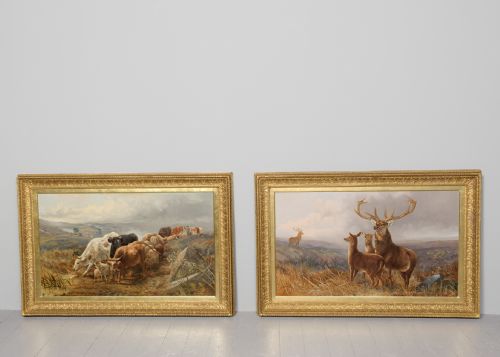
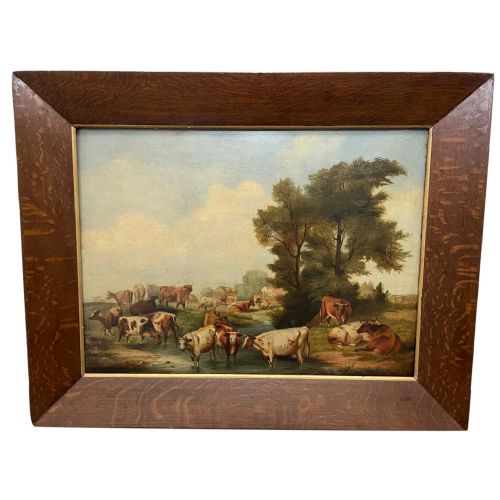
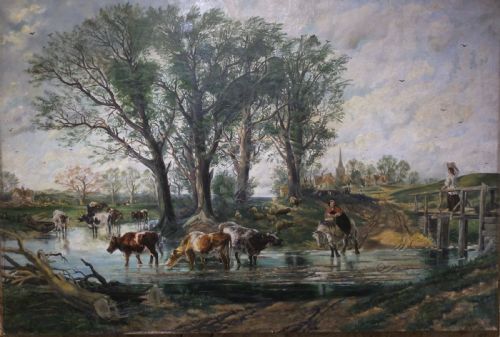
When you search for large cattle oil painting, you encounter substantial canvas works capturing pastoral scenes, Highland cattle, and riverbank grazing. The pieces available span the Georgian, Victorian, and Edwardian eras, executed by named artists and regional English or Scottish schools.
Victorian pastoral and realism pieces dominate the selection, often framed in elaborate giltwood and gesso. You meet everything from naïve farmyard stables to sweeping landscapes featuring herds gathered at water.
The most common formats showcase majestic Highland cattle in misty Scottish glens or placid cows beside rivers. These works serve as major decorative focal points, reflecting nineteenth-century romanticism towards rural life.
How they were made
Artists painted these large compositions using oil paint on stretched canvas or board, building rich textures and deep tones. Canvases were prepared with traditional grounds before receiving layers of pigment that captured light on animal flanks and atmospheric skies.
Frames play a crucial role in the physical structure, constructed from wood and plaster before receiving applications of gold leaf or giltwood finishes. Elaborate moulding and gesso work give these substantial frames their weight and ornamental depth.
Cows gazing placidly across nineteenth-century canvas provide a steadfast, judgment-free audience for your daily routine.
What varies in quality
Anatomy, handling of light, and depth of landscape separate the ambitious gallery canvases from simpler folk art or decorative workshop output. Master hands render the muscular structure of cattle and the play of weather across a Highland scene with convincing weight and observation.
The integrity of the original canvas and the preservation of the heavy giltwood frame determine the overall presence of the piece. Works that retain their original unlined surfaces and richly ornamented frames hold greater visual authority.
Robert Cleminson·Thomas Sidney Cooper·William Sydney Cooper·Sidney Yates Johnson·Arthur Charles Dodd·John W Morris·Thomas Creswick·Etty Horton·C W Oswald·Poul Steffensen
The Large Cattle Oil Painting Glossary
- Oil on Canvas
- Pigments suspended in a drying oil medium applied to a woven fabric support. This combination allowed nineteenth-century painters to blend rich tones and achieve luminous effects.
- Giltwood
- Wood carved and coated with gold leaf or gold paint. It provides the ornate metallic border typical of nineteenth-century picture frames.
- Gesso
- A plaster-like mixture applied to wooden frames as a base for gilding. It allows craftsmen to carve intricate relief ornamentation.
- Pastoral
- A genre of art depicting rural life, shepherds, and grazing livestock. These scenes evoke an idealized, peaceful connection to the countryside.
- Naive
- Art created by self-taught painters working outside academic traditions. These works prioritize direct expression and charm over strict perspective.
Large Cattle Oil Painting: Frequently Asked Questions
Where should I hang a large cattle oil painting?
These substantial works need a prominent wall with balanced room proportions, often grounding a main reception space or dining area. Their broad scale works best away from direct sunlight to protect the oil pigments and gilt surfaces.
Ensure the wall fixings match the considerable weight of both canvas and heavy giltwood framing. Positioning the painting at eye level allows the pastoral details and brushwork to be fully appreciated.
How do I identify a Victorian pastoral canvas?
Victorian pastoral canvases typically feature naturalistic landscapes populated by cattle, sheep, or horses near rivers and highlands. The palette relies on earthy greens, moody skies, and warm light on animal flanks.
Look for period framing materials such as gesso and gold leaf alongside canvas textures typical of nineteenth-century British workshops.
What is the difference between naive and academic animal paintings?
Academic works from this era demonstrate a formal understanding of animal anatomy, light direction, and perspective. Artists trained in academies achieved realistic textures and convincing depth in their Highland or river scenes.
Naive paintings simplify these elements, offering charming, flat perspectives and direct interpretations of farmyard life without strict adherence to proportion.
How do I care for an antique oil painting?
Keep the canvas away from extreme temperature swings and high humidity to prevent the paint layer from cracking. Dust the surface gently with a soft, dry brush without applying pressure to the pigment.
Avoid using commercial cleaning sprays on either the canvas or the giltwood frame. Professional conservation ensures the longevity of both the oil medium and the original wooden support.