


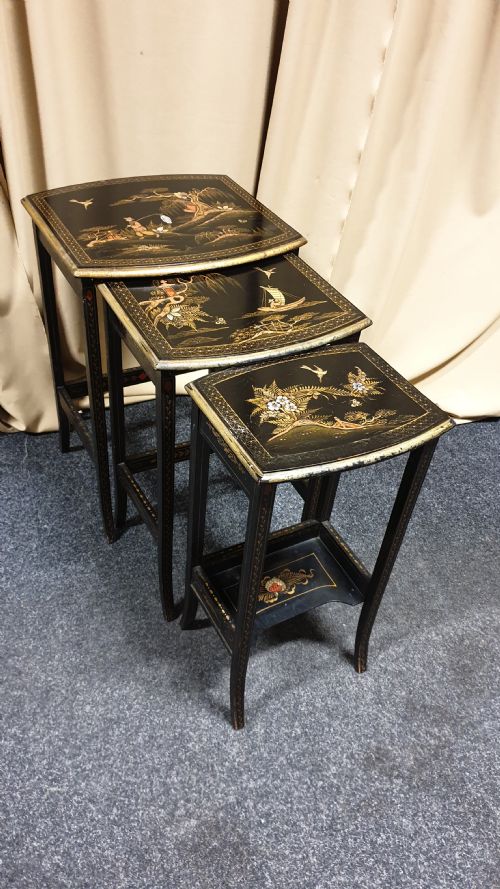


Lacquered Nest of Tables
These lacquered nest of tables are clever space-saving tables that slide one beneath another, offering brilliant surface space without cluttering a room.
Lacquered Nest of Tables
A lacquered nest of tables is a set of graduating occasional tables designed to stack neatly together when not in use. The form appears most frequently as sets of three or four stacking tables, though larger groupings and occasional smaller iterations such as sake cups also surface.
Most examples found on this page date from the nineteenth century through the early twentieth century, spanning periods up to the nineteen-twenties. These pieces frequently showcase Chinoiserie decoration, Japanese Meiji period influences, and Queen Anne style proportions.
How they were made
These tables are constructed from timber or hardwood bases, which are then treated with multiple layers of lacquer to achieve a smooth, durable surface. Black lacquer and red lacquer predominate across the pieces, providing a rich, deep ground for subsequent ornamentation.
Decoration is applied using gold leaf, gilding, or gilt paint to render intricate Chinoiserie motifs, figures, and landscapes across the upper surfaces. Boulle-work and specific carving techniques such as cinnabar layering also appear among the decorative methods.
Lacquered Nest of Tables Retail Price Guide 2026
Typical asking prices for lacquered nest of tables among the pieces listed under this phrase on Sellingantiques today, from the lower quarter to the upper quarter. They describe what is for sale here now, not the wider market.
Among the stately procession of stacking tables, a set of tiny Japanese Meiji sake cups quietly waits to pour.
What varies in quality
The refinement of the painted and gilded Chinoiserie decoration largely dictates the quality of a set, ranging from simple linear detailing to deeply layered and meticulously detailed pictorial scenes. The depth and richness of the lacquer itself, whether deep black or vibrant red, also indicate the level of craftsmanship involved.
Structural integrity through the graduating sizes determines how smoothly the tables slide and stack together. Sets retaining their original matching surfaces across all three or four pieces demonstrate greater cohesion than those assembled later.
The Lacquered Nest of Tables Glossary
- Chinoiserie
- A European decorative style reflecting Chinese artistic influences, characterised by pictorial scenes of figures, pavilions, and landscapes rendered in gold on lacquer grounds.
- Lacquer
- A durable resin finish applied in successive coats and polished to a hard sheen, serving as the protective and decorative surface for these tables.
- Boulle-work
- An elaborate marquetry technique using materials like brass and tortoiseshell inlaid into wood, occasionally appearing alongside lacquer decoration.
- Meiji Period
- The era in Japanese history spanning from eighteen sixty-eight to nineteen twelve, known for fine lacquerware and export decorative arts.
Lacquered Nest of Tables: Frequently Asked Questions
What is a lacquered nest of tables used for?
These tables are designed to provide temporary surfaces for tea, drinks, or books while occupying the floor space of only a single small table. When entertaining, the smaller tables slide out from beneath the largest one to be placed around the room.
Once the gathering concludes, they stack back together into a compact column. This clever stacking mechanism made them immensely popular in nineteenth and early twentieth-century drawing rooms.
How do I date a lacquered nest of tables?
Dating relies heavily on observing the timber construction underneath, the wear patterns in the lacquer, and the specific stylistic details of the decoration. Nineteenth-century examples often show distinct hand-finishing and softer patination in the wood compared to later twentieth-century iterations.
Stylistic markers such as Queen Anne style cabriole legs or specific Chinoiserie motifs help narrow down the period of manufacture. Comparing the construction methods of the smaller inner tables to the main outer table offers further clues to age.
Are these tables sturdy enough for daily use?
While these tables were built to be functional occasional furniture, their delicate lacquer and gilt surfaces require thoughtful handling. They easily support everyday items like cups and books, but benefit from coasters to protect the finish.
Moving the tables requires lifting them rather than dragging them across the floor to protect the joints and the lacquer edges. Placed with care, they function reliably as practical living room furniture.
How do I care for antique lacquer?
Antique lacquer should be dusted gently with a soft, dry cloth to prevent scratching the polished surface. Avoid using modern chemical polishes, abrasive cleaners, or excess water, which can damage the aged finish.
Keeping the tables away from direct sunlight and dramatic temperature changes prevents the timber beneath from expanding and cracking the lacquer. Proper environmental placement preserves both the colour and the structural integrity of the piece.