

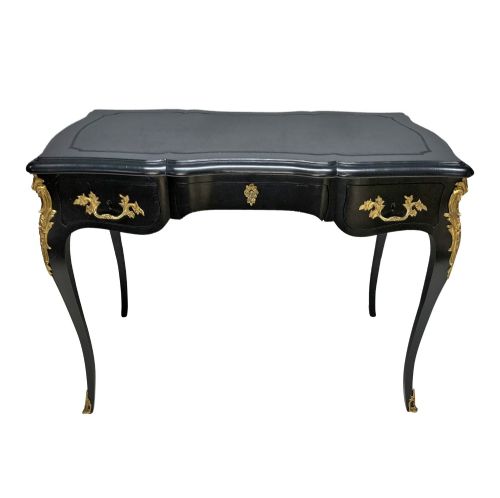


Lacquered Bureau
Lacquered bureau pieces bring hand-painted narrative scenes and deep polished finishes into a room, offering practical workspace alongside centuries of decorative art.
Lacquered Bureau
A lacquered bureau provides a drop-front writing surface concealing internal compartments, often rising into tall bookcase superstructures or standing on slender table frames. The pieces on this page span several centuries, taking forms from compact travelling desks and toilet mirrors with miniature bureau bases up to full-scale bureau bookcases.
Makers drew heavily upon Asian decorative traditions, producing Chinoiserie and Chinese export items alongside European revivals in the Queen Anne, Georgian, and French Rococo styles. Woods like kingwood and bamboo form the structural carcass beneath layers of applied lacquer, gilt, and gold leaf.
Originating primarily from British, French, Venetian, and Chinese workshops, these writing furniture items combine utility with elaborate pictorial storytelling across their sloping lids and fall-front panels.
How they were made
Craftsmen built the underlying carcases from wood, frequently applying multiple coats of dark or red lacquer to create a smooth, reflective ground before executing the decorative scheme. Artisans then built up raised motifs using gesso beneath applications of gold leaf and intricate hand-painting.
Mounts in ormolu, gilt, and brass reinforce corners, drawers, and hinges, while specialised finishes such as Vernis Martin add translucent decorative panels to French writing cabinets. Glass doors and internal mirror plates complement the reflective quality of the exterior lacquering.
Lacquered Bureau Retail Price Guide 2026
Typical asking prices for lacquered bureau among the pieces listed under this phrase on Sellingantiques today, from the lower quarter to the upper quarter. They describe what is for sale here now, not the wider market.
Some miniature bureau bases on toilet mirrors prove that even eighteenth-century correspondence required proper filing space.
What varies in quality
The sophistication of the hand-painted Chinoiserie scenes and the depth of the lacquer finish distinguish finer pieces from simpler decorative items. Crisp detailing in the raised gilding and the precision of the brass or ormolu mounts indicate the skill invested by the workshop.
Structural integrity of the drop-front hinges and internal pigeonholes determines the practical success of the desk, while the preservation of early surface coatings maintains the visual impact of the pictorial panels.
The Lacquered Bureau Glossary
- Lacquer
- A durable resin finish applied in multiple layers and polished to a high gloss, often decorated with painted or gilt scenes. It protects the wood beneath while providing a smooth canvas for Chinoiserie artwork.
- Bureau bookcase
- A writing cabinet featuring a sloping fall-front desk combined with an upper shelving or bookcase section. These dual-purpose forms provide both concealed workspace and display storage.
- Ormolu
- Gilded bronze mounted onto furniture as decorative handles, feet, or edging. It adds metallic contrast to wood and lacquer surfaces.
- Vernis Martin
- A simulated Japanese lacquer technique developed in France, using transparent varnishes over metallic leaf and painted designs. It creates a luminous depth characteristic of fine European cabinets.
Lacquered Bureau: Frequently Asked Questions
How do I clean a lacquered surface?
Dust gently with a soft, dry cloth without applying modern chemical polishes or water. Maintaining stable room humidity prevents the lacquer ground from crazing or lifting.
Harsh cleaning agents strip delicate gold leaf and historical finishes. Consult a professional restorer if deeper cleaning becomes necessary.
Where were these desks placed historically?
Wealthy owners positioned these decorative writing pieces in private withdrawing rooms, parlours, or bedchambers where guests could admire the intricate lacquer work. They served for correspondence, record-keeping, and the display of small status objects.
Their striking visual presence made them central decorative elements within period interiors.
How can I tell an eighteenth-century piece from a later revival?
Early pieces exhibit traditional carcase construction methods, hand-mixed lacquer components, and wear patterns consistent with age. Revival items from later periods often utilise machine-sawn timbers and different secondary woods.
Examining the internal drawer linings and the chemistry of the lacquer surface helps clarify the date of manufacture.