

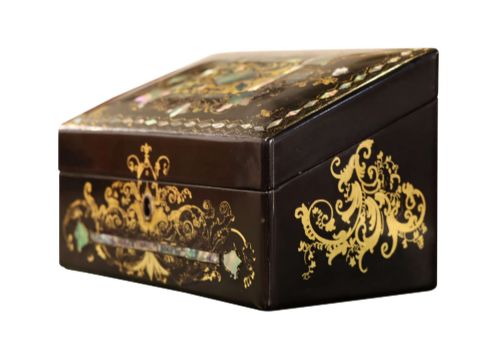
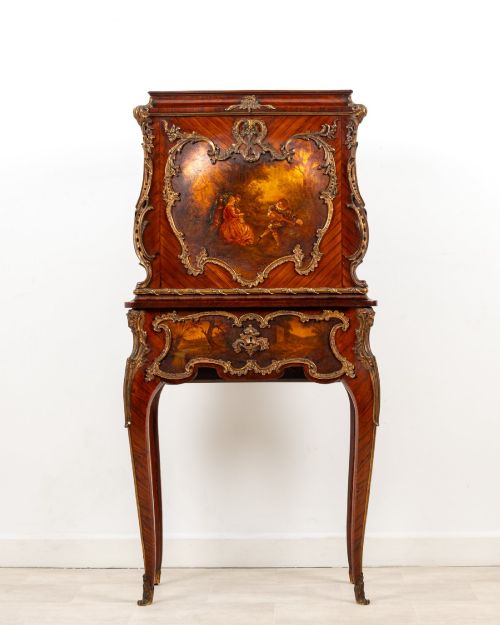

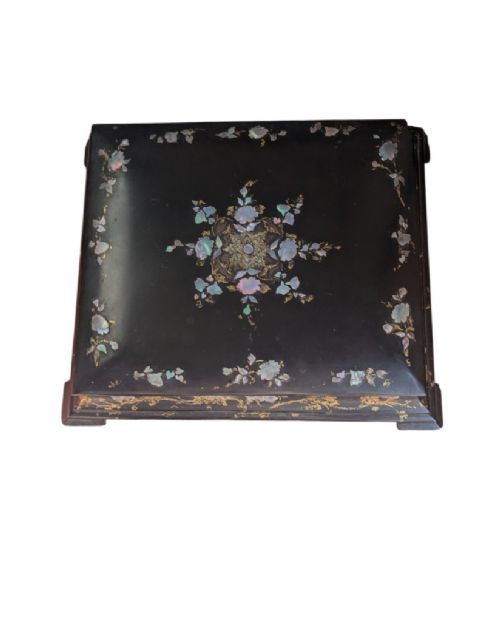


Lacquer Writing Cabinet
These lacquer writing cabinet examples bring together decorated surfaces and fitted desks, offering practical writing spaces enriched by period ornament.
Lacquer Writing Cabinet
A lacquer writing cabinet provides a dedicated surface for correspondence and record-keeping, often combining concealed drawers with a hinged writing flap. The examples found here range from compact stationery boxes and table writing desks to tall bureau bookcases and bureau cabinets.
The selection encompasses pieces spanning from the eighteenth century through to the Edwardian era, featuring styles such as Chinoiserie, Louis XV Revival, Venetian Rococo, and Queen Anne. Buyers will frequently encounter bureau bookcases and desks displaying oriental motifs or European lacquer interpretations.
Origins stretch across British, French, Chinese, and Venetian workshops, demonstrating diverse approaches to cabinet-making. Whether seeking a large travelling bureau or a small papier-mâché stationery box, each item serves both a functional and a decorative role.
How they were made
Construction relies upon seasoned wood frameworks, including kingwood and lacquered wood, built to support intricate surface finishes. Cabinet-makers applied layers of lacquer, sometimes enhanced with gold leaf and gilt details, to achieve deep, reflective surfaces.
Many examples incorporate cast brass, ormolu mounts, and bamboo elements to frame the lacquer panels and structural forms. Artisans also utilised papier-mâché for lighter desktop stationery boxes and writing cabinets.
Lacquer Writing Cabinet Retail Price Guide 2026
Typical asking prices for lacquer writing cabinet among the pieces listed under this phrase on Sellingantiques today, from the lower quarter to the upper quarter. They describe what is for sale here now, not the wider market.
Some nineteenth-century makers concealed tiny spring-loaded drawers behind pigeonholes, rewarding curious writers with hidden compartments for secrets.
What varies in quality
The refinement of the surface decoration largely dictates the standard of a piece, separating straightforward painted finishes from intricate, multi-layered lacquer work enriched with gold leaf. Hand-chiselled ormolu mounts and finely chased brass hardware indicate higher workshops.
Structural complexity also distinguishes the range, moving from simple boxes to architectural bureau bookcases with fitted interior pigeonholes and secret compartments. The integrity of the original lacquer and the precision of the joinery define the standing of each cabinet.
Jennens & Bettridge
The Lacquer Writing Cabinet Glossary
- Bureau
- A sloping desk with a hinged flap that covers pigeonholes and small drawers. It often sits upon a chest of drawers or a table stand.
- Ormolu
- Gilded bronze used for decorative mounts and furniture handles. It adds metallic contrast to wood and lacquer surfaces.
- Vernis Martin
- A simulated Japanese lacquer developed by the Martin brothers in eighteenth-century France. It employs translucent varnishes over painted panels.
- Escritoire
- A small writing cabinet with a fall-front desk surface. The term derives from the French word for writing.
Lacquer Writing Cabinet: Frequently Asked Questions
How do I identify a bureau bookcase?
A bureau bookcase combines a sloping desk compartment with upper shelving enclosed by doors. The lower section provides a fold-down writing flap.
These taller pieces often incorporate adjustable shelving and intricate interior compartments for documents.
Where were Chinoiserie cabinets made?
Chinoiserie cabinets were produced across Britain, France, and Italy as European craftsmen interpreted East Asian designs. Workshops in Venice and London adopted these aesthetic traditions.
Artisans applied European lacquer techniques to mimic imported Chinese screens and panels.
How do I care for lacquered wood?
Lacquered wood requires stable indoor humidity away from direct sunlight to prevent cracking. Dusting with a soft, dry cloth preserves the finish.
Avoid chemical polishes and abrasive cleaners that can damage the underlying gold leaf or varnish layers.