



Japanese Ceramic Dragon Urn
These Japanese ceramic dragon urn pieces bring remarkable Meiji and Showa period craftsmanship and striking reptilian motifs directly into your interior scheme.

Japanese Ceramic Dragon Urn
When you search for a japanese ceramic dragon urn, you encounter vessels produced across the Meiji, Taisho, and Showa periods. The selection spans earthenware and porcelain forms created in distinct styles.
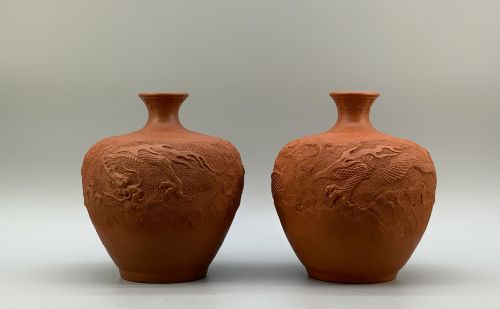
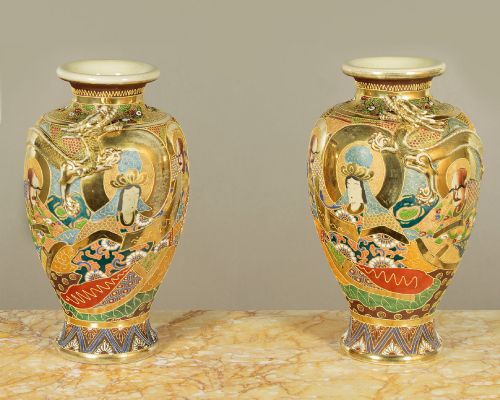
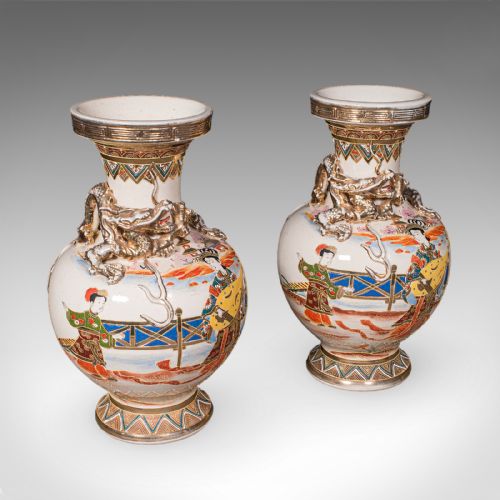
The pieces listed on this page include Satsuma baluster vases, Tokoname red clay vessels, and Imari works. Hand-painted decoration frequently depicts traditional figures alongside dragon and phoenix motifs.
Vessels range from pairs of hexagonal vases to large Satsuma examples bearing intricate hand painting and gilt detailing. Makers utilise conventional forms such as baluster vases and two-handled urns.
Materials and construction methods
The evidence records earthenware, porcelain, stoneware, and terracotta as the primary ceramic bodies used for these vessels. Artisans shape these materials into robust bodies ready for detailed surface decoration.
Enamel, gold leaf, and metal wire appear across the pieces to build complex polychrome designs and cloisonné effects. Totai Shippo techniques involve applying enamel over a ceramic or tree bark base rather than traditional metal.
Moulded and ribbed bodies provide structural texture beneath hand-painted glazes. Makers combine these foundational techniques to achieve the dense visual layering characteristic of Japanese export ceramics.
Japanese Ceramic Dragon Urn Retail Price Guide 2026
Typical asking prices for japanese ceramic dragon urn among the pieces listed under this phrase on Sellingantiques today, from the lower quarter to the upper quarter. They describe what is for sale here now, not the wider market.
Materials appearing across the current inventory include earthenware, porcelain, stoneware, terracotta, enamel, and gold leaf.
What separates standard pieces from the finest examples
Quality in a japanese ceramic dragon urn rests upon the precision of the hand painting and the ambition of the composition. Masterpieces feature dense figurative scenes alongside finely rendered dragon scales and facial expressions.
The application of gold leaf and enamel contributes significantly to the distinction between standard production and exceptional work. Superior examples demonstrate controlled brushwork that remains crisp across complex multi-figure designs.
Hotoda·Fukagawa
The Japanese Ceramic Dragon Urn Glossary
- Satsuma
- A type of Japanese earthenware featuring an ivory-coloured crackle glaze, typically decorated with polychrome enamels and gold leaf.
- Meiji Period
- The era in Japanese history spanning from 1868 to 1912, noted for a surge in export ceramics destined for Western markets.
- Baluster
- A vase form characterised by a rounded body that tapers toward the base and swells gracefully above.
- Totai Shippo
- A specialised technique where cloisonne enamel is applied directly to a ceramic or organic core instead of a traditional metal base.
- Tokoname
- A historic Japanese pottery centre known for unglazed and red clay ceramic production, often associated with tea wares and vessels.
Japanese Ceramic Dragon Urn: Frequently Asked Questions
What is a japanese ceramic dragon urn?
These objects are decorative ceramic vessels, primarily vases and jars from Japan, featuring sculpted or painted dragon motifs.
They reflect the diverse manufacturing styles of the late nineteenth and early twentieth centuries.
How do I date a japanese ceramic dragon urn?
Dating relies on stylistic markers associated with the Meiji, Taisho, and Showa periods alongside specific regional types like Satsuma.
Signatures from recorded makers or distinct material properties such as red clay and crackle glaze further narrow the period.
Where were these ceramic pieces made?
The items originate from traditional Japanese kiln centres and workshops specialising in export wares for international collectors.
Specific traditions represented include Satsuma earthenwares and Tokoname red clay works.
How should I display a japanese ceramic dragon urn?
Position these vessels on stable surfaces away from direct sunlight to protect the delicate enamel and gold leaf details.
Pairing matching baluster vases symmetrically enhances their visual impact within a room.