




Jacobean Leather Dining Chairs
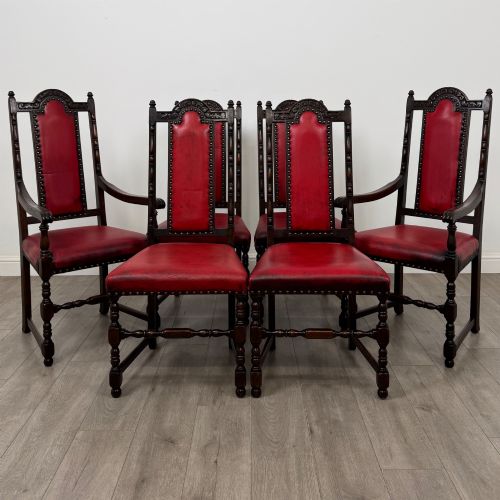
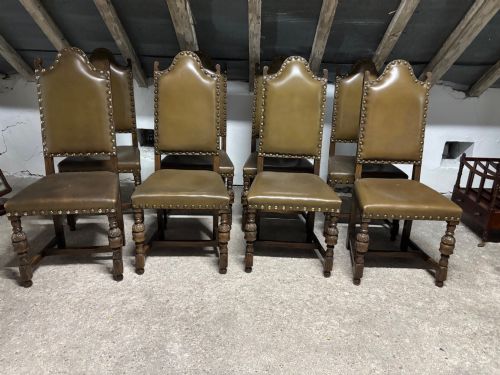
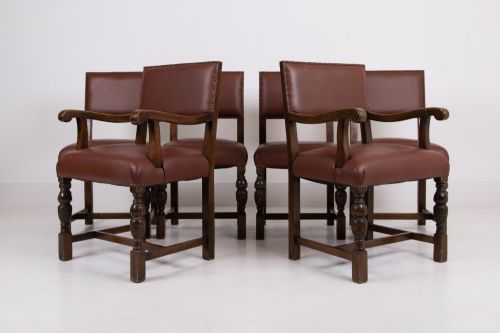
These jacobean leather dining chairs bring substantial timber frames and patinated hides to the room, offering period character for daily seating.
Jacobean Leather Dining Chairs
Jacobean leather dining chairs combine heavy timber frames with hide upholstery, drawing on seventeenth-century motifs while frequently dating from later revival periods.
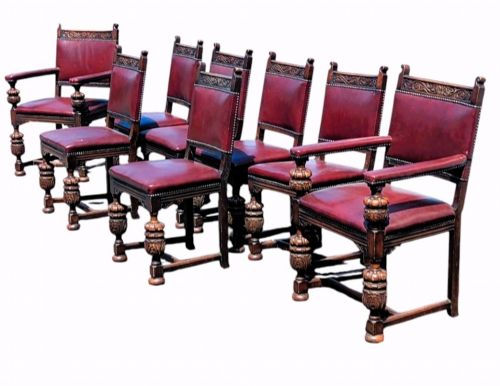
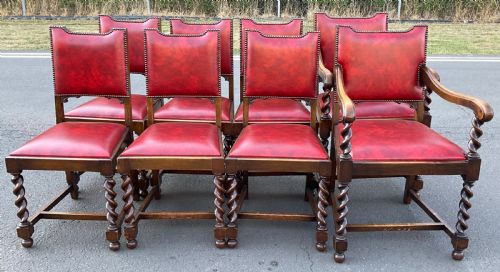
The selections encountered here span formats from individual side chairs and carvers to large matching dining sets alongside complete refectory suites.
Production dates cluster heavily around the early twentieth century, Edwardian era, and nineteenth-century revival movements, bringing vernacular British furniture styles into later domestic interiors.
Materials and construction
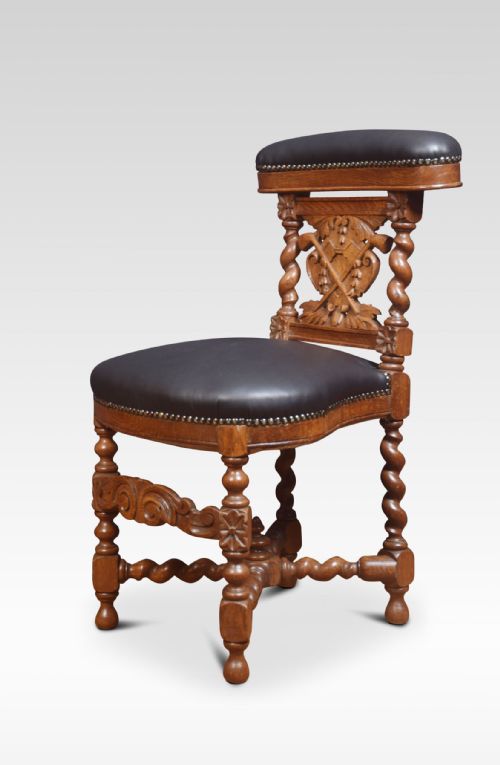
Makers utilised solid oak for the structural frames, legs, and high backs, often applying carved enrichment such as barley twist turnings.
Hides and upholstery leather were secured to the timber using brass nails or metal studs, complementing the dark tones of the wood.
Cane and secondary upholstery elements appear alongside leather panels, supporting the rigid upright posture characteristic of these seating forms.
Some highback carvers are grand enough to make diners feel they are presiding over a medieval court rather than eating Sunday lunch.
Factors of quality
Depth and crispness of the timber carving separate standard production from superior examples, particularly on heavily worked crest rails and splats.
The integrity of the oak frame and the gauge of the leather determine longevity, with matched sets commanding greater consistency than assembled groups.
The Jacobean Leather Dining Chairs Glossary
- Jacobean Revival
- A nineteenth and twentieth-century style imitating the heavy, rectilinear furniture forms of the early seventeenth century. It relies on dark oak and pronounced joinery.
- Barley Twist
- A spiral-turned wooden column or leg resembling twisted barley sugar. This turning method is common on seventeenth-century style chair supports.
- Carver
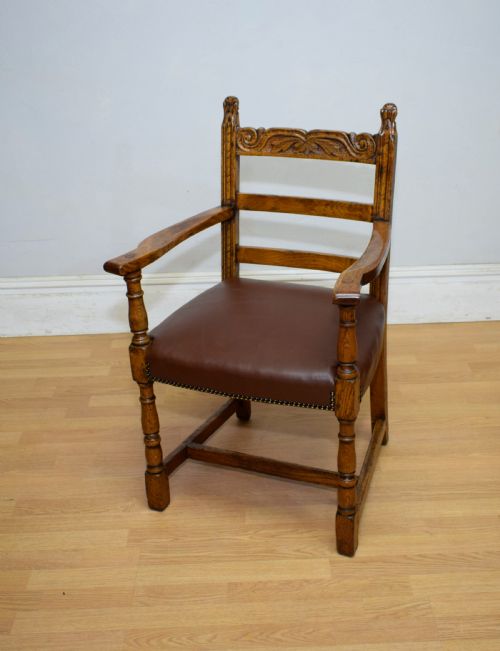
- An armchair, traditionally placed at the head of a dining table for the head of the household. These chairs feature armrests attached to the main uprights.
- Side Chair
- An upright chair without arms designed for use at the sides of a dining table. They form the majority of seating found in larger sets.
- Refectory
- A long dining table and associated seating arrangement originating from monastic dining halls. The term applies to large suites designed for communal dining.
Jacobean Leather Dining Chairs: Frequently Asked Questions
How do I date these chairs?
Dating relies on timber patination, tool marks, and construction methods rather than just stylistic details. Revival pieces from the Edwardian period or nineteen-twenties often use machine-cut joinery concealed beneath hand-carved surfaces.
Examining the underside of the seat frames and the fastening of the leather upholstery reveals the age of the fixings. Earlier nineteenth-century examples display different wear patterns on the oak compared to later twentieth-century interpretations.
Are these chairs comfortable for daily use?
These chairs provide an upright, supportive seating position characteristic of historical dining habits. The high backs and rigid frames encourage an erect posture during meals.
Because many examples date from the Victorian and Edwardian revival periods, seat padding can feel firmer than modern commercial seating. Adding loose squabs or cushions is a traditional method for adjusting the comfort level.
How do I care for the leather?
Leather upholstery requires regular dusting and periodic conditioning to prevent the hide from drying out. Maintaining stable room humidity protects both the leather and the underlying oak frame.
Avoid placing these chairs in direct sunlight or close to heat sources, which causes the hide to crack. Natural wax feeds the leather and preserves the historical surface finish.
What is the difference between side chairs and carvers?
Side chairs lack arms and possess a compact footprint designed to fit closely along the sides of a dining table. They make up the bulk of standard dining sets.
Carvers feature integral armrests and broader proportions, traditionally positioned at the table ends. These armchairs repeat the decorative vocabulary of the matching side chairs.