

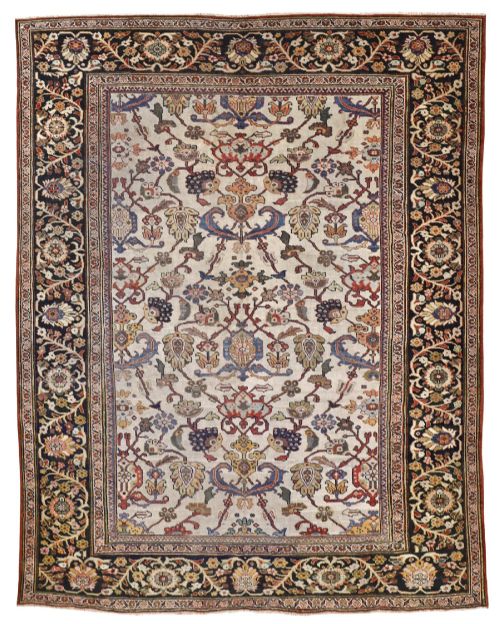
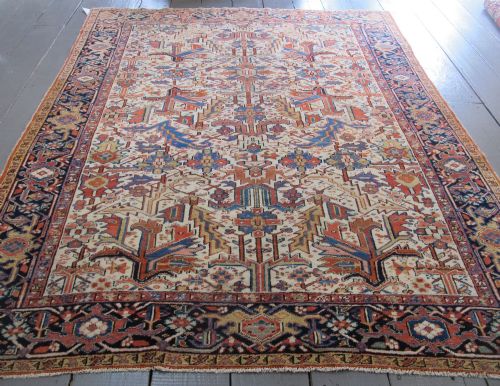


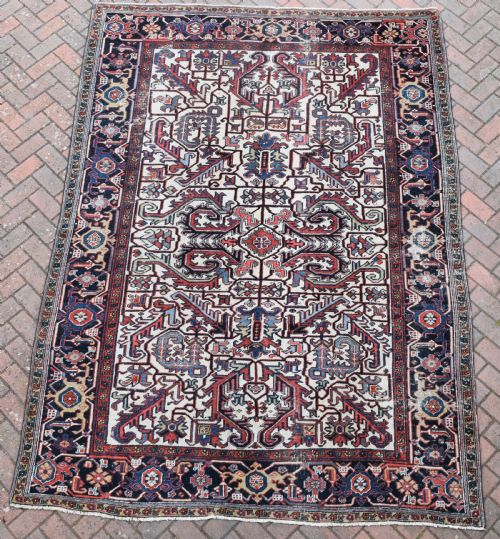


Ivory Ground Rug
An ivory ground rug brings pale, luminous warmth to a room through traditional Persian and Caucasian weaving.
Ivory Ground Rug
An ivory ground rug centres on a pale field of unbleached wool or cotton, allowing bolder medallion and lattice designs to stand out with crisp clarity. When searching for an ivory ground rug, collectors encounter regional village and nomadic pieces alongside larger city carpets.
The selections span from the nineteenth century into the early decades of the twentieth century. Traditional formats include small prayer rugs, torba faces, runners and room-sized carpets.
Origins stretch across Persian weaving centres like Heriz, Mahal, Tabriz, Malayer, Senneh and Afshar, as well as Anatolian, Kurdish and Caucasian workshops. Turkmen tribal pieces also appear with this distinctive pale palette.
Materials and construction
Weavers constructed these textiles using wool for the pile and foundation, often combined with cotton foundations in city workshops. Natural dyes provided the deep reds, blues and greens that contrast sharply against the pale field.
Nomadic and village pieces display hand-knotted piles tied by individual weavers working from memory or tribal tradition. City carpets demonstrate finer knot densities and more rigid geometric or curvilinear precision.
Ivory Ground Rug Retail Price Guide 2026
Typical asking prices for ivory ground rug among the pieces listed under this phrase on Sellingantiques today, from the lower quarter to the upper quarter. They describe what is for sale here now, not the wider market.
Listings feature pieces spanning the nineteenth century through to the 1930s, utilising wool, cotton, and natural dyes.
Judging quality and character
Quality rests in the handling of the natural dyes and the crispness of the drawing against the pale background. Subtle variations in the shade of the ivory field show the use of unspun wool and hand-dyeing methods.
The proportion of the central medallion or floral lattice to the surrounding field dictates visual balance. Finer knot counts and durable wool quality distinguish major city workshop productions from looser nomadic weaving.
The Ivory Ground Rug Glossary
- Ivory ground
- A pale, unbleached background colour forming the primary field of the rug. This light tone accentuates the darker geometric or floral motifs.
- Medallion
- A central ornamental design element placed in the middle of the field. Many Heriz and Ushak carpets feature this prominent central feature.
- Prayer rug
- A small format textile featuring a mihrab or arch design indicating the direction of prayer. Examples appear frequently in Caucasian and Anatolian weaving.
- Torba
- A small tribal storage bag face produced by Turkmen weavers. These pieces often display specialised guls and curled leaf motifs.
- Boteh
- A stylised almond or paisley motif representing a floral or cypress shoot. Kurdish runners and Persian rugs frequently employ this repeating symbol.
Ivory Ground Rug: Frequently Asked Questions
How do I clean an antique rug?
Antique textiles require gentle professional care rather than domestic washing. Surface dust is best managed through careful, low-suction vacuuming without a rotating brush.
Harsh detergents and scrubbing damage natural wool piles and destabilise traditional dyes. Specialists in antique textile conservation should handle deep washing.
Where were these rugs made?
Production centres span traditional weaving regions across Persia, the Caucasus and Anatolia. Village workshops and nomadic tribes each contributed distinct regional styles.
City ateliers in locations such as Tabriz produced larger, finely knotted carpets. Tribal groups like the Tekke Turkmen and Afshars created smaller utilitarian formats.
How do I date an older rug?
Dating relies on examining material wear, natural dye variations and structural characteristics. Stylistic motifs often align with specific nineteenth or early twentieth-century periods.
Comparisons with documented regional weaving help narrow the decade of production. Foundation materials and knotting techniques provide further chronological clues.
Can I place these rugs in heavy traffic areas?
Durable wool pile allows these pieces to withstand moderate foot traffic in domestic settings. Placing a quality underlay beneath the textile prevents slipping and reduces fibre friction.
Direct, prolonged sunlight causes natural dyes to fade across the pale field. Rotating the placement periodically ensures even exposure and wear.