



Italian Neoclassical Commode
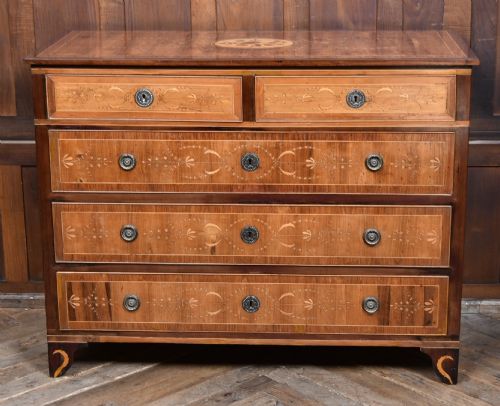
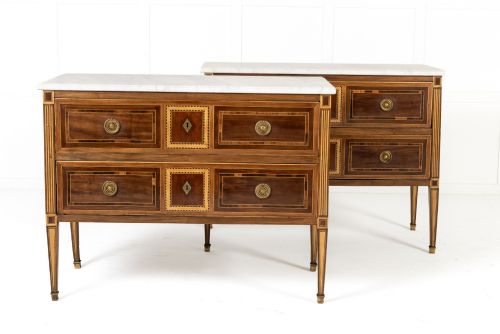
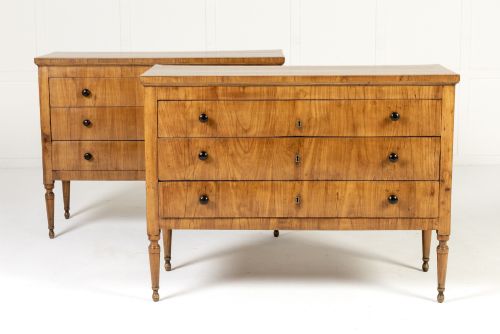
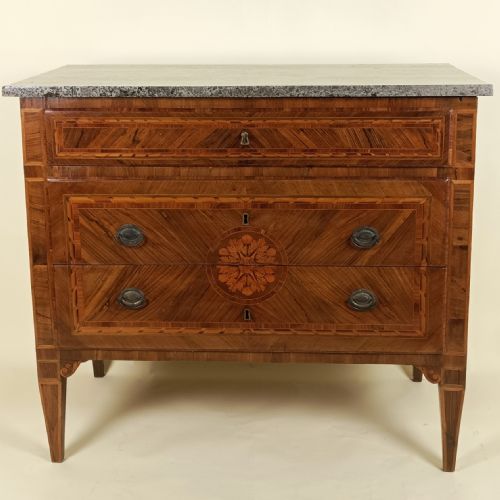
These Italian neoclassical commodes bring architectural discipline and fine marquetry into a room, offering both generous storage and striking proportion.
Italian Neoclassical Commode
An Italian neoclassical commode stands as a formal chest of drawers or side cabinet, defined by straight lines, architectural symmetry, and classical restraint. You will most frequently meet walnut examples from the eighteenth century, often displaying rich marquetry or striking serpentine fronts.
Makers shaped these pieces in regional centres such as Lombardy, adopting styles that ranged from severe architectural forms to fluid Louis XVI influences. The evidence records variations including demi-lune side cabinets, bow front cabinets, and marble top chests of drawers.
The form developed across several centuries, with pieces recorded from the eighteenth and nineteenth centuries alongside later twentieth-century interpretations. Each piece serves as a formal storage unit that anchors a reception room or grand hallway.
Materials and construction methods
Cabinetmakers constructed these commodes using a foundation of walnut, fruitwood, kingwood, mahogany, and satinwood, frequently enhanced by intricate marquetry and inlay work. Artisans applied parcel gilt details and fitted heavy marble tops to create durable, highly decorative surfaces.
Workshops employed specialised techniques such as painted wood finishes and detailed wood inlay to depict geometric patterns and classical motifs. Brass hardware often complemented the timber framework, securing drawers and doors while adding metallic contrast.
Italian Neoclassical Commode Retail Price Guide 2026
Typical asking prices for italian neoclassical commode among the pieces listed under this phrase on Sellingantiques today, from the lower quarter to the upper quarter. They describe what is for sale here now, not the wider market.
Distinguishing quality in design and execution
Quality rests upon the precision of the marquetry and the architectural harmony of the proportions, where master workshops achieved crisp geometry and seamless wood selection. Pieces bearing attribution to known makers or specific northern regions display superior cabinetwork.
The choice of secondary timbers and the complexity of the carcass shape, such as a serpentine or demi-lune front, dictate the level of craftsmanship involved. Original surface treatments and intact marble tops further separate standard utilitarian chests from exhibition-grade works.
Maggiolini·Pietro Ferrario
The Italian Neoclassical Commode Glossary
- Commode
- A low chest of drawers or cabinet designed for domestic use. The form developed in France before being adopted by Italian cabinetmakers.
- Marquetry
- Decorative veneer applied to a furniture structure to form geometrical patterns or pictorial designs. Artisans used contrasting woods such as walnut, kingwood, and fruitwood.
- Serpentine front
- A furniture front curving inward centrally and outward at the ends in a continuous wave. This shape demands high skill from the woodworker.
- Demi-lune
- A half-moon shape used for the plan of specialised side cabinets and commodes. It allows the furniture to sit flush against a wall while projecting into the room.
- Parcel gilt
- Woodwork partially covered with gold leaf to highlight carved details or architectural moulding. This technique emphasises the classical lines of neoclassical design.
Italian Neoclassical Commode: Frequently Asked Questions
What is an Italian neoclassical commode?
An Italian neoclassical commode is a formal chest of drawers or cabinet produced during the eighteenth or nineteenth century, featuring classical proportions, symmetrical design, and often intricate wood marquetry.
These pieces served as practical storage furniture for grand interiors, combining utility with sophisticated decorative arts traditions found across regions like Lombardy.
Where should I place a commode?
These pieces suit reception rooms, grand hallways, or dining spaces where their architectural lines and decorative marquetry can function as a focal point.
Because many examples feature delicate fruitwood inlay or heavy marble tops, positioning them away from direct heat sources helps preserve the timber and surface.
How do I identify a neoclassical style?
Neoclassical furniture rejects heavy baroque curves in favour of straight lines, classical symmetry, architectural mouldings, and restrained ornamentation inspired by antiquity.
In Italian pieces, this often appears alongside rich walnut veneers, geometric marquetry panels, and parcel gilt accents.
What woods were commonly used?
Cabinetmakers primarily utilised walnut as a base timber, complemented by contrasting veneers including kingwood, satinwood, mahogany, and various fruitwoods.
Selected examples also incorporate painted wood surfaces and heavy marble slabs fitted to the top surface.