



Italian Gilt Armchair
An italian gilt armchair brings warmth and old theatre to a room, catching the low evening light across carved surfaces.
Italian Gilt Armchair
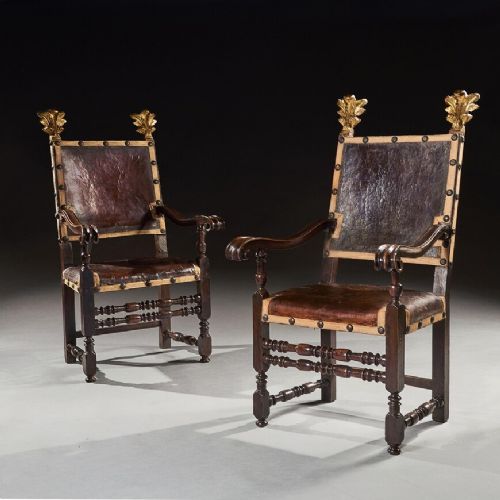
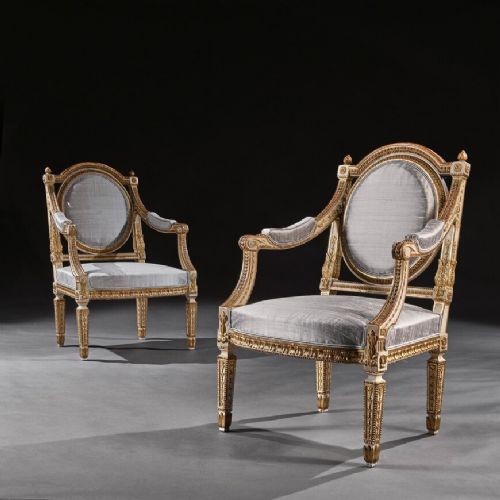
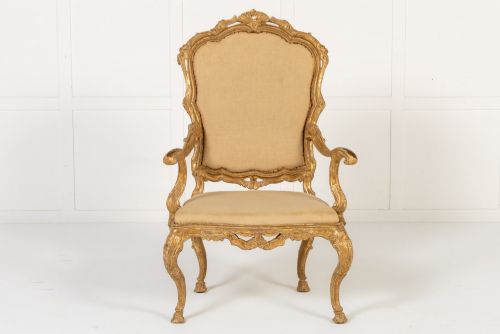
An italian gilt armchair is a substantial seating piece originating from Italy, finished in gold leaf, silver leaf, or paint over carved wood. These pieces emerge from periods spanning the seventeenth century through to nineteen hundred, showing the distinct shifts in taste across Italian workshops.
Buyers meet several key styles within this group, including Italian Baroque, Italian Rococo, Neoclassical, and Renaissance Revival forms. Pairs feature frequently among the available items, alongside individual armchairs and folding Savonarola chairs.
The construction relies heavily on walnut and other carved wood foundations, often paired with fabrics or hessian upholstery. Scale varies from standard domestic proportions to large scale statement pieces designed for grand salons.
How They Were Made
Makers shaped these frames from solid walnut and other carved woods, building up intricate relief work before applying surface decoration. Gesso provided a smooth ground layer over the carved wood to receive the metal leaf.
Artisans applied gold leaf or silver leaf over the prepared surfaces, sometimes combining parcel-gilt details with painted wood finishes. Upholstery techniques utilised traditional materials like leather and hessian to complete the seating structure.
Italian Gilt Armchair Retail Price Guide 2026
Typical asking prices for italian gilt armchair among the pieces listed under this phrase on Sellingantiques today, from the lower quarter to the upper quarter. They describe what is for sale here now, not the wider market.
Materials recorded across the inventory include gold leaf, silver leaf, painted wood, solid walnut, and hessian upholstery.
What Varies in Quality
The crispness of the wood carving dictates much of the visual success, separating deeply articulated foliage and scrolls from softer, shallower cutting. The application of gold leaf or silver leaf also varies, with superior examples showing rich burnishing and subtle interaction with the gesso beneath.
Proportion and scale distinguish standard seating from grand salon pieces, particularly in large scale pairs where symmetry and balance across both chairs matter immensely. The integrity of the underlying walnut frame and the historical consistency of the painted or gilded surfaces determine the overall character of the piece.
The Italian Gilt Armchair Glossary
- Giltwood
- Wood that has been coated with gold leaf or silver leaf applied over a prepared gesso ground. This finish provides a luminous surface that catches candlelight and natural daylight.
- Parcel-gilt
- A decoration method where only specific carved details, such as high points or motifs, are gilded while the rest of the surface is painted or left as exposed wood.
- Gesso
- A mixture of binder and chalk applied to carved wood to create a smooth, absorbent base for gilding. It allows craftsmen to achieve sharp definition in relief ornament.
- Savonarola chair
- A folding chair constructed from multiple curved wooden slats intersecting in an X-shape, named after the fifteenth-century Dominican friar. This portable form dates back to the Renaissance.
- Baroque Revival
- A nineteenth-century historicist style that emulates the dramatic curves, heavy ornamentation, and theatrical scale of seventeenth-century Baroque art.
Italian Gilt Armchair: Frequently Asked Questions
How do I place an armchair in a modern room?
These gilded seats add a strong focal point when contrasted against neutral walls and clean modern lines. Their rich surfaces benefit from placement where natural light can cross the carved details.
Allow enough space around large scale pieces so the silhouette can be appreciated without feeling crowded by other furniture.
Were these chairs meant for everyday sitting?
Many historical seating pieces served decorative roles in formal reception rooms rather than heavy daily use. Their sturdy walnut and carved wood frames provide solid structure, though delicate gilded surfaces require mindful placement.
Upholstery materials like leather and hessian support practical seating while maintaining the historical character of the frame.
How can I tell a Baroque style from a Neoclassical one?
Baroque designs feature exuberant curves, dynamic asymmetry, and heavy sculptural foliage that create a sense of dramatic movement. These seventeenth-century traits emphasise rich texture and deep relief carving.
Neoclassical pieces shift towards restrained symmetry, straight lines, and classical motifs inspired by archaeological discoveries, appearing cleaner and more orderly in their geometry.
What is the difference between gold leaf and silver leaf?
Gold leaf provides a warm, enduring metallic lustre that resists tarnishing over centuries of exposure to air. It forms the classic finish associated with grand European interiors.
Silver leaf offers a cooler, brighter tone that oxidises naturally over time, developing a darker, moody patina that appeals to collectors of specific regional decorative traditions.