

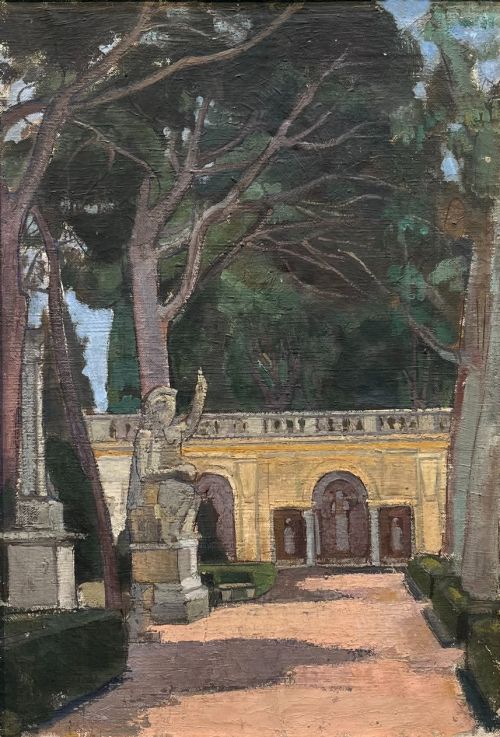


Italian Architectural Study
An italian architectural study captures the classical grandeur of southern ruins and monuments through watercolours, oils, and engravings.
Italian Architectural Study
An italian architectural study focuses on the historic buildings, piazzas, and ancient ruins of Italy, captured in watercolours, oil paintings, and engravings. Buyers seek these pieces to bring the classical scale of Venetian canals, Roman forums, and Pompeian villas into domestic interiors.
The versions most commonly met on this page span from the eighteenth century up through the Edwardian period and the mid-twentieth century. Works range from Grand Tour watercolours and detailed engravings of Vatican loggias to atmospheric oil paintings of cathedrals and gardens.
Subjects often highlight famous sites such as the Colosseum, the Arch of Titus, Padua Cathedral, and the Medici Gardens. These artworks document how generations of artists recorded the physical fabric of Italy over centuries.
How they were made
Artists applied watercolour, oil, pastel, gouache, and ink onto paper and canvas to record these Italian subjects. Many works incorporate delicate ink pen drawings alongside washes of colour or utilise gold leaf accents to highlight architectural details.
Framed artworks and prints rely on traditional framing techniques using wood and glass to protect fragile paper supports. Engravings often derive from plates documenting specific classical monuments and vaulted cathedral interiors.
Someone spent hours meticulously inking gondolas on the Grand Canal just so you could stare at Venice from your sofa.
What varies in quality
Quality rests upon the precision of the draughtsmanship and the artist's ability to render perspective and scale within complex architectural forms. Hand-painted watercolours and original oil paintings demonstrate greater individual artistry than standard reproductive prints.
The depth of historical observation separates standard souvenir records from accomplished works by named artists and recognised schools, such as the British School in Rome.
Thomas Ellison·Pio Panfili
The Italian Architectural Study Glossary
- Grand Tour
- A traditional trip through Europe undertaken by upper-class European young men of means in the seventeenth, eighteenth, and nineteenth centuries to absorb classical culture and art.
- Gouache
- An opaque watercolour paint consisting of pigment, water, and a binding agent such as gum arabic, often producing a heavier, matte finish.
- Neoclassical
- A Western cultural movement drawing on the art and culture of classical antiquity, highly influential during the eighteenth and nineteenth centuries.
- Engraving
- A printmaking process where an artist carves an image onto a metal plate, usually copper, to transfer ink onto paper under pressure.
- Pastel
- A dry art medium in the form of a stick, consisting of powdered pigment and a binder, used to create soft-textured coloured drawings.
Italian Architectural Study: Frequently Asked Questions
What is an Italian architectural study?
These works are paintings, watercolours, and engravings depicting historic Italian buildings, ruins, and landscapes created from the eighteenth century onwards.
They served as records for travellers and scholars documenting the classical architecture of Rome, Venice, and Pompeii.
How were these pieces used historically?
Travellers collected these artworks during their travels across Europe as mementoes of classical sites and to display their cultural education at home.
Artists also produced them as independent studies of perspective, light, and historical form.
How do I live with these artworks?
These framed pieces suit studies, libraries, and hallways where their classical subjects and muted tones complement traditional interiors.
Keep them away from direct sunlight to protect delicate watercolours, paper supports, and pigments from fading.
How can I tell the periods apart?
Eighteenth-century works often feature precise architectural engravings and classical neoclassical compositions, whereas Edwardian and later pieces lean towards looser watercolour and oil techniques.
Stylistic cues, framing materials, and artist signatures help place each piece within its historical era.