
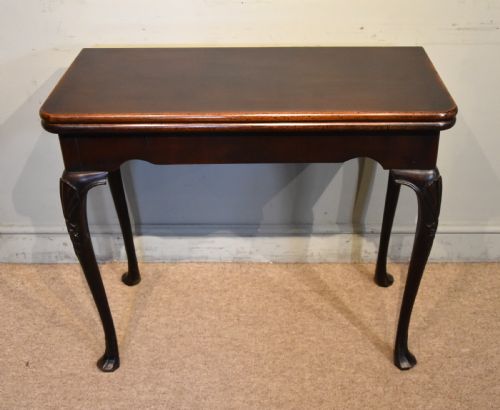


Irish George III Table
An irish george iii table brings robust mahogany timber, generous proportions, and crisp carved detail straight from eighteenth-century workshops into a modern room.
Irish George III Table
The version you are most likely to meet on this page is a mahogany card table, console table, or side table from the Georgian period. These items range from simple side and hall tables to triple top card tables and large wake or dining tables.
Makers working during this era produced metamorphic library tables, silver tables, and drop leaf tables, often utilising brass or leather alongside the primary timber. The material record also extends to silver strainer spoons and wine tables or kettle-stands attributed to Irish makers.
How they were made
Makers of an irish george iii table relied primarily on solid mahogany, augmented with boxwood and satinwood inlay to create decorative contrast on surfaces and borders. Brass hardware and leather inserts appear on specialised forms such as desks, writing tables, and library tables.
Construction techniques involve structural carving on timber frames, supporting serpentine consoles, demi-lune pier tables, and folding leaves on games and card tables. Cabinetmakers combined dense hardwoods with precise joinery to build large-scale items like wake and dining tables that endured heavy daily use.
Several tables conceal extra folding leaves or entire mechanical libraries, proving eighteenth-century cabinetmakers loved a secret compartment just as much as we do.
What varies in quality
The distinction between standard pieces and the finest examples rests on the depth and crispness of the carving, the selection of figured mahogany timber, and the precision of inlaid satinwood or boxwood banding. Tables with complex mechanisms, such as metamorphic library items or triple tops, demonstrate higher joinery skill.
Proportion and scale also separate ordinary items from superior ones, particularly in large console, serving, and wake tables where timber stability and original surface patination dictate desirability.
The Irish George III Table Glossary
- Console table
- A wall-mounted or freestanding table designed to stand against a vertical surface, frequently featuring carved mahogany and serpentine fronts.
- Serpentine
- A curved line of furniture fronts and edges that bends inward centrally and outward at the corners, seen on console and card tables.
- Wake table
- A large drop-leaf dining table with multiple legs, built to accommodate many diners in eighteenth-century domestic spaces.
- Demi-lune
- A half-moon shape utilised in the design of pier tables and small side tables from the Georgian period.
- Metamorphic table
- A multifunctional piece of furniture engineered to transform from one form, such as a desk or library table, into another.
Irish George III Table: Frequently Asked Questions
What rooms suit an irish george iii table?
These tables adapt easily to dining rooms, hallways, and living spaces depending on their original function. Side, hall, and console tables fit narrower passageways against walls.
Larger dining, wake, and tea tables anchor principal rooms as central gathering surfaces, while card and games tables occupy corners or drawing rooms.
How do I identify a georgian table?
Examination of the timber reveals dense, heavy mahogany and characteristic eighteenth-century construction methods. Look for hand-cut joinery and period-appropriate hardware.
Stylistic markers include carved mahogany details, boxwood or satinwood inlay, and specific table forms like silver tables and triple top card tables.
Were these tables used for dining?
Certain forms served specific domestic rituals, such as large wake tables built for communal meals and tea tables designed for beverage service. Other formats accommodated card games or writing.
Console and side tables functioned primarily as serving surfaces or decorative furniture placed against walls in formal rooms.