

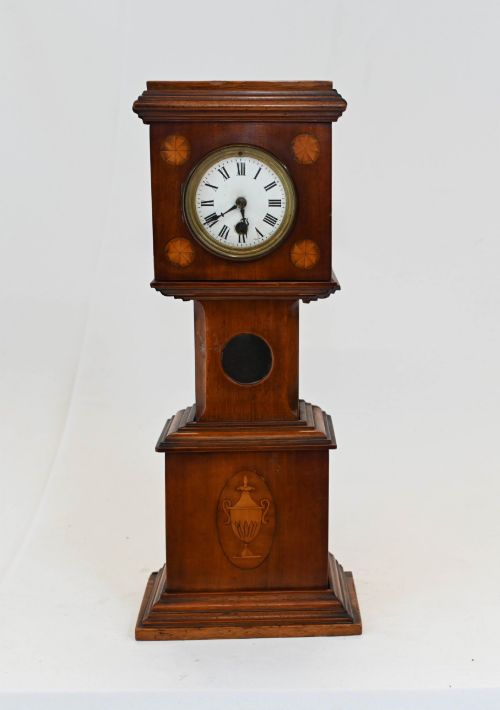
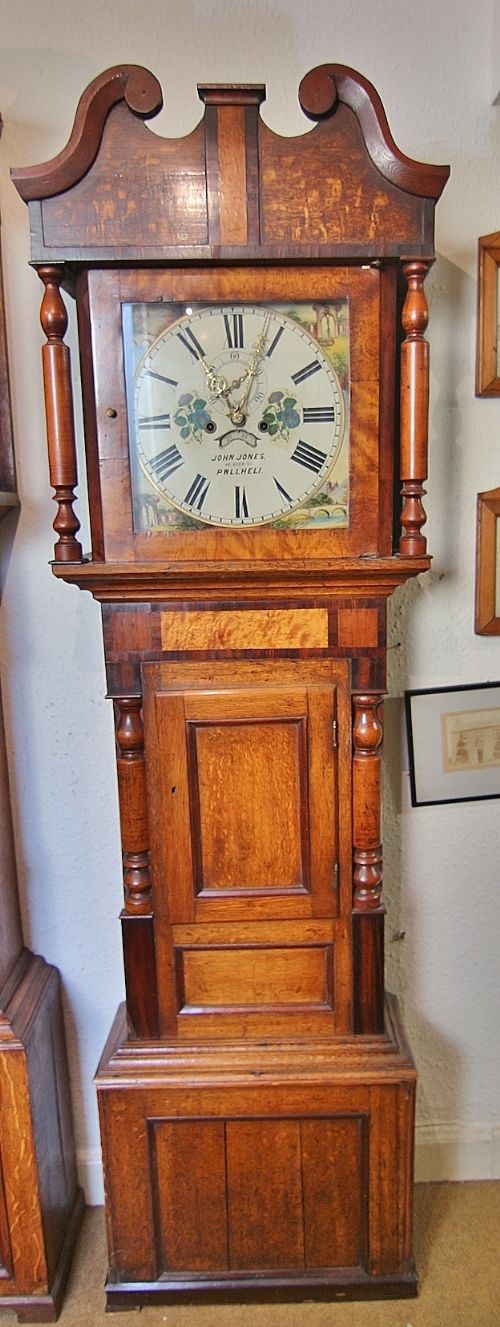
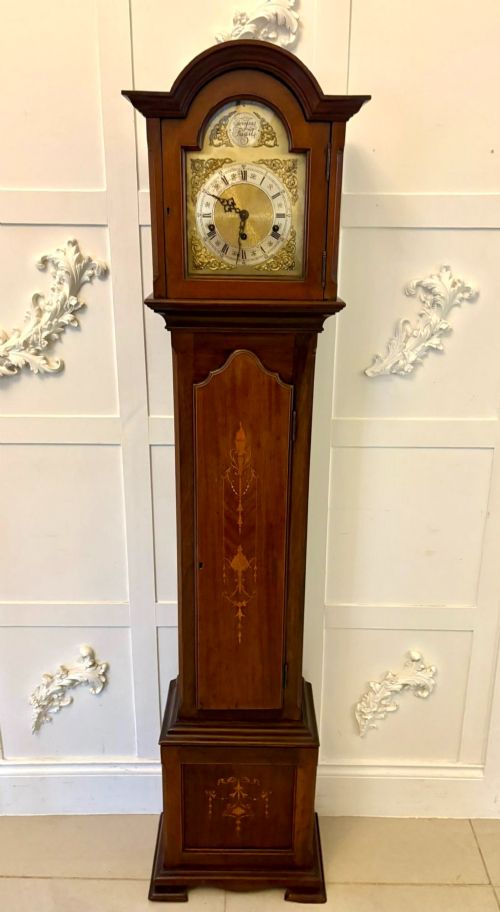
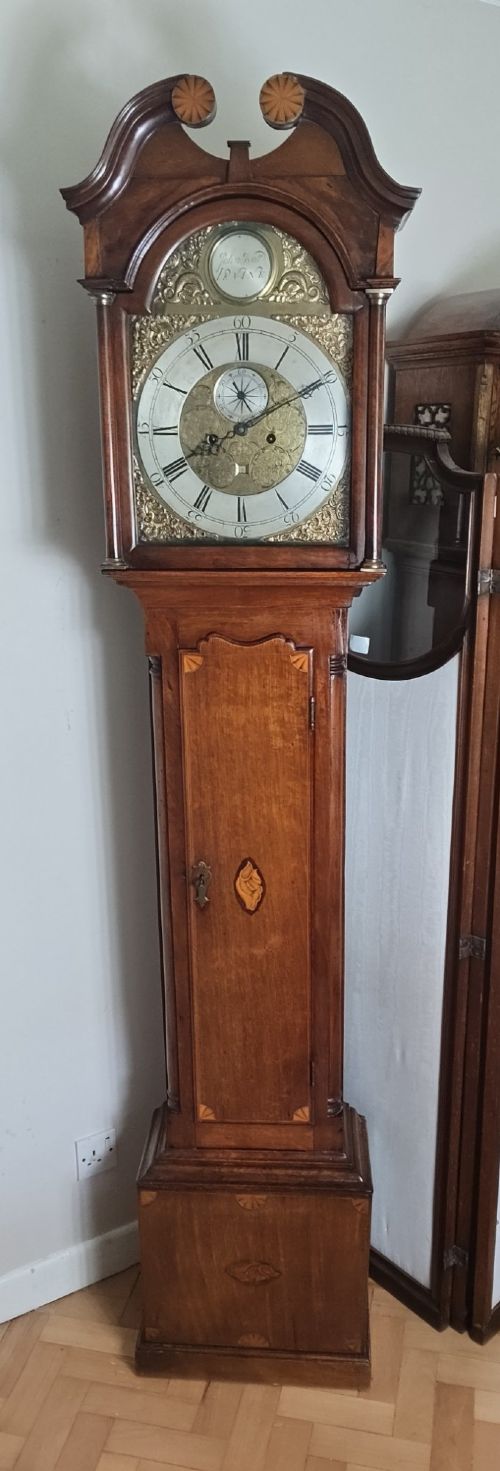
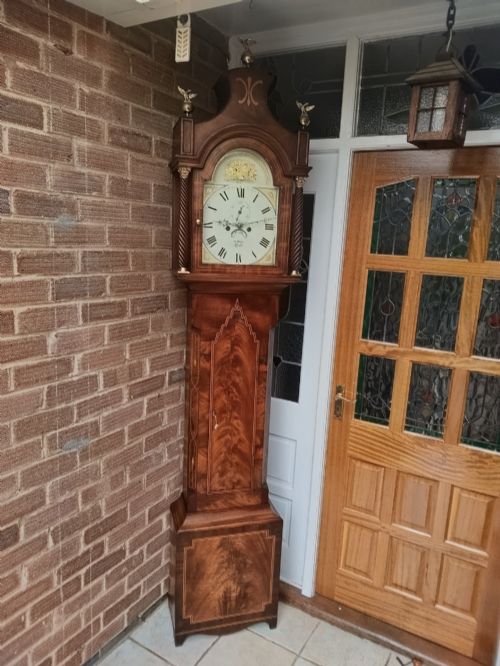


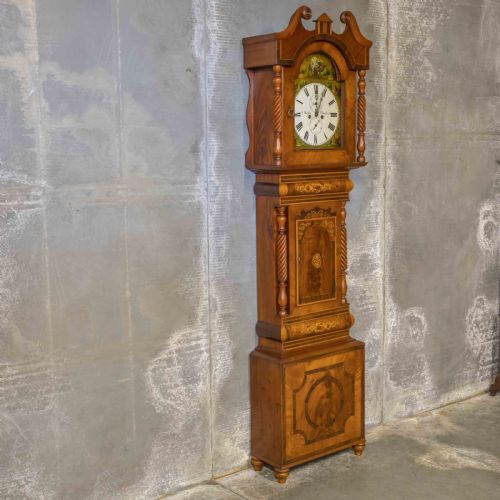


Inlay Mahogany Grandfather Clock
An inlay mahogany grandfather clock brings architectural presence and mechanical precision into a room through centuries-old cabinetmaking.
Inlay Mahogany Grandfather Clock
An inlay mahogany grandfather clock combines tall wooden casework with a weight-driven movement, commonly designated in period records as a longcase clock. These timepieces span the Georgian, Regency, and Edwardian eras, appearing in substantial proportions or as smaller grandmother and miniature versions.
The versions most frequently encountered on this page date from the late 18th century and the 19th century, constructed with regional variations originating from English, Scottish, and Channel Island makers. Their tall timber trunks house brass or painted iron dials, often featuring subsidiary seconds and moon phase displays.
What varies in quality
The distinction between standard and superior pieces rests on the choice of timber figure, the crispness of the cabinetmaker's inlay work, and the reputation of the dial's signed maker. Flame mahogany with fine satinwood stringing commands greater regard than plain timber bodies.
Movement complexity further separates examples, with eight-day duration movements, moon phase indicators, and quarter-striking or musical capabilities reflecting higher manufacturing skill than simple thirty-hour timepieces.
Inlay Mahogany Grandfather Clock Retail Price Guide 2026
Typical asking prices for inlay mahogany grandfather clock among the pieces listed under this phrase on Sellingantiques today, from the lower quarter to the upper quarter. They describe what is for sale here now, not the wider market.
Listings feature mahogany, flame mahogany, and satinwood inlay across Georgian, Regency, and Edwardian periods.
John Denbigh Merton Park·William Moon London·David Morice Auchtermuchty·Benjamin Peers Chester·Thomas Lees Bury·Thomas De Gruchy Jersey·Edward Glase Bridgnorth·Edward Renouf Jersey·Joseph Lum·G Brown Edinburgh·Sam Robson·Summerhayes of Taunton
The Inlay Mahogany Grandfather Clock Glossary
- Longcase clock
- The correct horological term for what is commonly called a grandfather clock, describing a tall floor-standing timekeeper.
- Moon phase
- A dial mechanism tracking the lunar cycle through a rotating painted disc visible beneath an arched opening on the clock face.
- Satinwood inlay
- A decorative technique using contrasting pale timber inserts to create geometric borders and floral motifs on the mahogany case.
- Paterae
- Small circular carved or inlaid medallions frequently set into the corners of longcase hood doors or friezes during the Georgian period.
- Quarter striking
- A mechanical train configuration enabling the clock to chime every fifteen minutes in addition to sounding the full hour.
Inlay Mahogany Grandfather Clock: Frequently Asked Questions
How do I wind an eight-day grandfather clock?
Winding requires inserting a crank key into the winding holes on the dial face and turning it clockwise until the weights rise near the top of the case.
Care must be taken not to overwind the movement, stopping as soon as resistance increases.
Where should I place a longcase clock in my home?
These clocks require a stable, dry interior wall away from direct sunlight, central heating vents, and exterior doors to protect the mahogany timber and mechanical movement.
A secure fixing to the wall through the backboard prevents accidental tipping and ensures the pendulum swings evenly.
How do I tell an 18th-century clock from an Edwardian one?
Eighteenth-century examples typically feature brass dials with cast corner spandrels and slender proportions, whereas Edwardian pieces often incorporate painted iron faces and revival styling influences such as Chippendale motifs.
Examining the secondary timbers inside the trunk also reveals period-specific joinery methods.
Why does the clock strike incorrectly?
Striking discrepancies usually occur when the minute hand has been moved past the hour too quickly or the striking train has run out of synchronization with the going train.
Allowing the clock to complete a full sequence or gently advancing the minute hand helps realign the countwheel.