



Inlaid Wellington Chest
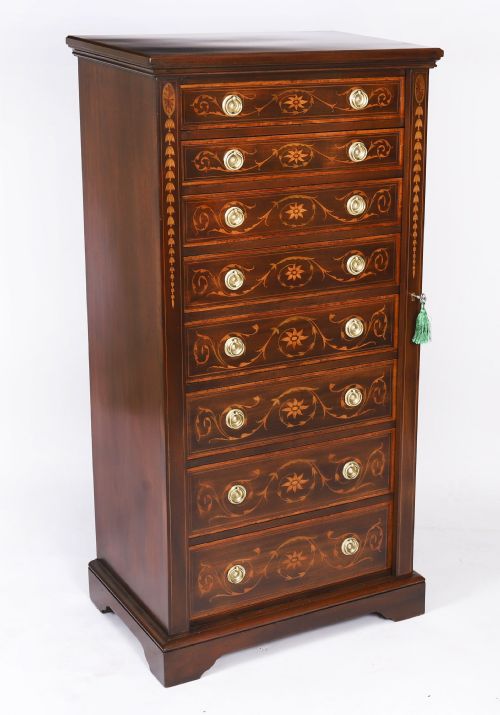
These inlaid wellington chest pieces are tall, narrow locking cabinets designed for discreet storage, offering collectors an elegant vertical footprint.
Inlaid Wellington Chest
When you search for an inlaid wellington chest, you encounter tall, slender case pieces characterised by a hinged locking stile that secures all the drawers at once. These narrow cabinets originate predominantly from the Victorian and Edwardian eras, alongside late nineteenth century and early twentieth century examples.
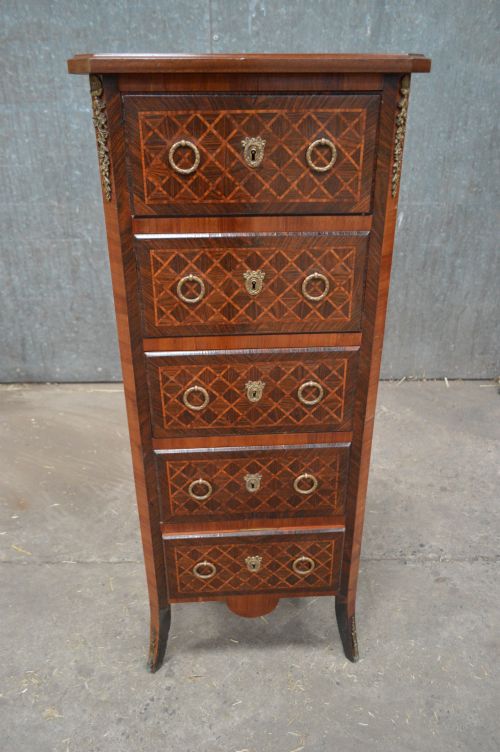
The versions most commonly met on this page include mahogany, walnut, and rosewood bodies embellished with satinwood or marquetry details, occasionally taking the form of bedside cabinets or narrow pedestal chests. Alongside standard seven drawer formats, variations stretch from French parquetry and Sheraton Revival styles to North African interpretations.
How they were made
Cabinet makers utilised dense primary timbers such as mahogany, walnut, and rosewood to construct the carcass, ensuring the tall, narrow frame remained stable. Surfaces were then enriched with contrasting veneers including satinwood, kingwood, and burr walnut, laid down as parquetry or marquetry.
Detailing relied on precision brass hardware for handles, escutcheons, and the signature locking mechanism sidebar. Glass elements and intricate wood inlays completed the decoration of these specialised locking chests.
Inlaid Wellington Chest Retail Price Guide 2026
Typical asking prices for inlaid wellington chest among the pieces listed under this phrase on Sellingantiques today, from the lower quarter to the upper quarter. They describe what is for sale here now, not the wider market.
Every single drawer must wait in line behind one stubborn wooden pillar before it is allowed to open.
What varies in quality
The standard of an inlaid wellington chest rests on the crispness of its marquetry and the choice of face veneers, where figured timbers like burr walnut or satinwood display superior depth. Finer pieces exhibit seamless parquetry geometry and harmonious timber selection across every drawer front.
Structural integrity also separates the upper tier from lesser examples, particularly the precision fit of the locking stile and its concealed hinge. Maker attribution, such as work by J Shoolbred or Holland and Sons, distinguishes workshops of higher repute.
J Shoolbred·Holland and Sons
The Inlaid Wellington Chest Glossary
- Wellington chest
- A tall, narrow chest of drawers featuring a hinged vertical locking flap on one side that secures all the drawers when locked. This form typically contains seven drawers.
- Marquetry
- Decorative veneer work forming pictorial or geometric patterns using various coloured woods. It is applied to the visible exterior surfaces of the cabinet.
- Parquetry
- Geometric mosaic woodwork used for decorative flooring or furniture surfaces. It creates patterned arrangements using contrasting wood blocks.
- Stile
- The upright vertical member of a frame, in this context acting as the locking bar that holds the drawers shut. It pivots on hinges to release the stack.
- Satinwood
- A durable, lustrous timber native to India and Sri Lanka, prized for its golden yellow sheen. It is frequently employed for stringing and inlay details.
Inlaid Wellington Chest: Frequently Asked Questions
What is a wellington chest?
A wellington chest is a tall, narrow set of drawers distinguished by a locking sidebar on the right or left edge. This hinged stile fastens over the drawer edges, securing the entire stack with a single key.
Originally designed for gentlemen's wardrobes or offices, the format maximises vertical storage while occupying minimal floor space in a room.
How do I date these chests?
Dating relies on timber choices, construction methods, and decorative styles visible across the carcass. Victorian and Edwardian examples often feature mahogany or walnut carcasses with distinct inlay motifs.
Maker signatures, brass hardware styles, and specific revival movements like Sheraton Revival also help narrow down the period of manufacture.
Where should I place one?
These narrow cabinets suit tight spaces, alcoves, or bedside areas where standard wide chests cannot fit. Their vertical height draws the eye upward without dominating the room.
Keep them away from direct sunlight and radiators to protect the delicate surface veneers and parquetry work from drying out.
How do I operate the lock?
To open the drawers, unlock the side stile with the matching key and swing the vertical wooden bar outward. Once the stile clears the drawer fronts, individual drawers pull open freely.
Closing the drawers requires pushing them completely flush before swinging the locking bar back into place and turning the key.