

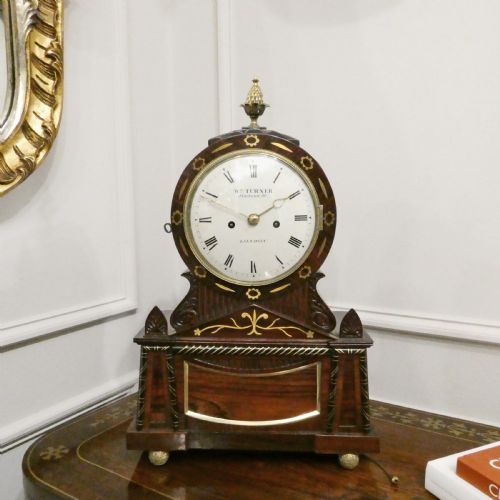
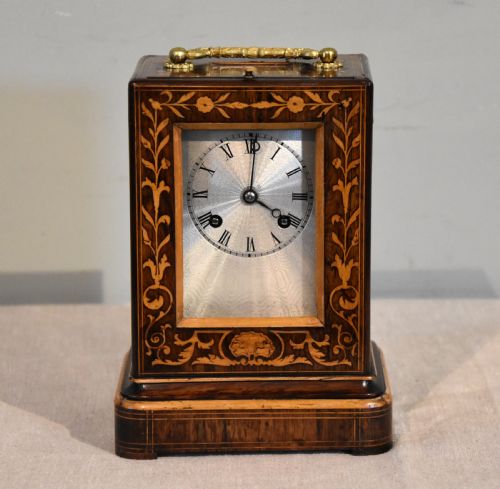


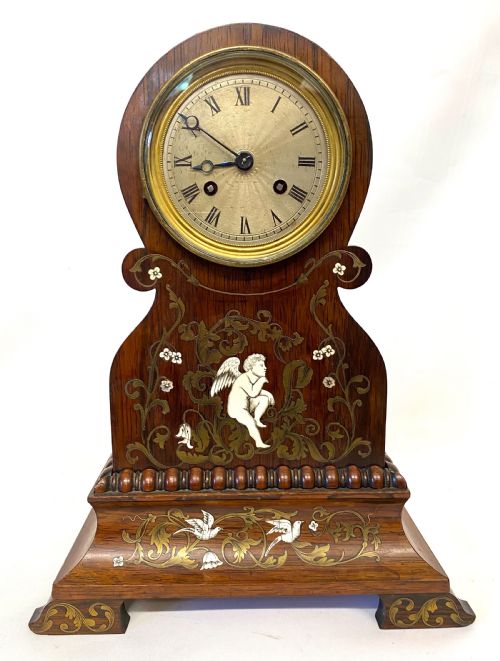
Inlaid Rosewood Bracket Clock
An inlaid rosewood bracket clock brings serious architectural presence and warm timber grain to a mantel, table or shelf.
Inlaid Rosewood Bracket Clock
An inlaid rosewood bracket clock combines rich, dark tropical timber with contrasting stringing or marquetry, built to sit solidly on a flat surface rather than hang upon a wall. The pieces recorded here span the Georgian, Regency, Victorian and Edwardian eras, taking the form of mantel clocks, table clocks and traditional bracket clocks.
The Regency period and the nineteenth century supply the bulk of the examples, often featuring bold brass inlay or delicate boxwood lines following the architectural contours of the case. French makers also contribute distinct shaped and marquetry-decorated variants from the same broad timeline.
While earlier examples relied on fusee movements designed for precise timekeeping across a sustained power reserve, later nineteenth and early twentieth century pieces introduced chiming mechanisms and eight-day trains.
How they were made
Cabinetmakers utilised dense rosewood veneers laid over a secondary timber carcase, cutting delicate channels into the surface to receive brass, boxwood or mother-of-pearl inlay. The contrasting materials are flush-fitted by hand, creating crisp geometric patterns or floral marquetry across the front and sides.
Dials employ silvered metal, white enamel or brass, protected behind bevelled glass within hinged bezels. Movements incorporate brass plates, steel pivots and gear trains driven by weighted cords or spring-powered fusee cones.
Inlaid Rosewood Bracket Clock Retail Price Guide 2026
Typical asking prices for inlaid rosewood bracket clock among the pieces listed under this phrase on Sellingantiques today, from the lower quarter to the upper quarter. They describe what is for sale here now, not the wider market.
Some nineteenth-century French makers incorporated bovine cherub inlay right alongside traditional brass stringing.
What varies in quality
The standard of an inlaid rosewood bracket clock rests upon the crispness of the brass or boxwood inlay and the integration of the case architecture. Finer pieces display tight, unbroken stringing that curves smoothly around corners without visible gaps or filler.
Movement execution separates workshop standards, with signed London makers or named French horologists typically offering more refined escapements and heavier brass plates than unrecorded production. The depth and figure of the rosewood grain itself further divide standard examples from exceptional ones.
Turner of London·George Orpwood·Seller of Reading·S Simpson Southampton·Henry Marc·Walker and Hall·Plumbly and Tupman·Dumont·Malecot of Paris
The Inlaid Rosewood Bracket Clock Glossary
- Bracket clock
- A portable timepiece originally designed to sit on a wall bracket to aid in sound projection and visibility. Most later examples sat directly on tables or mantelpieces while retaining the traditional terminology.
- Fusee
- A conical pulley connected to the mainspring by a cord or chain, designed to equalise the diminishing power of the spring as it unwinds. This mechanism ensures more consistent timekeeping throughout the duration of the wind.
- Marquetry
- The art of applying pieces of veneer to a structure to form decorative patterns and pictures. In these pieces, lighter woods and metal are set into the rosewood background.
- Stringing
- Thin inlays of contrasting timber or metal let into the surface of the wood. It outlines panels and structural borders on the clock case.
- Bezel
- The metal ring that holds the glass protecting the clock dial. It usually hinges open to allow hand-setting.
Inlaid Rosewood Bracket Clock: Frequently Asked Questions
What is a fusee movement?
A fusee movement uses a conical gear that regulates the pull of the mainspring. This keeps the force driving the clock gears even as the spring runs down.
It marks a higher grade of clockmaking commonly found in better Regency and nineteenth-century examples.
Why are they called bracket clocks if they sit on tables?
The name originates from seventeenth- and eighteenth-century portable clocks that rested on wooden wall brackets to help sound travel through a room.
Over time the term remained attached to the rectangular or bell-topped case style even when placed strictly on mantelpieces and sideboards.
How do I tell a Regency clock from a later Victorian one?
Regency cases lean towards classical architectural forms with bold brass inlay, classical pediments and robust proportions. Victorian and Edwardian examples often introduce more eclectic revival styles, marquetry panels and chiming complications.
Examining the dial signature, movement construction and timber treatment helps confirm the period.