
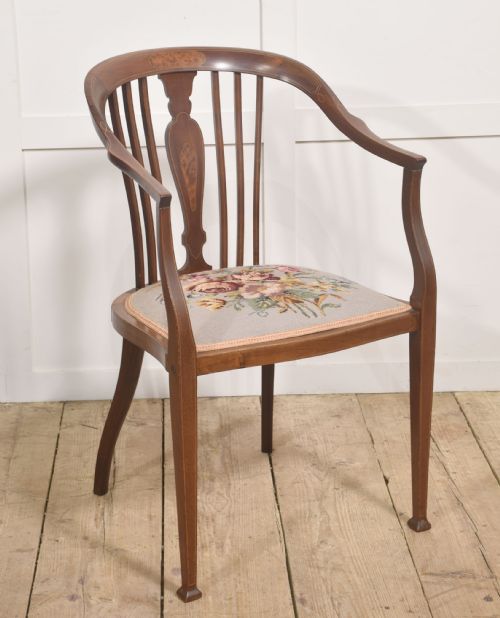


Inlaid Occasional Armchair
These inlaid occasional armchair examples bring lighter seating into smaller rooms, combining useful support with decorative detail.
Inlaid Occasional Armchair
An inlaid occasional armchair provides flexible seating for drawing rooms, bedrooms and studies, appearing most frequently in Edwardian forms alongside Victorian and Regency examples. These pieces function as accent seating rather than heavy primary chairs, designed to be moved easily around a room as needed.
The selection here includes salon chairs, corner chairs, tub chairs and elbow chairs created across several decades. Most examples date from the Edwardian period and the late nineteenth century, while earlier Regency pieces also surface.
Makers and workshops utilised specific regional designs, resulting in items spanning Sheraton Revival, Art Nouveau, Neoclassical Revival, Chinese Oriental and Anglo-Indian styles. Buyers encounter both single chairs and matched pairs suitable for domestic placement.
How they were made
Decoration relies heavily on precision string inlay and marquetry inlay set into the primary timber frame. Cabinetmakers applied contrasting veneers to create linear patterns and floral motifs across the crest rails and splats.
Several corner chairs in this selection arrive in matched sets of four, ready to fill every unused angle of a Victorian parlour.
What varies in quality
The refinement of the decorative inlay separates standard production from finer workshop pieces. Crisp, tightly fitted marquetry and varied timber tones indicate skilled craftsmanship.
Structural integrity within the joints and the crispness of carved or shaped mahogany elements determine the overall grade of the frame. Original upholstery framing and balanced proportions further distinguish better examples.
Jenks and Wood
The Inlaid Occasional Armchair Glossary
- Occasional chair
- A movable, light chair intended for use in various rooms when extra seating is required. These pieces prioritize decorative presence alongside practical utility.
- Inlay
- A technique where contrasting materials are inserted into recessed cavities of a wooden base to form a flat decorative surface. This method defines the primary visual appeal of these chairs.
- Marquetry
- Formed pieces of veneer fitted together to create pictorial or decorative designs before application to the wooden substrate. It appears frequently on late nineteenth century and Edwardian panels.
- Corner chair
- A seat designed to fit diagonally into the corner of a room, typically featuring a continuous curved backrest supported by multiple upright pillars. Several examples in this group survive as matched sets.
- Tub chair
- An armchair characterised by a rounded, solid back that curves continuously into low arms. This form offers enclosed seating comfort while maintaining a compact footprint.
Inlaid Occasional Armchair: Frequently Asked Questions
Where do these chairs work best?
These pieces suit bedrooms, dressing rooms and studies where light, movable seating is practical. Their compact proportions allow them to sit comfortably in corners or beside desks.
They add decorative character to an interior without dominating the floor space, functioning effectively as accent pieces.
How do I spot an Edwardian piece?
Edwardian examples generally display lighter mahogany frames combined with delicate satinwood stringing or subtle floral marquetry. The proportions tend to be slender and refined compared to heavier earlier furniture.
Stylistic cues often reference Sheraton Revival designs typical of the early twentieth century.
What is a salon chair?
A salon chair is a lightweight decorative seat made for formal reception rooms. These items prioritize visual appeal and slender construction over heavy lounging comfort.
They appear frequently in pairs or small sets designed to match the reception spaces of the period.
Are brass details common?
Metal elements appear on specific regional or period pieces, such as Regency designs incorporating brass inlay. These contrasting materials highlight structural lines and decorative motifs.
Such additions reflect the specific stylistic preferences of the cabinetmakers working during those decades.