

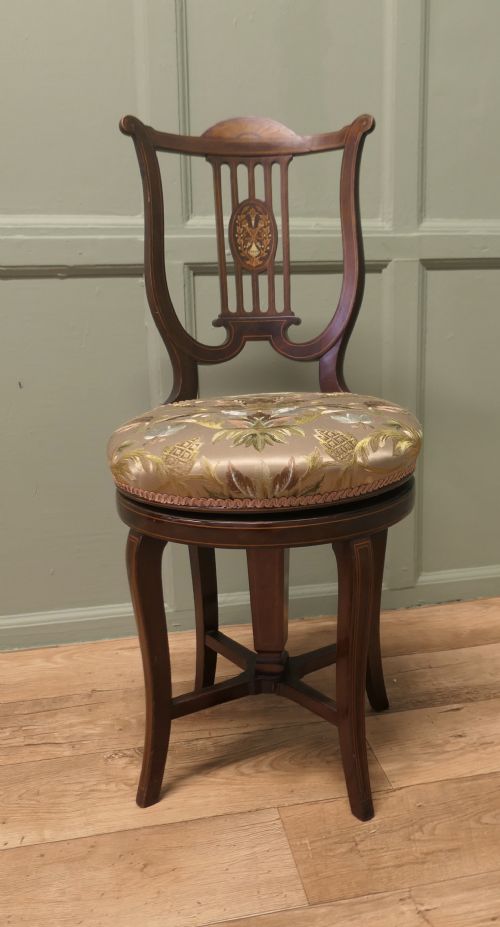
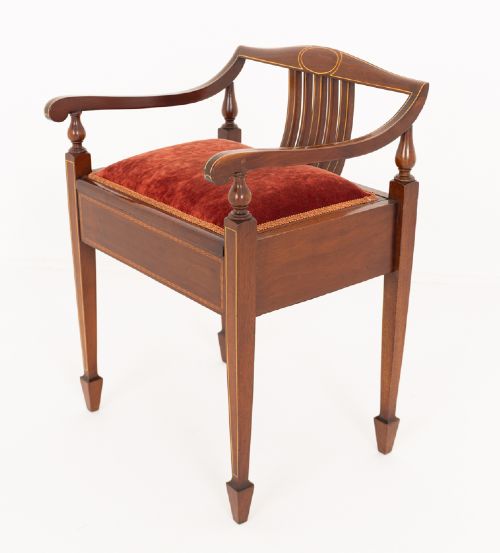


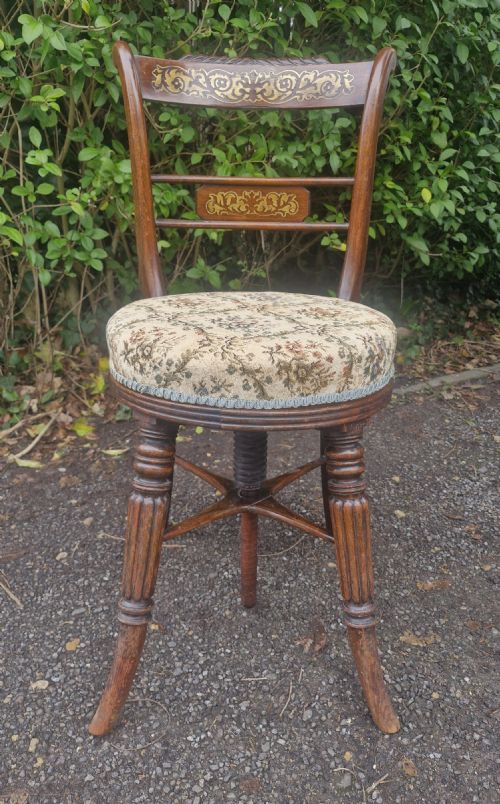


Inlaid Music Seat
An inlaid music seat brings domestic melody into focus, offering a dedicated perch for the pianist or harpist.
Inlaid Music Seat
An inlaid music seat provides firm support at the keyboard or music stand, taking forms such as piano stools, music chairs, and side chairs. These pieces originate from periods including the Regency, Victorian, and Edwardian eras, as well as the year 1900.
Most examples found here date from the Edwardian period or the year 1900, constructed primarily in mahogany with contrasting satinwood or boxwood inlay. Collectors also encounter revolving harpist and cello music chairs, rise and fall piano stools, and X-framed designs.
Makers of these seats incorporated specialised mechanics, such as revolving tops and rising mechanisms, alongside decorative woodwork. The integration of musical themes appears directly in pieces like the lyre-back chair and the Swiss musical chair.
Materials and construction
Carpenters utilised timbers such as mahogany, rosewood, walnut, and simulated rosewood to build the frames of these seats. Satinwood and boxwood inlay provides crisp contrast against the darker body woods.
Upholstery forms a primary component of the upper section, with fabric and velvet applied to cushion the seat. Brass inlay also appears on Regency period examples, adding metallic detail to the wooden structure.
Inlaid Music Seat Retail Price Guide 2026
Typical asking prices for inlaid music seat among the pieces listed under this phrase on Sellingantiques today, from the lower quarter to the upper quarter. They describe what is for sale here now, not the wider market.
Listings feature mahogany, rosewood, walnut, and satinwood inlay across pieces from the Regency, Victorian, and Edwardian eras.
Distinctions in quality
Timber selection and finishing dictate the overall presence of the piece, where richly figured mahogany and rosewood surpass plain secondary woods. The integration of specialised forms, including lyre backs and X-frames, demonstrates greater design complexity.
The Inlaid Music Seat Glossary
- Inlay
- A technique where pieces of contrasting wood, such as satinwood or boxwood, are inserted into recesses within a primary timber base to form a decorative pattern. This method creates flat, flush surface ornamentation.
- Lyre back
- A chair back shaped in the outline of a classical lyre instrument, frequently utilised in music room seating. This motif directly references the purpose of the room.
- Rise and fall
- A mechanical seating adjustment system allowing the height of the stool top to be altered via a central screw or ratchet mechanism. Players utilised this to achieve proper posture.
- X-framed
- A structural design utilising two intersecting pieces of timber in the shape of the letter X to form the support base. This configuration offers distinct bracing strength.
- Marquetry
- The art of forming decorative veneers from various woods and applied materials to cover a complete surface. It differs from inlay by blanketing the groundwork rather than sitting inside cut recesses.
Inlaid Music Seat: Frequently Asked Questions
What is an inlaid music seat used for?
These seats provide functional seating for musicians practicing at a piano, harp, or cello within the Victorian or Edwardian parlour. Their compact proportions suited domestic music rooms.
Mechanisms on specific models allowed the player to adjust their height or rotate during a performance. They combined utility with decorative cabinet work suited to formal interiors.
How do I identify a Regency music stool?
Regency music stools often feature dark timbers like rosewood combined with precise brass inlay work. Their silhouettes reflect classical architectural influences.
Proportions remain strict, and the hardware used for adjustment differs substantially from later Victorian or Edwardian manufacturing methods.
What is a Sheraton Revival music stool?
Sheraton Revival pieces date predominantly from the Edwardian era or around 1900, mimicking late eighteenth-century neoclassical designs. They showcase light mahogany frames paired with delicate satinwood inlay.
These items catered to Edwardian preferences for revived Georgian elegance in domestic furnishings.
How do revolving music chairs work?
Revolving music chairs utilise a central threaded wooden or metal screw mechanism hidden beneath the seat upholstery. This allows the sitter to turn freely.
Harpists and cellists relied upon this rotational freedom to manage their instruments and music stands comfortably.
How should I care for velvet upholstery?
Velvet seat coverings require gentle brushing to maintain the pile and prevent dust accumulation over time. Avoid harsh chemical cleaners that might damage the fabric fibres.
Keep the timber frame polished with appropriate wax to preserve the finish of the mahogany or rosewood.