


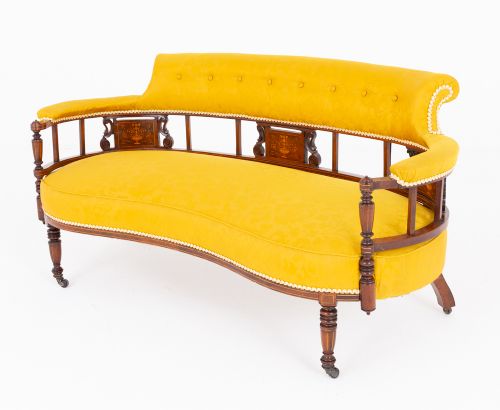


Inlaid Love Seat
These inlaid love seat pieces bring intimate two-seater seating into a room, combining period timber and delicate stringing.
Inlaid Love Seat
When you search for an inlaid love seat, you are looking at compact two-seater settees and sofas designed for close seating. These pieces span the Victorian, late Victorian, and Edwardian periods, dating from eighteen eighty up to nineteen hundred.
You are most likely to meet Edwardian and Victorian examples on this page. They appear as salon settees, end of bed sofas, and traditional two-seater settee forms.
The dominant timbers throughout these periods are mahogany and rosewood. Makers integrated satinwood and boxwood inlay to decorate the polished wooden surfaces.
Materials and construction
Makers built these frames using solid mahogany and rosewood. These dense hardwoods provided the structural stability required for compact two-seater settees.
Decoration relied on contrasting lighter timbers. Craftsmen set satinwood and boxwood inlay directly into the darker wood of the frame.
Upholstery completed the piece, combining fabric or velvet with brass fixings. This provided the soft seating surface characteristic of the period.
Inlaid Love Seat Retail Price Guide 2026
Typical asking prices for inlaid love seat among the pieces listed under this phrase on Sellingantiques today, from the lower quarter to the upper quarter. They describe what is for sale here now, not the wider market.
Object forms on this page include two-seater salon settees, end of bed sofas, and compact love seats.
Judging quality and execution
Quality rests in the precision of the timber work and the execution of the inlay. Sharp, clean contrasting lines in the satinwood and boxwood show superior cabinet-making.
The choice of primary timber influences the overall character. Richly grained mahogany and rosewood frames distinguish finer salon pieces from simpler iterations.
The Inlaid Love Seat Glossary
- Love seat
- A compact two-seater sofa or settee designed for two occupants. This form emerged strongly during the Victorian and Edwardian periods.
- Inlay
- A decorative technique where contrasting materials are set into the surface of a base timber. Boxwood and satinwood are typical examples.
- Settee
- An upholstered bench with a back and arms, sharing its function with a small sofa. Victorian and Edwardian makers produced numerous salon variations.
- Edwardian
- A stylistic period spanning the early years of the twentieth century. Furniture from this era often lighter in proportion than Victorian pieces.
Inlaid Love Seat: Frequently Asked Questions
What is an inlaid love seat?
An inlaid love seat is a compact two-seater settee or sofa decorated with contrasting wood inlay. These pieces date from the Victorian and Edwardian eras.
They function as intimate seating furniture. Their smaller proportions make them suited for bedrooms and smaller reception spaces.
How do I date an inlaid love seat?
Dating relies on identifying stylistic markers from the Victorian, late Victorian, and Edwardian periods. Timber choices such as rosewood or mahogany also indicate the era.
Construction methods and the specific patterns of satinwood and boxwood inlay help narrow the timeline between eighteen eighty and nineteen hundred.
Where were these pieces used?
These two-seater settees were placed in parlours and reception rooms as salon furniture. Some specific variants functioned as end of bed seating.
Their compact scale allowed them to fit into intimate corners where larger sofas proved impractical.
What woods are used?
The primary structural timbers seen in these pieces are mahogany and rosewood. Both woods provided strong frames for upholstered seating.
Satinwood and boxwood appear specifically as decorative inlay elements, creating bright contrast against the darker body timber.