
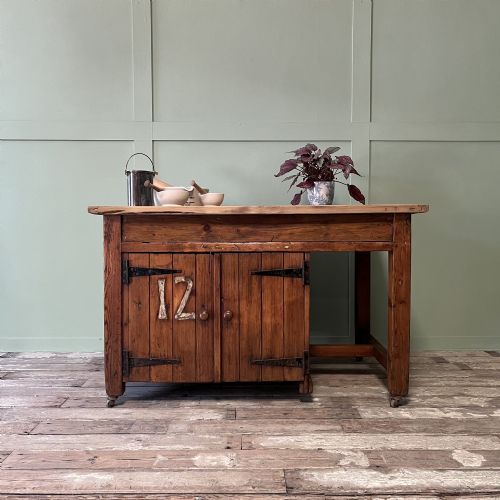

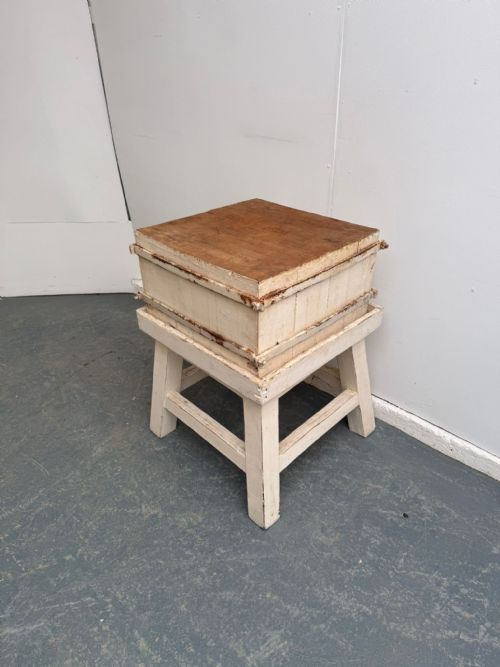
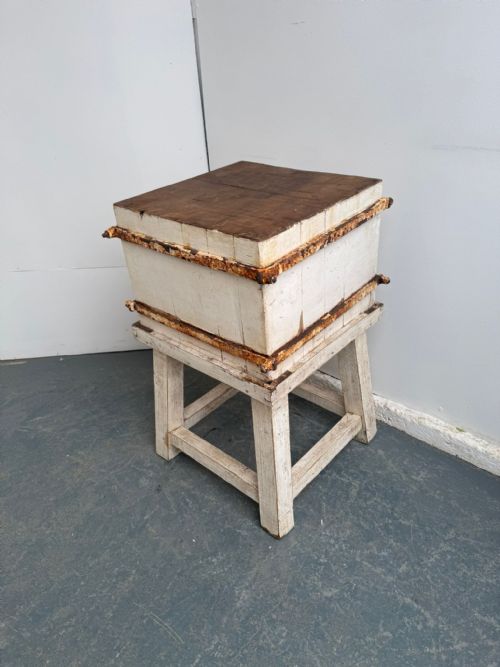


Industrial Prep Table
An industrial prep table anchors a room with honest utility, offering sturdy timber surfaces and metal frames built for heavy daily work.

Industrial Prep Table
An industrial prep table serves as a functional workspace, drawing on the practical needs of kitchens, bakeries and trades. When searching for an industrial prep table, buyers encounter robust pieces designed for hard physical labour rather than polite display.
The selections here span the Victorian era, the 1860s, and the 1920s through to 1950, showing how working furniture evolved over time. Forms range from kitchen islands and console tables to bakers prep tables and butchers blocks on stands.
French Provincial, rustic farmhouse, and industrial styles appear frequently, often showing regional origins such as France and Hungary. Buyers most commonly meet wooden work tables with pine or beech tops alongside heavy block surfaces.
How they were made
Construction relies on solid timbers like beech, pine, and hardwood paired with structural iron, cast iron, and wrought iron. Makers built these pieces to withstand constant impact, utilising thick wooden slabs for the tops and rigid metal for the underframes.
Specialist elements include marble surfaces, brass details, bronzed mounts, and glass tops, alongside painted finishes in white. These materials were chosen strictly for hygiene, strength, and endurance in working environments.
Hungarian and French origins appear across the selection, encompassing bakers tables, console tables, and butchers blocks.
What varies in quality
Quality rests in the original integrity of the materials, from the density of the hardwood or marble top to the heft of the iron base. Pieces retaining their authentic working patina and original mounts stand apart from lesser examples.
The distinction also lies in the balance between robust construction and proportion, where specialised maker signatures or distinct regional hardware elevate a straightforward utility table into a notable object.
Trussant & Cie·Hennes France
The Industrial Prep Table Glossary
- Butchers block
- A heavy, thick wooden table top designed for chopping and preparing meat. It is usually constructed from end-grain or edge-grain strips of dense hardwood.
- Prep table
- A utilitarian work surface used in kitchens and bakeries for food preparation. These tables prioritize stability and durable materials over decorative detail.
- Cast iron
- An iron-carbon alloy poured into moulds to create rigid, heavy machine parts and furniture bases. It provides exceptional weight and stability.
- Wrought iron
- Iron that is heated and hammered into shape by hand, resulting in a fibrous structure with high tensile strength. It bends rather than snaps under extreme pressure.
- Hardwood
- Timber derived from broad-leaved deciduous trees such as beech. It offers superior hardness and resistance to denting compared to softwood.
Industrial Prep Table: Frequently Asked Questions
What is an industrial prep table?
An industrial prep table is a heavy-duty working surface originally built for trades, bakeries, or butchers. These tables combine robust timber tops with iron or steel frames designed for rigorous daily use.
They bring an authentic architectural presence to modern domestic kitchens and living spaces.
How do I date an industrial prep table?
Dating relies on examining the construction methods, materials, and hardware used in the frame. Victorian and nineteenth-century examples often feature hand-forged ironwork and dense timber joined with traditional pegged construction.
Later twentieth-century pieces from the 1920s or 1950s introduce cast components, painted finishes, and alternative top materials like marble or glass.
How do I care for a wooden prep table?
Wooden prep tables benefit from regular cleaning with mild soap and water rather than harsh chemical sprays. Treating the timber periodically with food-safe oils keeps the surface nourished and prevents excessive drying.
Avoiding standing water and direct heat sources preserves both the wood and the structural integrity of the base.
Where were these tables used?
These tables originated in commercial food preparation environments, including French butcher shops, country bakeries, and Hungarian workshops. Their primary purpose was to provide a stable, sanitary, and indestructible surface for manual tasks.
Today, their utilitarian origins make them adaptable as kitchen islands, sideboards, or central work tables.