



Impressionist Woodland Painting
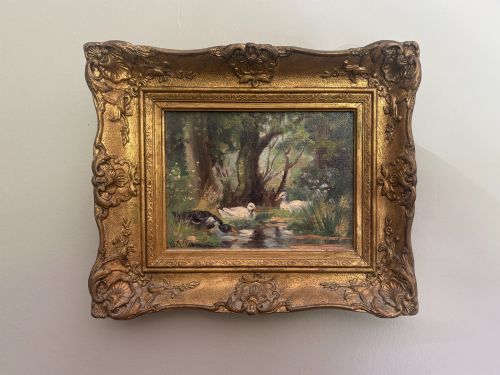
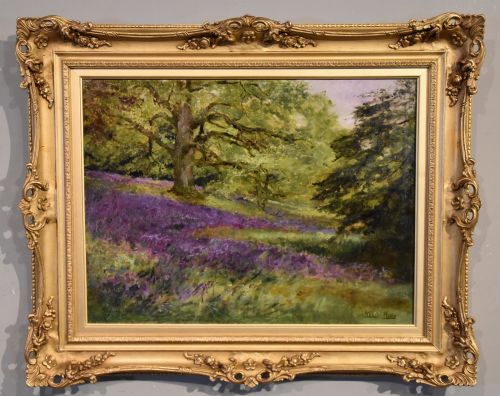
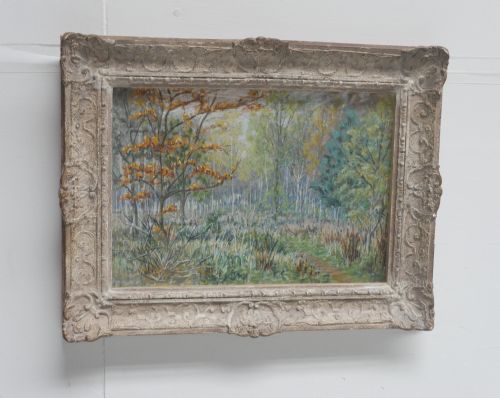
Impressionist woodland painting captures light filtering through trees using loose brushwork, offering buyers a serene piece of nature for their walls.
Impressionist Woodland Painting
An impressionist woodland painting brings the atmospheric depth of forests and tree-lined paths directly into a room, executed in oil or watercolour. When exploring this selection, buyers frequently encounter works originating from the nineteenth century through to the mid-twentieth century.
The assortment spans diverse regional movements, incorporating British Impressionism, French Naturalism, and the Barbizon School alongside pieces dated from the Edwardian and Victorian eras. Canvases and panels depict local woods, bluebell glades, and sunlit country lanes with distinct regional character.
Oil on canvas remains the predominant medium, though works executed in oil on panel, pastel, and watercolour appear regularly across various periods. These landscape depictions range from intimate woodland paths to wide river views framed by trees.
Materials and Technique
Artists built these scenes using oil paint applied to woven canvas, wooden panels, or prepared paper, often employing gesso to prime the surface before working. Brushwork varies from smooth blended applications to rapid, visible strokes designed to catch flickering light.
Watercolour and pastel works utilise paper supports to achieve lighter, translucent effects for woodland views, while heavier oil compositions rely on thick pigment layers. Original frames frequently incorporate gold leaf and moulded gesso details that complement the period of the painting.
Evaluating the Work
Quality rests upon the artist's handling of light and shadow, where the most accomplished works create a convincing sense of atmosphere beneath a canopy of trees. Brushwork that feels deliberate and expressive elevates a composition above standard decorative landscapes.
The interaction between the canvas surface and the pigment layer dictates longevity, with stable grounds and minimal surface cracking representing superior preservation. A strong composition uses the woodland forms and perspective to draw the eye naturally into the depth of the scene.
Paul Désiré Trouillebert·Henri Joseph Harpinies·Arthur Herbert Rigg·Thomas Bromley Blacklock·Owen Bowen·Ernest Higgins Rigg·Edward H.Holder·George F. Wetherbee·Herbert Royle·John Falconar Slater·Hans Kappel Øvre·Walter Emsley·Charles Edmond Rene His·Kershaw Schofield·George Neil
The Impressionist Woodland Painting Glossary
- Barbizon School
- A nineteenth-century French art movement dedicated to realistic, direct landscape painting from nature. Painters associated with this group focused on forest interiors and rural scenes.
- Oil on Canvas
- Pigment mixed with drying oil applied to a stretched fabric support. This combination allows for rich colour depth and textured brushwork.
- Gesso
- A plaster mixture used as a paint primer on wood panels or canvases. It creates a smooth, stable surface for oil application.
- Watercolour
- Paint made with water-soluble pigments used on paper supports. It produces translucent washes ideal for atmospheric landscape effects.
- British Impressionism
- A late nineteenth and early twentieth-century movement adapting French techniques to British subjects. Artists captured local light and weather conditions outdoors.
Impressionist Woodland Painting: Frequently Asked Questions
What defines an impressionist woodland painting?
These works focus on capturing momentary effects of light, shadow, and atmosphere within a forest setting using visible brushstrokes.
Artists working in this style prioritise the overall visual impression of nature over precise botanical detail.
How do I care for an oil painting on canvas?
Keep the canvas away from direct sunlight, high humidity, and rapid temperature fluctuations to prevent cracking in the paint layer.
Dust the surface gently with a soft, dry brush and avoid using water or cleaning solutions.
Where were these woodland scenes painted?
Painters travelled to rural locations, country lanes, and riverbanks across Britain, France, and Canada to work directly from nature.
Many compositions record specific regional spots, such as Yorkshire valleys or Berkshire woods, during different seasons.
How can I tell the period of a landscape painting?
Clues appear in the stretcher frames, canvas stamps, framing materials, and the specific clothing or architecture depicted in the scene.
Stylistic shifts, from Victorian realism to mid-century abstraction, also help place a work in its era.