
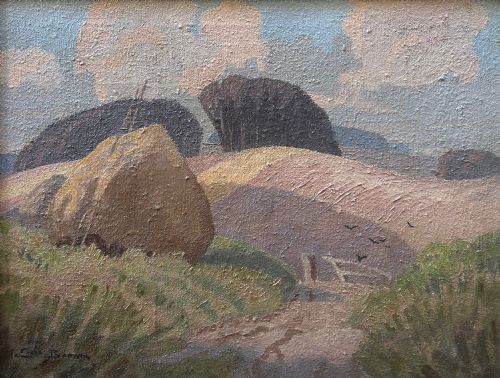


Impressionist Farm Scene
An impressionist farm scene captures rural labour and pastoral quiet through loose brushwork and direct observation of light.
Impressionist Farm Scene
An impressionist farm scene focuses on agricultural subjects such as haystacks, working horses, farmsteads, and harvesting. These works record the daily rhythms of the countryside through the lens of late nineteenth and early twentieth-century artistic movements.
Most examples encountered here are oil paintings on canvas, panel, or board, alongside watercolours on paper. The geographical scope spans British, Scottish, and French provincial traditions from the Edwardian era through the nineteen-thirties.
Common compositions depict specific named rural locations, from Yorkshire dales and Normandy troughs to Cumberland pastures, anchored by identifiable names like Herbert Royle and Owen Bowen.
Evaluating quality
Quality rests upon the confidence of the handling and the artist's ability to structure light across a landscape without losing the immediacy of the sketch. Stronger works demonstrate assured draughtsmanship beneath the loose pigment, particularly in depictions of livestock, carts, and figures.
The relationship between the atmospheric context and the physical structure of the farmyard separates routine topographical records from compelling artistic achievements. Palette harmony and surface preservation further distinguish the finer pieces.
Listings span works executed on canvas, wood panel, board, and paper utilising oil and watercolour media.
Raimond Louis Lecourt·Herbert Royle·Ernest Pile Bucknall·George Soper·Florence Hess·Arthur Winter Shaw·Robert Russell MacNee·Owen Bowen·Rowland Henry Hill·Frederick William Jackson·Ernest Higgins Rigg·T.B.Garvie·John Falconar Slater·William Greaves·Kershaw Schofield·James William Booth
The Impressionist Farm Scene Glossary
- Impressionism
- A style of painting that emphasises spontaneous brushwork and the depiction of light in its changing qualities. It emerged in the nineteenth century as artists moved outdoors to capture direct visual experience.
- Post-Impressionist
- A subsequent development that extended impressionist techniques while retaining a focus on distinct subject matter like rural landscapes. It often employs bolder outlines and more expressive colour.
- Oil on canvas
- Pigment ground in oil medium and spread upon a stretched woven fabric support. This combination offers durability and rich textural possibilities.
- Watercolour
- Paint consisting of colour pigment suspended in a water-based solution applied to paper. It yields transparent washes well suited to luminous atmospheric effects.
- Panel painting
- A flat piece of wood used as a rigid support for oil paint rather than fabric. Artists favoured panel for its smooth resistance and stability.
Impressionist Farm Scene: Frequently Asked Questions
What subjects appear in these paintings?
The compositions typically feature farmsteads, haystacks, ploughing horses, milking scenes, and harvest fields. Artists recorded active agricultural tasks alongside quiet rural corners.
Named locations frequently anchor the titles, connecting the imagery to specific regions in Britain and France during the early decades of the twentieth century.
How do oil and watercolour differ here?
Oil paintings utilise heavy pigment on canvas, wood, or board to build rich textures and deep chromatic layers. They present a robust surface suited to capturing heavy farm carts and rolling hills.
Watercolours on paper offer a lighter, more translucent medium that relies on the white of the paper to generate luminosity in sky and field.
How do I date an impressionist farm scene?
Dating relies upon stylistic markers, artist biographical records, and framing details preserved with the piece. Edwardian and interwar pastoral works often carry dated signatures or exhibition labels on the reverse.
Clothing styles of figures, agricultural equipment such as older horse-drawn carts, and the specific landscape palette also indicate the active period of creation.
Where should I hang a rural landscape?
These works suit well-lit spaces where natural daylight can illuminate the varied brushwork and colour harmony of the pigment. They pair naturally with traditional or eclectic interiors that complement historic canvas textures.
Protecting the painting from direct sunlight and damp environments ensures the preservation of both the paint layer and any original wooden frame.