
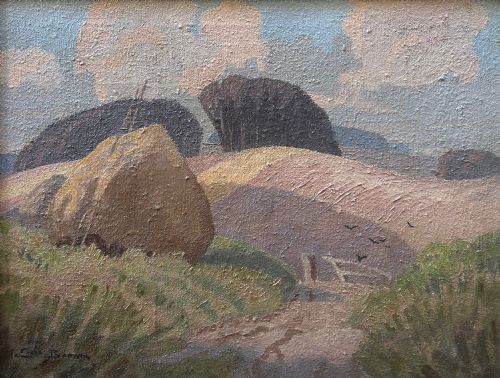


Impressionist Farm Scene Artwork
Impressionist farm scene artwork captures rural labour and pastoral landscapes through loose brushwork, predominantly emerging from British and French regional schools.
Impressionist Farm Scene Artwork
An impressionist farm scene artwork presents pastoral life, agricultural labour, and rural architecture through loose brushwork and atmospheric light. When searching this phrase, buyers encounter depictions of haystacks, working horses, milking time, and farmyards.
The selections on this page span the nineteenth century, Edwardian era, and the decades leading to 1930. British regional scenes, French provincial views, and Scottish landscapes dominate the available forms.
Oil paintings on canvas, panel, and board form the majority of the works, supplemented by watercolours on paper. Subjects range from intimate farmstead studies to large landscapes featuring harvesting and livestock.
How they were made
Artists applied oil paint and watercolour onto traditional supports including primed canvas, wooden panels, paper, and board. Brushwork remains visible and expressive, prioritising light and atmosphere over meticulous detail.
Many works were painted plein air to capture transient lighting conditions in farmyards and fields. Pigments were worked with fluid strokes to render skies, foliage, and agricultural equipment with immediate visual impact.
Several canvases record heavy horses pausing near troughs, immortalising equine breaks from Edwardian ploughing.
What varies in quality
Execution and handling of light separate standard regional records from accomplished artistic interpretations. Works by established painters demonstrate superior command of colour harmony and atmospheric depth within the rural setting.
Compositional strength and the integration of figures, such as farm hands or working horses, dictate the visual balance of the piece. The preservation of the original painted surface and framing context also influences the standing of each work.
Eric Brown·Raimond Louis Lecourt·Herbert Royle·Ernest Pile Bucknall·George Soper·Florence Hess·Arthur Winter Shaw·Robert Russell MacNee·Owen Bowen·Rowland Henry Hill·Frederick William Jackson·Ernest Higgins Rigg·T.B.Garvie·John Falconar Slater·William Greaves·Kershaw Schofield·James William Booth
The Impressionist Farm Scene Artwork Glossary
- Plein air
- Painting outdoors to capture direct observations of natural light and atmosphere. This method defined much of the impressionist approach to rural landscapes.
- Oil on panel
- A painting executed on a wooden board rather than stretched fabric. Panels offer a rigid support favoured by many early twentieth-century artists.
- Watercolour
- Pigments suspended in a water-based, translucent solution applied to paper. This medium allows for luminous washes particularly suited to pastoral skies.
- Impressionism
- An artistic movement focusing on everyday subjects, loose brushwork, and the shifting qualities of light. It emerged in France and heavily influenced British painters of the period.
- Post-Impressionist
- A stylistic development following impressionism that explored more expressive use of form and colour. Artists retained rural subjects while experimenting with structure and hue.
Impressionist Farm Scene Artwork: Frequently Asked Questions
What periods do these paintings date from?
The works span from the nineteenth century through the Edwardian period and into the 1930s. Most examples date from the early decades of the twentieth century.
British and French artists produced these scenes during a time of significant shift in rural life and artistic expression.
Are these works painted on canvas?
Canvas is a common support, though many pieces utilise wooden panels, boards, or paper for watercolours.
Artists selected their materials based on portability and the specific textural qualities required for capturing outdoor light.
How do I care for an oil painting?
Keep paintings away from direct sunlight and sources of extreme heat or humidity to protect the paint layer and canvas.
Dust the surface gently with a soft, dry brush and avoid using liquid cleaners on the pigment.
What subjects appear in these scenes?
Common subjects include farmyards, haystacks, ploughing horses, cattle, and farm buildings during harvest time.
Artists focused on the daily rhythms of agricultural labour and the natural beauty of rural landscapes.