

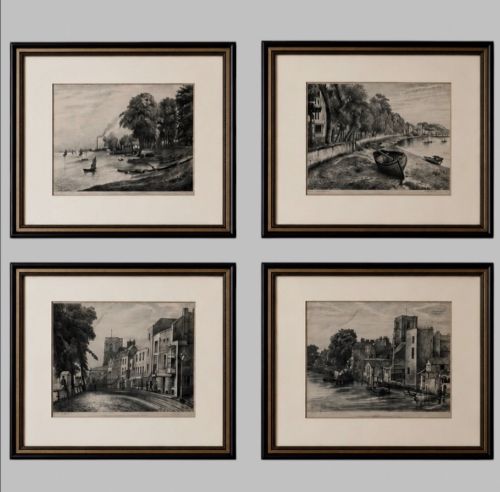


Historical River Artwork
Historical river artwork captures waterways and maritime scenes across centuries in oil, watercolour, and print.
Historical River Artwork
When you search for historical river artwork, you encounter topographical scenes, maritime views, and landscape paintings spanning from the seventeenth century to the twentieth century.
The selections on this page predominantly feature watercolours and oil paintings on canvas, panel, or paper, capturing notable rivers such as the Thames, the Medway, and the Hull.
Works range from Georgian lithographs and Regency prints to Victorian British School impressions and Edwardian maritime compositions.
Materials and execution
Painters utilised oil on oak panel or canvas, and watercolour paint or ink upon paper, applying techniques characteristic of Realism and British Impressionism.
Printmakers employed lithography and etching to produce detailed topographic images, often finished with dedicated printers such as William Day.
Framed art prints and original paintings demonstrate period mounting methods, glazing, and wooden framing suited to works on paper and canvas.
Historical River Artwork Retail Price Guide 2026
Typical asking prices for historical river artwork among the pieces listed under this phrase on Sellingantiques today, from the lower quarter to the upper quarter. They describe what is for sale here now, not the wider market.
Early printmakers ensured that even a routine shipping barge on the Thames had a distinct personality.
Distinctions in quality
Top-tier examples exhibit confident brushwork, precise topographical detail, and established provenance linking the artist to specific locations like London or Hever Castle.
The handling of light upon water and atmospheric depth separates masterworks from standard topographical illustrations.
Condition of the support - whether oak panel, canvas, or paper - alongside the preservation of the original pigments dictates the visual strength of the piece.
J.C Burgess·William Day·Henry Barlow Carter·Walter Duncan·George Lambert·Edward Fletcher·Herbert John Finn·Jacob Knyff
The Historical River Artwork Glossary
- Lithograph
- A print made from a flat stone or metal plate on which the image is applied with greasy ink. This technique allowed for the faithful reproduction of topographical views.
- Etching
- A print created by cutting lines into a metal plate with acid before applying ink. Artists utilised this method for fine linear detail in architectural and bridge scenes.
- Topographical watercolour
- A painting in water-soluble pigments that accurately records a specific geographical location. These works often served as historical records before the widespread use of photography.
- Oil on oak panel
- A traditional painting support utilising sturdy wood rather than canvas. This method provides a rigid surface often seen in seventeenth and eighteenth-century works.
- British Impressionism
- A late nineteenth and early twentieth-century painting style focusing on light and spontaneous brushwork. Artists working in this manner portrayed rivers with loose, vibrant strokes.
Historical River Artwork: Frequently Asked Questions
How do I date historical river artwork?
Dating relies on stylistic evidence, costume, shipping vessels depicted, and artist signatures or biographical records. Paper and panel analysis further assists in confirming the active period of production.
Changes in artistic movements, such as the shift from Georgian topographical precision to Victorian Impressionism, provide reliable chronological markers.
Where were these river scenes painted?
Many works focus on major English waterways, particularly the River Thames in London, alongside regional rivers in Yorkshire and Kent. Locations often include identifiable landmarks like St Paul's Cathedral or Hever Castle.
Artists frequently set up along riverbanks or aboard vessels to capture accurate topographical perspectives of working ports and rural estuaries.
How should I display watercolour river artwork?
Works on paper require conservation mounting behind glass to protect fragile watercolours and ink from ultraviolet light and humidity. Keeping them away from direct sunlight prevents fading of the pigments.
Stable indoor environments without extreme temperature fluctuations preserve both the paper support and the original framing.
What is an Admiralty yacht in these paintings?
An Admiralty yacht was an official vessel used for ceremonial transport and hydrographic surveying by naval officials. Their inclusion in seventeenth-century river scenes denotes official maritime activity.
Artists frequently placed these distinctive vessels in the foreground of Thames and shipyard compositions to add narrative scale and local authority.