


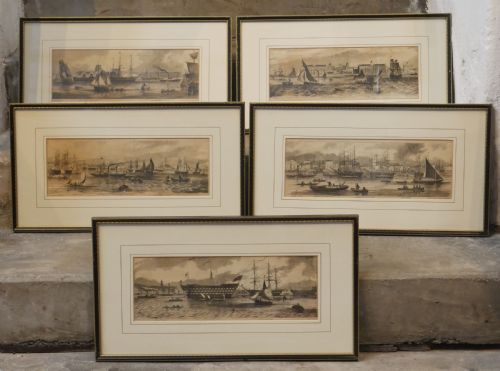


Historical Harbor Artwork
Historical harbour artwork captures the grit and movement of maritime life through centuries of shifting coastal trade and naval power.
Historical Harbor Artwork
When you search for historical harbour artwork, you are looking at visual records of ports, docks, and coastal shipping created across several centuries. The pieces available here span from the seventeenth century through the Edwardian era, encompassing both bustling commercial quays and quiet estuaries.
You are most likely to meet nineteenth-century British school watercolours and oils, alongside notable depictions of specific locations like London, Portsmouth, and Whitby. These works range from tightly detailed topographical views to atmospheric marine scenes dominated by steam and sail.
The subjects naturally lean toward shipping, dockyards, and coastal figures actively engaged in maritime trade. Painters recorded these working environments with varying degrees of topographical precision and romantic mood.
Materials and construction
These works rely on traditional painting supports, predominantly oil paint on canvas and watercolour pigment on paper. The watercolours frequently utilise paper mounted under glass within period frames, while the oil paintings employ heavy linen canvases stretched over wooden frames.
Frames often incorporate gilt ornamentation, reflecting the formal presentation standards of the Victorian and Edwardian periods. The application of paint ranges from the fine, translucent washes of nineteenth-century watercolours to the thick impasto typical of marine oil paintings.
Historical Harbor Artwork Retail Price Guide 2026
Typical asking prices for historical harbor artwork among the pieces listed under this phrase on Sellingantiques today, from the lower quarter to the upper quarter. They describe what is for sale here now, not the wider market.
Some Victorian artists clearly struggled to paint horses accurately on busy quaysides.
Distinctions in quality
Quality in these maritime pieces rests on the sureness of the draughtsmanship and the artist's ability to render the specific weight and rigging of vessels. Works attributed to named hands or accomplished circle painters display a superior command of light upon water and atmospheric perspective.
The handling of architectural details in dockyard buildings and the natural movement of coastal figures separate casual topographical records from genuine artistic interpretations. Framing and the overall preservation of the paper or canvas further distinguish the finer examples.
Alfred George Morgan·Samuel Owen·William Wyld·Edward Fletcher·Frank Wasley·Hubert Thornley·Bertram Priestman
The Historical Harbor Artwork Glossary
- Watercolour pigment
- Finely ground colour particles mixed with a water-soluble binder, applied to paper to achieve translucent washes of tone.
- Oil on canvas
- A painting medium utilising pigments suspended in drying oils, spread across a stretched fabric support.
- Maritime
- Pertaining to the sea, navigation, shipping, and the coastal infrastructure that supports marine commerce.
- Engraving
- A printmaking technique where an image is incised into a plate, producing sharp linear details on paper.
- Gilt
- A thin layer of gold leaf applied to wooden framing elements to provide a decorative metallic surface.
Historical Harbor Artwork: Frequently Asked Questions
What periods do these harbour artworks cover?
The listings span from the seventeenth century through the Edwardian era, with a strong concentration of nineteenth-century British school pieces.
Earlier seventeenth-century examples sit alongside detailed Victorian and Edwardian views of working docks and shipping.
How were these marine paintings originally displayed?
Most of these works were framed for domestic interiors, frequently utilising gilt wood frames that complemented the tones of the oil or watercolour within.
Framing styles evolved from classical moulded profiles to heavier Victorian ornamentation depending on the decade of creation.
How do I identify a watercolor from an oil painting?
Watercolours are executed on paper, usually displayed under glass to protect the water-soluble pigments from atmospheric moisture and dust.
Oil paintings utilise a textured canvas support that allows for heavier paint application and does not strictly require glass protection.
Where are the depicted locations usually situated?
The views concentrate heavily on British and European waterways, including the Pool of London, Portsmouth harbour, Whitby, and Rochester on the Medway.
Certain works also reference broader European coastal locations such as Ostia near Rome.