



Historic Ship Art
Historic ship art captures the drama of naval warfare and merchant trading across centuries of maritime heritage.
Historic Ship Art
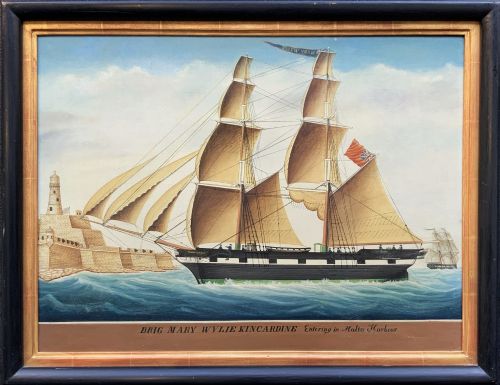
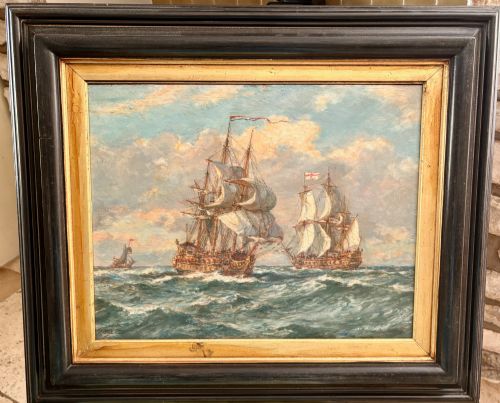
Historic ship art encompasses oil paintings, watercolours, and fine art prints depicting vessels ranging from 19th-century brigantines and galleons to Edwardian cruisers and ocean liners. Buyers encounter named subjects such as HMS Swift, the brig Mary Wylie, and the RMS Lusitania alongside specific locations like Valletta Harbour and the River Thames. These works record naval history, individual ship portraits, and dramatic sea battles through the eyes of period artists.
The material formats vary from oils on canvas and panel to watercolour and pencil signed etchings. Dating stretches from Georgian and Victorian maritime pieces through Edwardian depictions up to mid-century marine realism. Works feature both named vessels of the Royal Navy and anonymous sailing craft passing lighthouses.
Collector interest focuses on the specific documentation of naval architecture, named engagements like Trafalgar, and recognisable waterways. Pieces combine artistic skill with maritime record-keeping, offering a direct window into sailing history. The selection balances detailed ship portraits with broader atmospheric seascapes.
Materials and methods
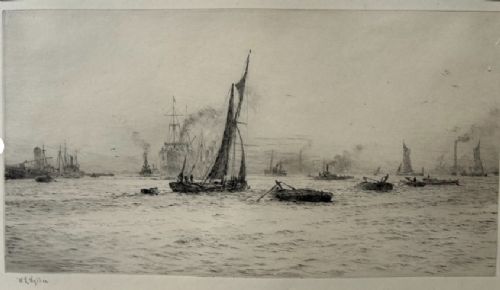
Artists deployed oil paint upon canvas and wood panels to build up detailed maritime scenes, often finishing the presentation within gold leaf frames. Watercolours on paper served for lighter studies, while ink and pencil were utilised for detailed etchings of river scenes.
Canvas supports received layered oil paint to capture the turbulent motion of water and the intricate rigging of warships. Panel supports provided a rigid base for meticulous harbour portraits, while paper accommodated delicate washes in watercolour works.
Historic Ship Art Retail Price Guide 2026
Typical asking prices for historic ship art among the pieces listed under this phrase on Sellingantiques today, from the lower quarter to the upper quarter. They describe what is for sale here now, not the wider market.
Napoleon occasionally photobombs naval art, appearing alongside stern maritime men in Edwardian oil paintings.
Distinctions in quality
Quality rests upon the precision of rigging and hull architecture, separating generic seascapes from accurate historical records by named marine painters. Works by documented artists command attention through their command of light, maritime perspective, and accurate vessel identification.
The condition of the canvas, paint surface, and original framing influences the overall presentation of each piece. Superior examples maintain intact brushwork and vibrant pigments that accurately render naval uniforms, signal flags, and coastal landmarks.
James Hardy·Bernard Gribble·William Lionel Wyllie·Charles William Wyllie·Dion Pears·Joseph Heard·WF Mitchell·Edward Fletcher
The Historic Ship Art Glossary
- Brig
- A two-masted, square-rigged sailing vessel commonly depicted in nineteenth-century marine art. These ships formed the backbone of both merchant trading and naval scouting fleets.
- Etching
- A printmaking method where lines are incised into a metal plate with acid before being inked and pressed onto paper. William Lionel Wyllie utilised this technique for detailed river views.
- West Indiaman
- A large merchant ship built for trade between Europe and the West Indies. Marine artists frequently portrayed these armed vessels off British lighthouses.
- Panel
- A flat wooden support used instead of canvas for oil paintings. This rigid medium allowed artists to achieve fine detail in harbour scenes.
- Marine Realism
- An artistic style focused on the accurate depiction of ships, water, and atmospheric conditions. Practitioners sought to record naval architecture and maritime topography with strict fidelity.
Historic Ship Art: Frequently Asked Questions
What is historic ship art?
Historic ship art comprises paintings, watercolours, and prints depicting naval vessels, merchant ships, and marine engagements from past centuries.
These artworks serve as both historical records of specific vessels and examples of maritime painting traditions.
How were these marine paintings created?
Artists employed oil paint on canvas or wood panels, watercolour on paper, and printed etchings to record ships and coastal environments.
Many works relied on firsthand observation of naval vessels, ports, and river traffic along waterways like the Thames.
Where should I hang maritime art?
Maritime art suits studies, hallways, and living spaces with stable lighting away from direct sunlight to protect pigments and canvas.
Framed works in gold leaf or traditional wood mouldings pair well with classical interiors and nautical decor themes.
How do I identify the ship in a painting?
Artists often inscribed vessel names, signal flags, or specific locations such as Valletta Harbour or Eddystone Lighthouse directly onto the work.
Detailed rigging, pennants, and naval architecture provide clues for identifying specific classes of ships like cruisers or brigantines.