





Historic Sampler Art
Historic sampler art brings domestic needlework into the room, showing maps, alphabets and verses stitched by young hands centuries ago.
Historic Sampler Art
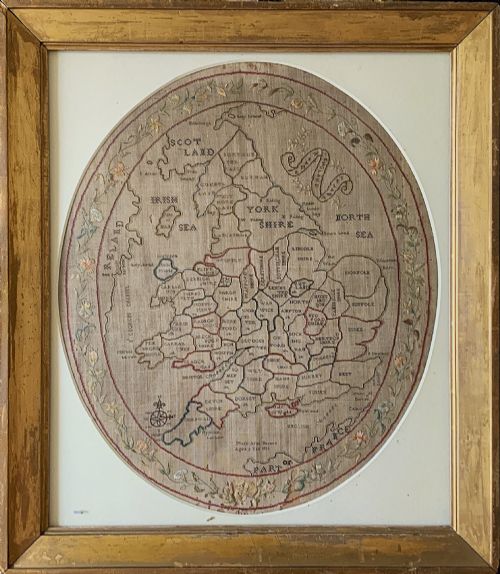
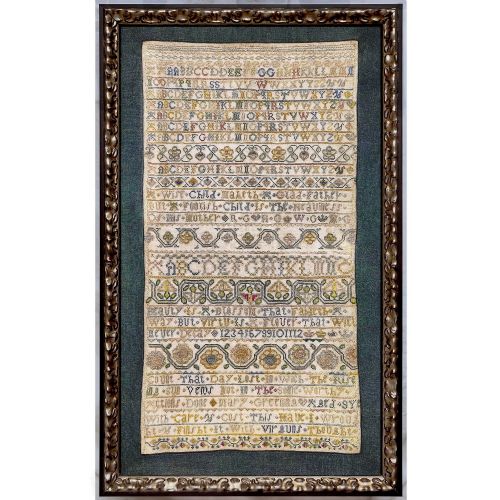
Historic sampler art comprises needlework panels created as exercises in skill, literacy and geography, often worked by young girls. These pieces range from early band samplers of the late seventeenth or early eighteenth century to nineteenth-century map samplers and moral verses.
Most examples found here date from the Georgian and Victorian eras, taking the form of framed textile art or needlework samplers. Makers recorded their names, ages and dates, leaving personal milestones stitched into linen grounds.
How they were made
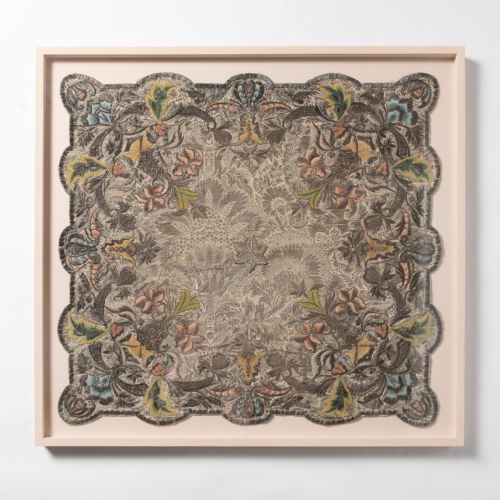
Makers stitched onto woven linen grounds using silk thread, wool and standard thread. The natural fibres support dense rows of cross stitch, satin stitch and intricate band patterns.
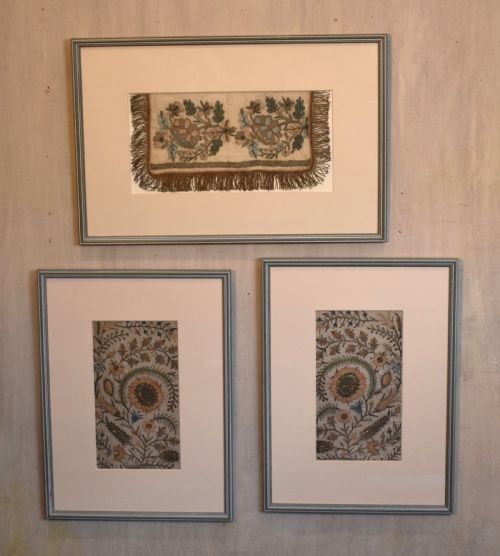
Makers housed these embroideries behind glass within wood frames to protect the delicate textiles from dust and handling.
Historic Sampler Art Retail Price Guide 2026
Typical asking prices for historic sampler art among the pieces listed under this phrase on Sellingantiques today, from the lower quarter to the upper quarter. They describe what is for sale here now, not the wider market.
Stitch errors survive quietly in the thread, proving that even Victorian children unpicked their mistakes.
What varies in quality
Quality rests upon the ambition of the design and the precision of the needlework. Map samplers and pictorial compositions require greater geometric planning than standard alphabets.
Condition alters the character of each piece. Intact silk threads, stable linen grounds and early frames preserve the original legibility of the maker's work.
The Historic Sampler Art Glossary
- Band sampler
- A long, narrow textile displaying horizontal rows of different embroidery stitches, often worked in the seventeenth century. These pieces served as pattern references for the maker.
- Needlepoint
- Embroidery stitched over a canvas or linen grid. The technique creates firm, geometric designs such as maps.
- Cross stitch
- A counted thread technique forming small X shapes. It is the primary stitch found across nineteenth-century examples.
- Georgian period
- The era spanning the reigns of the Hanoverian kings, roughly covering the eighteenth and early nineteenth centuries. Samplers from this time often include detailed cartography and moral texts.
Historic Sampler Art: Frequently Asked Questions
How old are these samplers?
The pieces span from the late seventeenth century through the Victorian era, with many examples originating in the Georgian period.
Makers frequently stitched their names, ages and precise dates directly into the linen, allowing for clear dating.
Why did girls make samplers?
Young makers used samplers to practice essential needle techniques, alphabets, numbers and religious verses.
Geographical maps were also stitched to demonstrate proficiency in education alongside needlecraft skills.
How should I hang framed textile art?
Keep textile pieces away from direct sunlight to prevent the silk threads and linen grounds from fading over time.
Maintain stable indoor humidity levels to protect the antique wood frames and the fragile fibres inside.
What is a map sampler?
Map samplers depict geographical regions, such as England and Wales, embroidered with borders, counties and place names.
These educational works required advanced planning to scale cartography accurately across a woven grid.