



Historic Nautical Artwork
Historic nautical artwork captures the power and majesty of the sea, offering a tangible connection to naval history through fine marine paintings and prints.
Historic Nautical Artwork
Historic nautical artwork comprises maritime paintings, watercolours, and etchings that record naval battles, ship portraits, and coastal scenes. These works span from the eighteenth century through to the mid-twentieth century, capturing the evolution of seafaring vessels and coastal architecture.
The pieces most frequently encountered on this page include oil paintings on canvas or panel, along with framed watercolours and fine art prints. Subjects range from named warships and passenger liners to specific lighthouses and riverscapes.
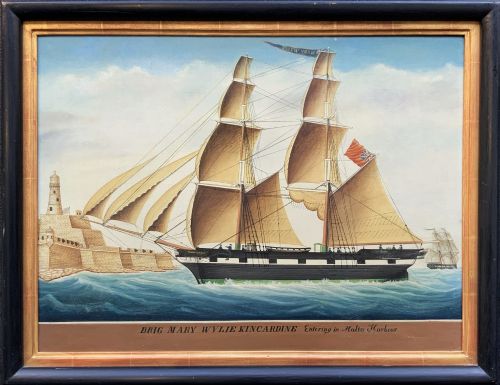
Originating across various periods such as the Georgian, Victorian, and Edwardian eras, these works reflect both dramatic historical moments and everyday maritime commerce. They document specific vessels like the HMS Lusitania and the Brig Mary Wylie with notable detail.
How they were made
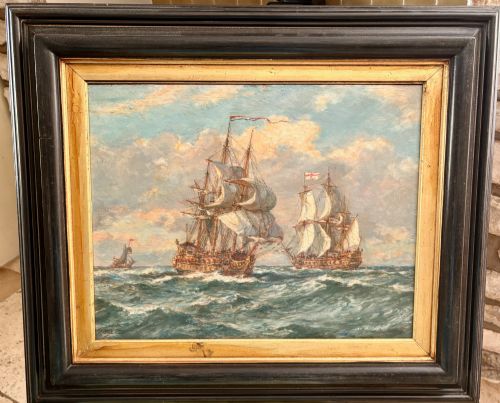
Artists utilised oil paint on canvas, wood panels, or paper, often building up rich layers to depict turbulent seas and dramatic skies. Watercolours were also applied to paper to achieve softer, more luminous coastal lighting.
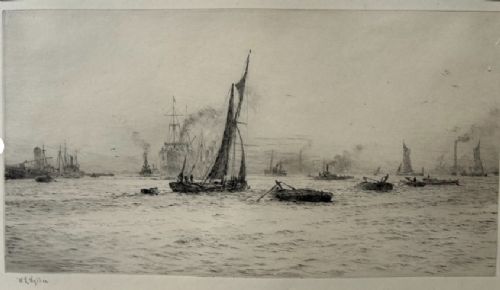
Frames frequently incorporated gold leaf to enhance the visual impact of oil paintings, while prints utilised traditional etching techniques on paper. Supporting materials like glass were added later to protect delicate works on paper and watercolours.
Historic Nautical Artwork Retail Price Guide 2026
Typical asking prices for historic nautical artwork among the pieces listed under this phrase on Sellingantiques today, from the lower quarter to the upper quarter. They describe what is for sale here now, not the wider market.
Several paintings record historic vessels sailing past specific lighthouses, ensuring the artists got the local coastlines right.
What varies in quality
The precision of maritime detail distinguishes works across the range, particularly in the accurate rendering of rigging, hull construction, and naval architecture. Works by accomplished painters demonstrate a deeper understanding of nautical perspective and maritime atmosphere.
Condition and preservation play a role in the overall quality, affecting the integrity of the canvas, panel, or paper support. The clarity of the artist's brushwork and the presence of original framing elements also contribute to the distinction between pieces.
William Lionel Wyllie RA·Joseph Heard·WF Mitchell·Edward Fletcher·Bernard Gribble
The Historic Nautical Artwork Glossary
- Ship portrait
- A painting or drawing created to document a specific vessel with accurate architectural and rigging details. These works were often commissioned by shipowners or captains.
- Etching
- A printmaking process where lines are incised into a metal plate with acid before ink is applied and transferred to paper. This technique allows for fine linear detail.
- Panel
- A rigid support surface, often wood, used by artists instead of canvas for painting. Panels provide a stable foundation for detailed oil works.
- Watercolour
- A painting method where coloured pigments are suspended in a water-based solution on paper. It yields translucent washes of colour well-suited to coastal skies.
Historic Nautical Artwork: Frequently Asked Questions
How do I identify the age of a marine painting?
Examine the materials, the style of the vessels depicted, and any signatures or dates on the canvas or panel. Rigging styles and uniform details often correspond to specific nineteenth or twentieth-century periods.
Framing methods and canvas stretchers can also provide physical clues to the era in which the artwork was produced.
Where should I hang historic nautical artwork?
Display these works away from direct sunlight and damp environments to protect oil paint, canvas, and delicate watercolours on paper. Stable indoor temperatures prevent warping in wood panels and paper degradation.
Consider eye-level placement in rooms with complementary traditional or maritime interior aesthetics.
How do oil paintings and watercolours differ in these works?
Oil paintings utilise heavy pigment on canvas or panel, offering rich textures and deep tones suitable for dramatic sea battles. Watercolours use translucent washes on paper, capturing lighter coastal atmospheres.
Oils generally prove more robust, whereas watercolours require protective glass to prevent environmental damage.