



Historic Marine Painting
Historic marine painting captures the movement of warships, merchant vessels and coastal harbours across centuries of maritime life.
Historic Marine Painting
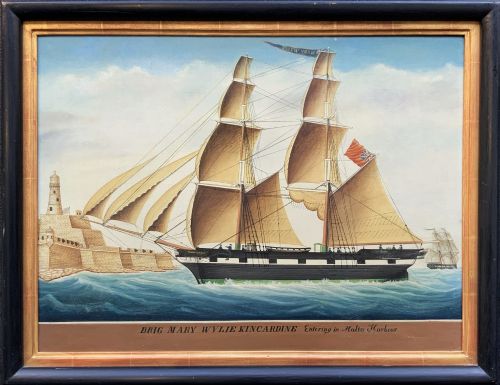
Historic marine painting encompasses oil on canvas, panel works and watercolours depicting naval engagements, individual ship portraits and busy commercial waterways. The works range from Georgian maritime scenes to Edwardian compositions, recording specific vessels like the brig Mary Wylie and RMS Lusitania alongside anonymous sailing ships.
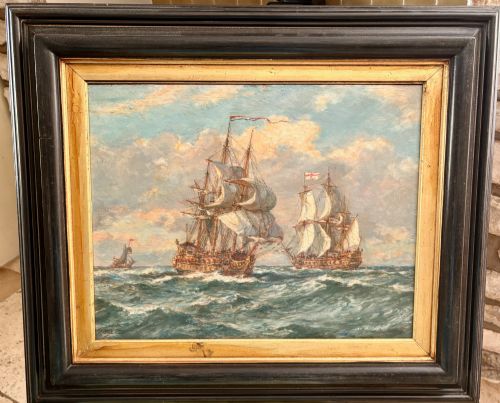
Most pieces on this page originate from the nineteenth century, extending into Edwardian interpretations and mid-century realism. Buyers encounter named subjects such as HMS Victory and Valletta harbour, framed in wood with gold leaf surrounds that complement the maritime palette.
Materials and Techniques
Painters relied primarily on oil paint applied to stretched canvas or wooden panels, utilising the slow-drying medium to build layered depths of sea and sky. Watercolours on paper also appear, capturing lighter coastal atmospheres and architectural details in harbour scenes.
Framing frequently involved wood enhanced with gold leaf, providing a traditional boundary that isolates the maritime scene. Pigments capture the tonal shifts of water, smoke from naval gunfire and the intricate rigging of warships.
Historic Marine Painting Retail Price Guide 2026
Typical asking prices for historic marine painting among the pieces listed under this phrase on Sellingantiques today, from the lower quarter to the upper quarter. They describe what is for sale here now, not the wider market.
Canvas battles capture permanent chaos while the gallery remains entirely dry.
Quality and Execution
The precision of maritime rigging and hull architecture distinguishes accomplished ship portraits from standard renderings, as artists must demonstrate deep technical knowledge of sailing vessels. Hand placement of light on water and the convincing weight of a vessel dictate the strength of a composition.
Attribution to documented practitioners such as Joseph Heard or Charles William Wyllie elevates a piece, alongside provenance connecting a depicted ship to specific historical events or naval deployments.
James Hardy·Bernard Gribble·Charles Euphraisie Kuasseg·Charles William Wyllie·Dion Pears·Joseph Heard·WF Mitchell·Robert Anderson·Edward Fletcher·John D. Walker
The Historic Marine Painting Glossary
- Ship portrait
- A painting commissioned to record the exact appearance of a specific merchant vessel or warship, often shown from the starboard or port side. These works prioritise accurate rigging and flag display over artistic licence.
- Brig
- A two-masted, square-rigged sailing vessel commonly depicted in nineteenth-century commercial and naval scenes. Their presence helps date and contextualise trade routes.
- Panel
- A rigid wooden support used by artists before stretched canvas became universal, frequently encountered in earlier or specific regional maritime works. Panels offer a smooth surface for fine brushwork.
- Watercolour
- A painting method using water-soluble pigments on paper, employed for rapid atmospheric studies and detailed harbour views. These works require careful preservation behind glass.
Historic Marine Painting: Frequently Asked Questions
How do I identify a ship portrait?
Look for specific vessel names inscribed on the frame or canvas, alongside precise depictions of flag signals and rigging configurations. Artists often recorded the exact tonnage or ownership of merchant vessels.
Compare the hull shape and mast count with naval records of the period to confirm the identity of warships or trading ships.
What periods do these paintings cover?
The works span from Georgian maritime depictions through Victorian and Edwardian interpretations up to mid-century realisms. Each era reflects shifting naval architecture and changing artistic techniques.
Nineteenth-century pieces dominate the selection, showing both commercial shipping and notable naval engagements.
Are watercolours as durable as oils?
Watercolours on paper require protection from direct sunlight and moisture to prevent fading and paper degradation. They are typically framed behind glass to preserve the delicate pigments.
Oil paintings on canvas or panel offer greater resilience against environmental factors, though both mediums benefit from stable indoor humidity.
Why are lighthouses common subjects?
Lighthouses served as vital navigational markers for coastal trade and provided artists with striking vertical focal points against open seas. They ground expansive horizon lines and add narrative tension to stormy compositions.
Works featuring structures like Eddystone Lighthouse often commemorate specific coastal hazards and engineering achievements.