

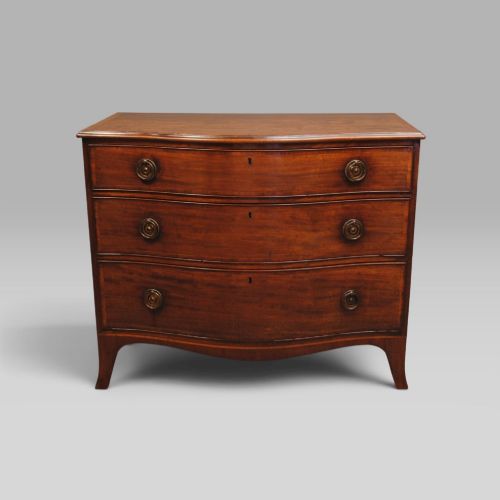
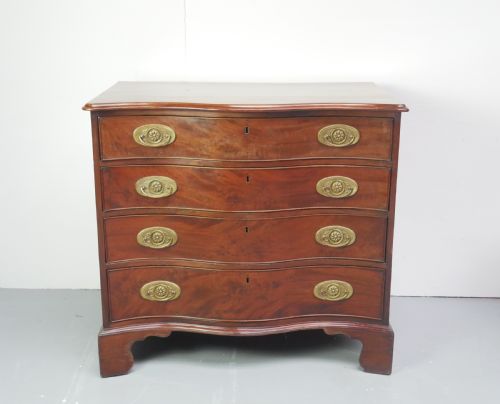


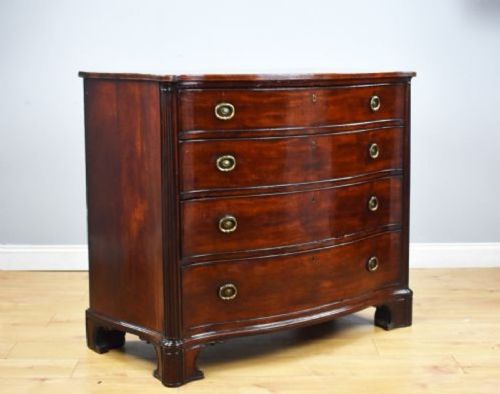
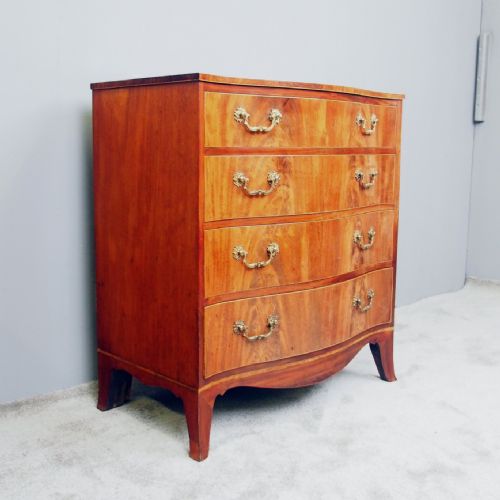


Hepplewhite Mahogany Serpentine Chest
These hepplewhite mahogany serpentine chest examples offer sweeping curved drawer fronts and rich timber figuring, satisfying a collector's demand for late-eighteenth-century elegance.
Hepplewhite Mahogany Serpentine Chest
A hepplewhite mahogany serpentine chest presents a distinctive undulating front that curves gracefully outward at the centre and inwards at the corners. These case pieces belong predominantly to the eighteenth century and the Georgian era, though later nineteenth- and early-twentieth-century revivals also appear on this page.
Most examples function as chests of drawers, whilst related variants emerge as sideboards and commodes. The core design reflects the graceful proportions associated with the Hepplewhite style and George III period.
Makers of the period shaped these carcases to command attention in principal rooms, combining practical storage with sophisticated cabinet work. Buyers seeking this form will find primarily eighteenth-century originals alongside later nineteenth-century interpretations dated around 1850 and 1910.
Materials and construction
Cabinet makers utilised dense, durable mahogany as the primary timber, often selecting boards with pronounced natural grain patterns for the drawer fronts. They constructed the carcases using traditional joinery methods to accommodate the complex curved lines of the serpentine shape.
Decoration relied on contrasting inlays executed in boxwood and satinwood to frame the drawer borders and top surfaces. Original brass hardware, including swing handles and lock escutcheons, completed the assembly on these case pieces.
Hepplewhite Mahogany Serpentine Chest Retail Price Guide 2026
Typical asking prices for hepplewhite mahogany serpentine chest among the pieces listed under this phrase on Sellingantiques today, from the lower quarter to the upper quarter. They describe what is for sale here now, not the wider market.
Materials recorded on this page include mahogany, brass, boxwood inlay, and satinwood.
Distinctions in quality
Superior examples display crispness in the execution of the serpentine curve, where the timber flows smoothly from edge to edge without distortion. The subtlety of the boxwood and satinwood inlay also indicates the hand of a more accomplished workshop.
Finer specimens retain well-matched mahogany veneers across the drawer fronts and harmonious proportions throughout the carcase. Later revivals from 1850 or 1910 demonstrate varying degrees of adherence to the eighteenth-century aesthetic, differing in timber selection and joinery precision.
The Hepplewhite Mahogany Serpentine Chest Glossary
- Serpentine front
- A furniture shape featuring a convex centre flanked by concave curves. This contour requires exceptional skill from the cabinet maker to shape timber accurately.
- Hepplewhite style
- A refined neoclassical furniture design characterised by light proportions and elegant curves. The style draws its name from the cabinet maker and designer George Hepplewhite.
- Commode
- A decorative low cabinet or chest of drawers developed in the eighteenth century. These pieces often served as ornamental storage in formal rooms.
- Boxwood inlay
- Narrow strips of pale boxwood set flush into the mahogany surface to create contrasting geometric borders. This technique highlights the structural lines of the chest.
- Georgian period
- The era spanning the reigns of the first four British Georges, renowned for stability and sophistication in decorative arts. Furniture from this time exhibits balanced proportions and quality timbers.
Hepplewhite Mahogany Serpentine Chest: Frequently Asked Questions
What is a serpentine chest?
A serpentine chest is a storage piece featuring a front that curves outward in the middle and inward near the ends. This undulating contour distinguishes it from standard flat-fronted furniture.
Cabinet makers of the eighteenth century adopted this form to introduce movement and visual interest into formal rooms. The curved drawers require precise carpentry to ensure smooth operation within the frame.
How do I date a mahogany chest?
Dating relies on examining the timber species, construction methods, and secondary woods used inside the drawers. Eighteenth-century examples typically show hand-cut dovetails and native woods on internal partitions.
Later revivals from the nineteenth or twentieth century often employ machine-sawn components and different internal framing techniques. Comparing the hardware fixings and inlay style further assists in establishing the period.
Where were these chests used?
These case pieces originated as principal bedroom or parlour furniture for affluent households. Their decorative fronts and fine timber veneers suited public reception spaces as well as private chambers.
Today, they function effectively in modern interiors as statement storage units in hallways, living rooms, or bedrooms. Their compact yet striking footprint allows them to integrate into various decorative schemes.
What is Hepplewhite furniture?
Hepplewhite furniture refers to the neoclassical style popularised during the late eighteenth century. It is defined by graceful curves, tapered legs, and delicate contrasting string inlays.
Pieces bearing these characteristics combine utility with restrained ornamentation. The style draws inspiration from the design book published posthumously by the cabinet maker's widow.