



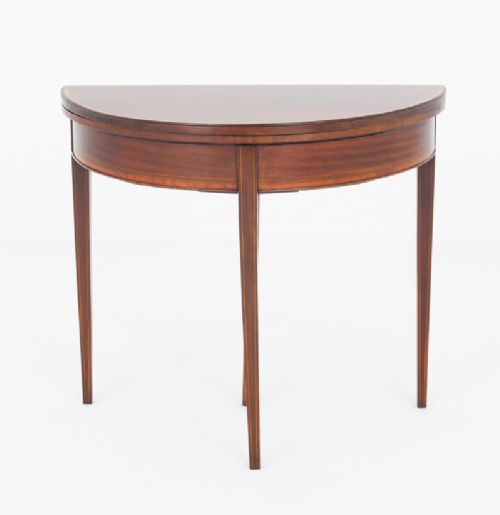


Hepplewhite Demi Lune
Hepplewhite demi lune furniture offers half-moon elegance through graceful mahogany and satinwood forms designed for period interiors.
Hepplewhite Demi Lune
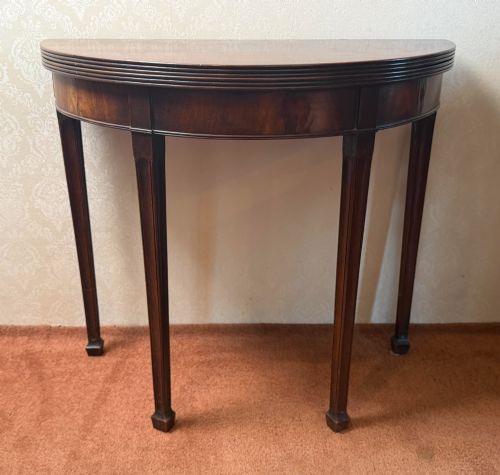
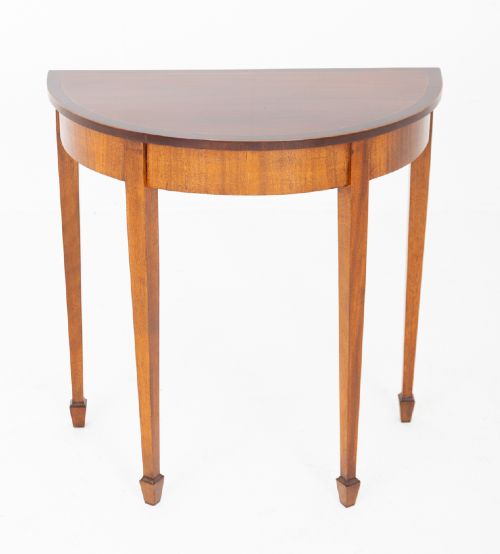
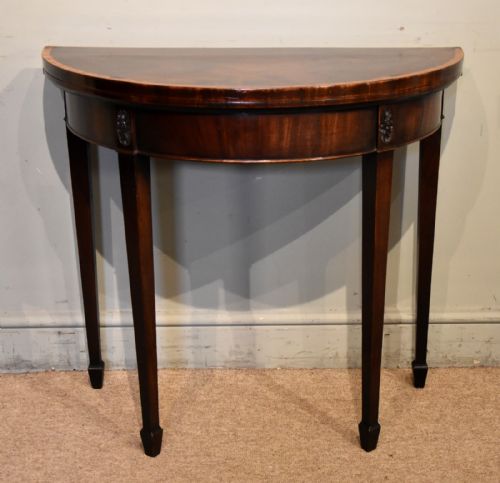
A hepplewhite demi lune presents a semicircular profile designed to stand flat against a wall as a console, pier, or side table. Many examples function as folding card or tea tables, revealing a doubled top supported on a swing leg.
Most pieces encountered on this page belong to the Georgian and George III eras, alongside later Hepplewhite Revival and Georgian Revival interpretations from the nineteenth and early twentieth centuries.
The form adapts to various domestic uses within the inventory, appearing primarily as console tables, card tables, and commodes rather than large dining furniture.
How they were made
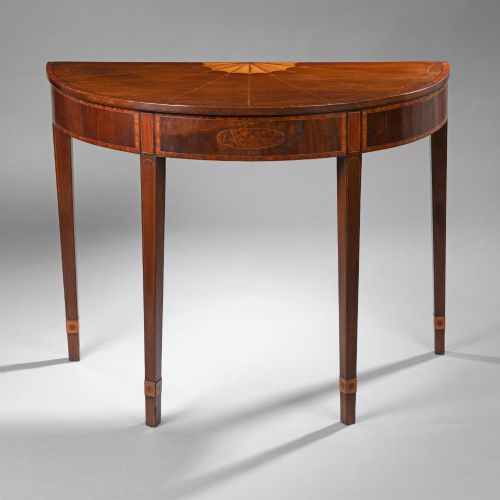
Cabinet makers utilised solid and veneered mahogany as the primary structural timber, frequently enriched with contrasting satinwood, boxwood inlay, and crossbanding.
Neo-classical ornamentation relies on delicate wood inlay and painted details to articulate the curved aprons and tapered legs characteristic of the style.
Some card tables hide secret compartments for counters.
What varies in quality
The distinction between tiers rests upon the crispness of the inlay work, the choice of figured timber veneers, and the refinement of the tapered legs.
Original hinges, working folding mechanisms, and balanced proportions determine the standing of an individual console or card table within the broader range.
The Hepplewhite Demi Lune Glossary
- Demi lune
- Half-moon shape used to describe tables with a flat rear edge and a curved front.
- Crossbanding
- A strip of veneer applied perpendicularly to the grain of the main surface to frame the top.
- Pier table
- A decorative table designed to stand against a wall, often between two windows beneath a mirror.
- Card table
- A folding table with a baize or wood surface made for evening games.
Hepplewhite Demi Lune: Frequently Asked Questions
How do I use a demi lune table?
These half-moon pieces fit neatly against narrow hallway walls or function as decorative side tables in a drawing room.
Fold-over variants open up to provide a stable surface for card games or tea service when entertaining guests.
Are these tables solid mahogany?
Cabinet makers built the main frames from timber while applying fine veneers and boxwood inlay to the curved surfaces.
Secondary woods support the internal structures of the drawers and folding tops.
How do I date a hepplewhite table?
Eighteenth-century examples display period construction methods and native timber patination developed over generations of use.
Revival pieces from the Edwardian era adopt similar neo-classical motifs but reveal different secondary woods and joinery.
What is the difference between revival and period pieces?
Period items date from the Georgian reign when the design originated, carrying the wear of actual eighteenth-century domestic life.
Revival versions were built later in the nineteenth and twentieth centuries to imitate the classic aesthetic.