



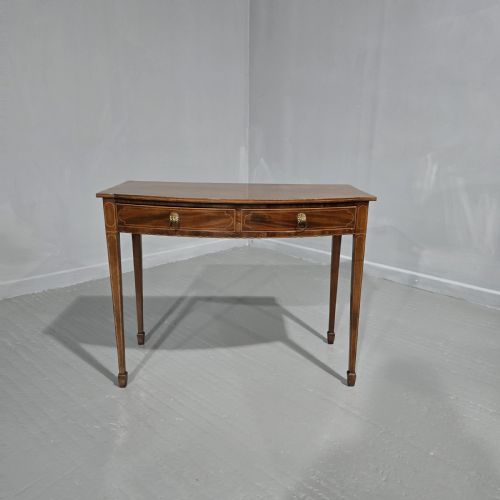

Hepplewhite Bowfront Table
A hepplewhite bowfront table brings sweeping elegance to a room, offering graceful curved storage rooted in eighteenth-century design.
Hepplewhite Bowfront Table
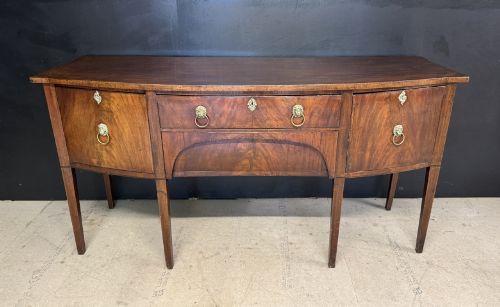
A hepplewhite bowfront table typically appears as a sideboard or side table, shaped with a rounded convex front that softens room corners. These pieces emerge predominantly from the Georgian period and later nineteenth-century revivals.
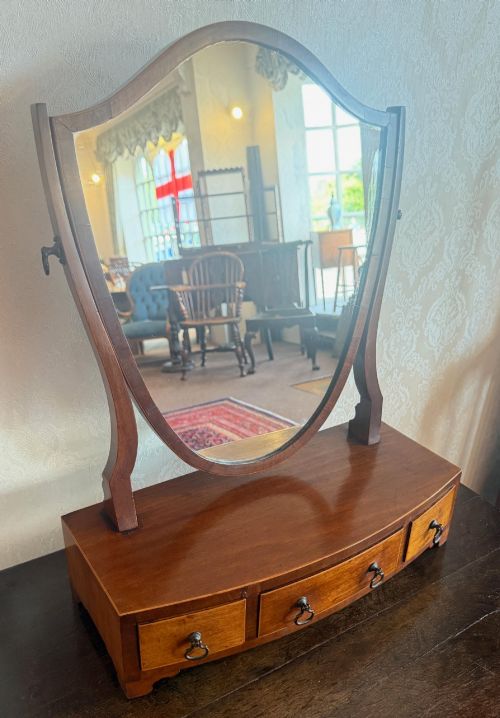
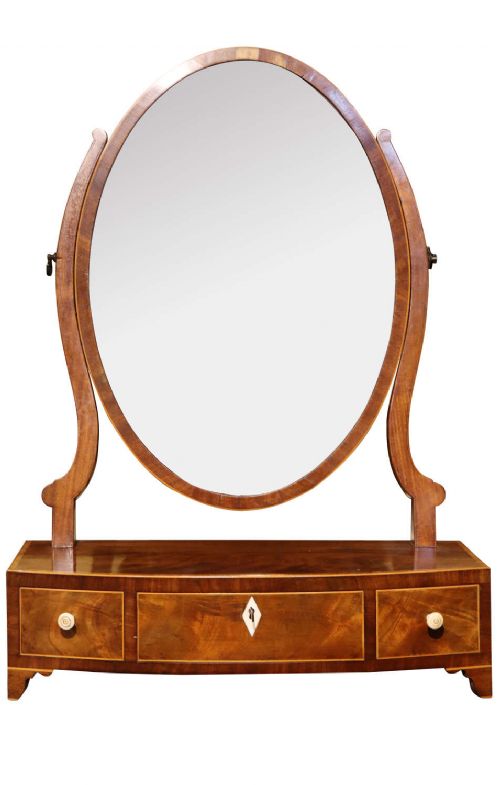
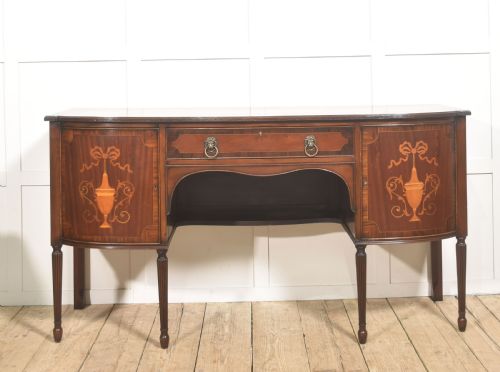
Sideboards dominate the selection, often featuring generous proportions and multiple legs. Side tables and dressing mirrors also appear, alongside occasional bedside cabinets and side cabinets.
The aesthetic relies on proportion and restrained curves rather than heavy carving. Makers of the Georgian era and subsequent revival periods followed the influential designs associated with George Hepplewhite.
Materials and construction
Mahogany serves as the primary timber across the pieces, providing a rich reddish-brown ground for cabinetwork. Artisans selected fine grains to showcase the natural beauty of the wood.
Inlay work adds delicate contrast using boxwood and satinwood, often forming linear borders or decorative motifs. Brass hardware, including handles and escutcheons, completes the construction on opening doors and drawers.
Some six-legged sideboards offer extra stability for midnight feasts.
Distinctions in craftsmanship
Quality rests in the precision of the curved front and the crispness of any inlay work. Finer examples display seamless timber matching across the bowed drawers and tabletops.
The integrity of the structural frame, leg proportions, and original brass fittings elevate certain pieces above later or simpler adaptations.
George Hepplewhite
The Hepplewhite Bowfront Table Glossary
- Bowfront
- A convex curved cabinet front that projects outward in an arc. This shape defines the silhouette of the piece.
- Crossbanded
- A border technique where veneer strips run perpendicular to the main grain. It frames tabletops and drawer fronts.
- Inlay
- Contrasting wood or material set flush into the primary surface. Boxwood and satinwood commonly create these decorative lines.
- Georgian
- The period spanning the reigns of the four British monarchs named George. It encompasses classic eighteenth-century design standards.
- Sideboard
- A long serving table with storage drawers and cupboards. These form the majority of the larger items in this group.
Hepplewhite Bowfront Table: Frequently Asked Questions
How do I spot a true Georgian piece?
Examine the timber quality, secondary woods used inside drawers, and the method of construction. Eighteenth-century cabinetmakers employed specific joinery techniques that differ from later nineteenth-century revival methods.
Look closely at the aged patina of the mahogany and the wear patterns around handles and feet. These indicators help distinguish original period pieces from later interpretations.
Where should I place a side table?
A side table works well in a hallway, dining room, or living space against a flat wall. The curved front allows it to soften linear room layouts without blocking walkways.
Ensure the depth of the piece matches your available floor space, keeping clearance for opening doors or drawers nearby.
How do I care for mahogany surfaces?
Dust regularly with a soft, dry cloth to prevent grit accumulation on the polished wood. Avoid placing the furniture in direct sunlight or near heat sources, which can dry out the timber.
Apply a traditional beeswax polish occasionally to nourish the grain and maintain the natural lustre of the finish. Avoid silicone-based sprays.
What is the difference between sideboards and side tables?
Sideboards incorporate built-in storage compartments, drawers, and cupboards designed for dining room service. They tend to be larger and heavier in scale.
Side tables offer an open frame with fewer or smaller drawers, serving a decorative or general display purpose rather than heavy storage.