

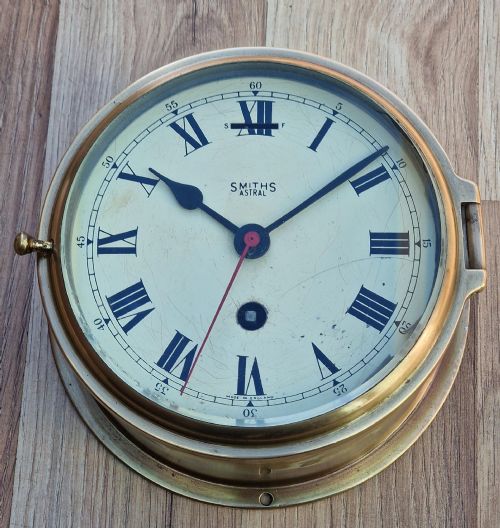
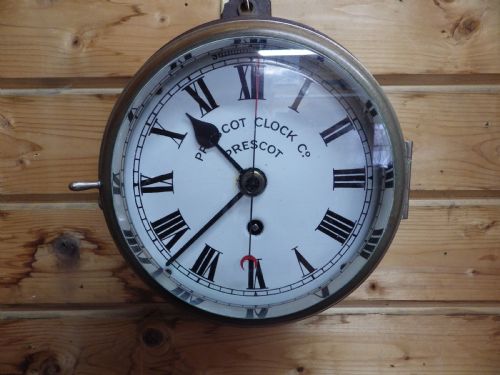


Heavy Brass Bulkhead
These heavy brass bulkhead timepieces are rugged marine instruments built for shipboard life, offering functional maritime history for the home.
Heavy Brass Bulkhead
When you search for heavy brass bulkhead, you are looking at robust marine timepieces and barometers designed to be mounted securely to the walls of a ship. These sturdy nautical instruments originate from various maritime eras, including Victorian, Edwardian, and mid-twentieth-century periods.
The versions you are most likely to meet on this page take the form of heavy ships clocks and wall barometers housed in substantial metal surrounds. Many examples reflect maritime or industrial design traditions, serving as dependable timekeepers originally engineered for harsh ocean environments.
Makers represented in these maritime instruments include established firms such as Smiths Astral, Prescot Clock Co, and Kelvin White & Hutton London. The forms range from standard wall clocks to specialised engine room pieces and fusee movement timepieces.
Materials and construction
These marine instruments combine solid brass cases with protective glass covers, occasionally utilising nickel-plated brass, steel, enamel for dials, and even wooden mounting elements. The use of heavy brass ensures resistance to the corrosive sea air and the physical shocks of shipboard conditions.
Internal mechanisms often feature chain fusee movements designed to maintain even tension on the gear train as the mainspring unwinds. Enamel dials provide clear legibility under difficult lighting, while robust metal construction secures the movement against vibration.
Heavy Brass Bulkhead Retail Price Guide 2026
Typical asking prices for heavy brass bulkhead among the pieces listed under this phrase on Sellingantiques today, from the lower quarter to the upper quarter. They describe what is for sale here now, not the wider market.
Engine room clocks often bear the subtle scars of industrial life, reminding us that time waits for no sailor.
Distinctions in quality
Quality in these marine timepieces rests upon the sophistication of the internal movement and the heft of the housing. Examples featuring complex twin fusee or chain fusee movements sit at the top of the range compared to standard timekeeping mechanisms.
The clarity of the enamel dial and the crispness of the maker engraving on the brass case further separate superior pieces from standard instruments. Substantial metal casting and specialised provenance, such as Air Ministry or established London makers, elevate the standing of an individual clock.
Smiths Astral·Prescot Clock Co·Kelvin White Hutton London·Sestrel
The Heavy Brass Bulkhead Glossary
- Bulkhead
- A vertical partition dividing the hull of a ship into several compartments. These clocks and barometers were designed to mount directly onto these structural walls.
- Fusee
- A conical pulley used on the mainspring of a clock to equalize the torque as the spring unwinds. This mechanism improves the timekeeping accuracy of the movement.
- Enamel dial
- A metal dial fused with powdered glass powder at high heat to create a glossy white surface. Markings are typically baked into the glaze for durability.
- Maritime
- Relating to the sea, ships, or navigation. This style encompasses the robust fittings designed specifically for nautical use.
- Barometer
- An instrument measuring atmospheric pressure, often housed in a matching brass case to accompany a bulkhead clock.
Heavy Brass Bulkhead: Frequently Asked Questions
What is a bulkhead clock?
A bulkhead clock is a heavy marine timepiece engineered specifically to be mounted to the wall of a ship's cabin or engine room.
These instruments are built with thick brass casings and secure mounting systems to withstand the constant motion and damp conditions at sea.
How do fusee movements work?
A fusee movement uses a conical pulley connected to the mainspring by a fine chain or cord.
This clever mechanical device compensates for the dropping power of the uncoiling spring, ensuring the clock maintains steady accuracy.
Where were these clocks used?
These instruments were utilised across various vessels, from commercial cargo ships to naval vessels and engine rooms.
They provided reliable timekeeping and atmospheric readings for navigation and shipboard coordination during voyages.
How do I care for a brass clock?
Keep the heavy brass case clean by dusting gently with a soft cloth, avoiding harsh chemical polishes that can strip the aged surface.
Ensure mechanical movements receive professional servicing periodically to keep the gears and chains functioning smoothly.