

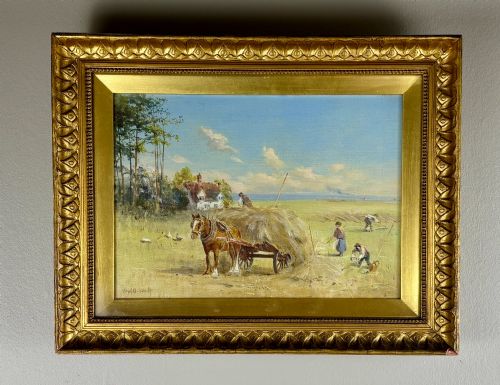


Haymaking Scene Oil Canvas
A haymaking scene oil canvas captures the timeless rhythm of agricultural toil through the distinct lens of nineteenth and early twentieth-century painters.
Haymaking Scene Oil Canvas
A haymaking scene oil canvas depicts traditional agricultural labour, rural harvests and pastoral landscapes across the British countryside during the Victorian and Edwardian periods. These oil paintings preserve a vanishing way of life when fields were cleared by hand and horse rather than machinery.
The pieces available here span from the 1870s into the 1920s, showcasing the evolution of artistic responses to the rural landscape from Victorian pastoralism towards British Impressionism and Impressionist Realism. Collectors find works ranging from intimate rural vignettes to broader Yorkshire river valleys and harvest fields.
Most examples present traditional formats executed on canvas, frequently housed within period gilt wood frames that complement the natural tones of the landscape. Each painting records specific regional topography, from Wharfedale to East Keswick, captured by artists working plein air or within established traditions.
Materials and technique
Artists built these compositions using oil paint applied to stretched canvas, utilising the medium's capacity for rich colour blending and textured impasto. The layering of oil paint allowed painters to capture changing atmospheric conditions, from bright harvest suns to overcast rural skies.
Frames are constructed from wood and finished with gilt, providing a reflective boundary that enhances the pictorial depth of the oil paintings. The combination of durable oil pigments on canvas ensures that the surface retains its tonal variation over the decades.
Haymaking Scene Oil Canvas Retail Price Guide 2026
Typical asking prices for haymaking scene oil canvas among the pieces listed under this phrase on Sellingantiques today, from the lower quarter to the upper quarter. They describe what is for sale here now, not the wider market.
Regional British landscapes from Yorkshire to the broader countryside form the primary topographical focus of these harvest scenes.
Distinctions in quality
Quality rests upon the artist's ability to render light and movement within the naturalistic landscape, distinguishing formulaic academic work from observant Impressionist Realism. The handling of foliage, cloudscapes and figures at labour demonstrates the painterly skill present in the composition.
The integrity of the original oil paint surface and the preservation of the canvas contribute significantly to the standing of a piece. Period gilt wood frames that match the age and character of the painting also elevate the overall integrity of the work.
Hugh Barry Scott·J C Grey·James William Booth·Herbert Royle·Arthur Walker Redgate·Frederick J Knowles·William Greaves·John Clayton Adams
The Haymaking Scene Oil Canvas Glossary
- Impressionism
- A style of painting that focuses on capturing the visual impression of the moment, particularly regarding shifting light and spontaneous brushwork. This approach emerged strongly in late nineteenth-century British art.
- Gilt wood
- Wood carved and covered with a thin layer of gold leaf or gold paint, commonly used for nineteenth-century picture frames. Such frames protect the canvas edges and complement the warm tones of oil paintings.
- Pastoral
- A genre of art that idealises rural life and agricultural scenes, portraying harmonious landscapes and manual labour. These depictions reflect nineteenth-century romanticism towards the countryside.
- Impasto
- The process of laying paint thickly on the canvas so that it stands out from the surface, creating tangible texture. Artists utilise this technique to emphasise highlights on haystacks or fields.
Haymaking Scene Oil Canvas: Frequently Asked Questions
What periods do these paintings cover?
The listings span from the late nineteenth century through the Edwardian era, specifically encompassing works dated between 1870 and 1920. This era covers Victorian pastoralism and the transition into British Impressionism.
Artists during this period recorded the changing agricultural landscape as industrialisation began to alter traditional rural practices across regions like Yorkshire.
How should I care for an oil painting?
Keep oil paintings away from direct sunlight and fluctuating humidity levels to protect both the canvas and the oil paint layer. Gentle dusting with a soft, dry brush is generally sufficient for surface maintenance.
Avoid using water or chemical cleaners on the painted surface or the gilt wood frame to preserve the original materials.
Are these paintings signed by the artists?
Many of the works retain the original signature or attribution of the nineteenth and early twentieth-century painters who created them. Signatures are typically located in the lower corners of the canvas.
Attributions are established through historical records, stylistic analysis, and the documented provenance associated with each individual piece.
What is Victorian pastoralism?
Victorian pastoralism is an artistic movement that romanticised rural life, agricultural labour, and the natural beauty of the countryside. Painters focused on seasonal activities such as the hay harvest.
These works provided urban audiences with an idealized view of agrarian traditions during a period of rapid industrial growth.