




Hanging Weather Station
These hanging weather station instruments range from practical domestic barometers to carved oak banjo forms that help you track atmospheric pressure with period character.
Hanging Weather Station
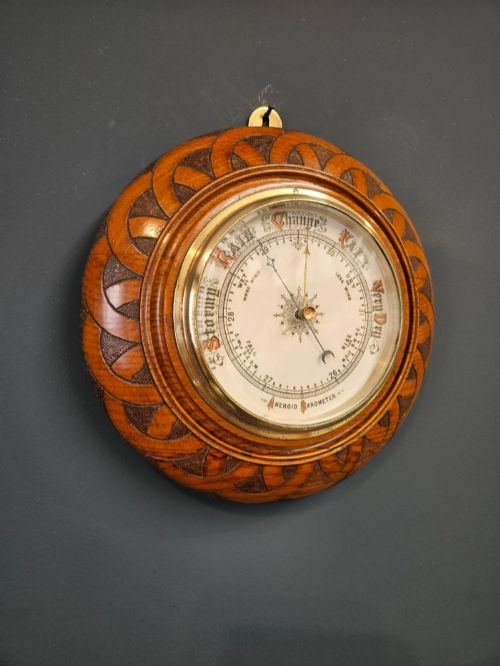
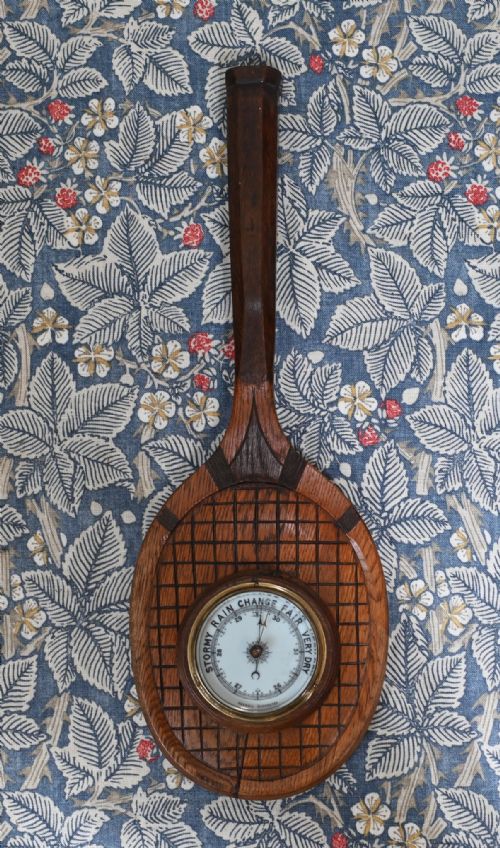
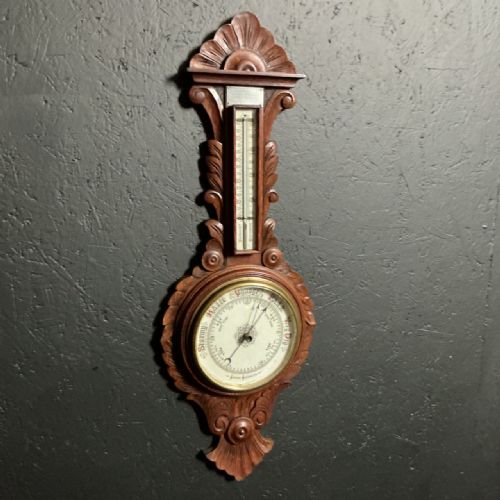
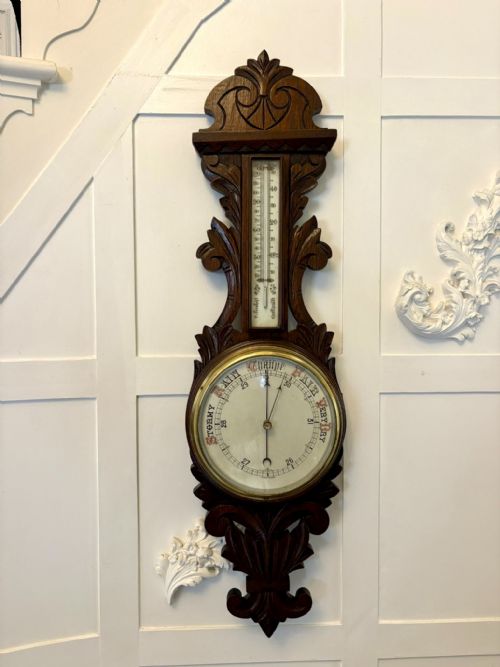
A hanging weather station combines functional meteorological instruments such as barometers and thermometers into wall-mounted wooden frames spanning the Victorian, Edwardian, and 1930s periods. You are most likely to encounter carved oak banjo barometers alongside circular beechwood and walnut examples from these eras.
These instruments served as essential household fixtures for predicting local atmospheric changes before modern electronic forecasting existed. The selection bridges simple utilitarian wall barometers with ornate Black Forest carvings and multi-function wall clock combinations.
Materials and construction
Cabinet makers utilised dense hardwoods such as oak, mahogany, walnut, and beechwood to house the delicate internal mechanisms securely. These wooden bodies often feature turned details or elaborate hand-carved motifs reflecting Victorian and Edwardian taste.
Silvered metal dials and protective glass bezels display the barometric scales and thermometer markings clearly. Instrument makers integrated aneroid mechanisms or traditional stick barometer tubes within these wooden housings to measure pressure accurately.
Hanging Weather Station Retail Price Guide 2026
Typical asking prices for hanging weather station among the pieces listed under this phrase on Sellingantiques today, from the lower quarter to the upper quarter. They describe what is for sale here now, not the wider market.
Listings span multiple eras from the 1860s through to the 1930s, featuring oak, mahogany, walnut, and beechwood.
Distinctions in quality
The refinement of the cabinet work and the crispness of the wood carving dictate the upper tier of quality. Pieces produced by established instrument makers or retailing firms display superior dial legibility and more substantial bezels.
Simpler turned beechwood or plain oak iterations represent utilitarian domestic production rather than high-end decorative output. The integration of auxiliary instruments like thermometers alters the complexity of the piece.
JB Bergna·Maple and Co·Negretti and Zambra·James Pitkin London
The Hanging Weather Station Glossary
- Aneroid barometer
- An instrument that measures atmospheric pressure using a flexible metal box without liquid. This design enabled compact wall-hanging weather station formats.
- Banjo barometer
- A household weather instrument housed in a distinctive curved wooden case resembling a banjo shape. These frequently include a thermometer and hygrometer alongside the main dial.
- Silvered metal
- A treated metallic dial surface providing high contrast for engraved inscriptions. This finish prevents glare and ensures clear reading of weather data.
- Stick barometer
- A tall, slender instrument containing a vertical column of mercury to measure atmospheric pressure. These traditional forms represent earlier 19th Century manufacturing methods.
Hanging Weather Station: Frequently Asked Questions
How do I hang a heavy oak barometer?
Secure the hanging weather station directly into a wall stud or use a heavy-duty wall anchor rated for the weight of the dense hardwood case. Ensure the mounting bracket catches the designated hanging point firmly on the reverse.
Check the instrument with a spirit level once mounted to keep the case straight against the wall surface.
Do these old barometers still work?
Many aneroid mechanisms remain surprisingly responsive to local atmospheric pressure changes after decades of domestic use. Gentle calibration using a known local reading can align the needle correctly.
Internal linkages may require professional adjustment if the instrument fails to register shifts in weather patterns.
How do I tell Victorian from Edwardian styles?
Victorian hanging weather station pieces typically feature heavier, deep relief carved oak cases with dense foliate ornamentation. Edwardian examples often display lighter wood tones and more restrained decorative carving.
Late Victorian production bridges these aesthetics through transitional dark oak banjo shapes with bevelled glass edges.
Where should I place my weather station?
Position the instrument on an interior wall away from direct sunlight, radiators, and exterior doors to avoid artificial temperature distortions. Stable indoor environments ensure the internal metal components respond accurately to true barometric pressure.
Living rooms and hallways provide ideal locations where the carved timber cases complement period interior schemes.