

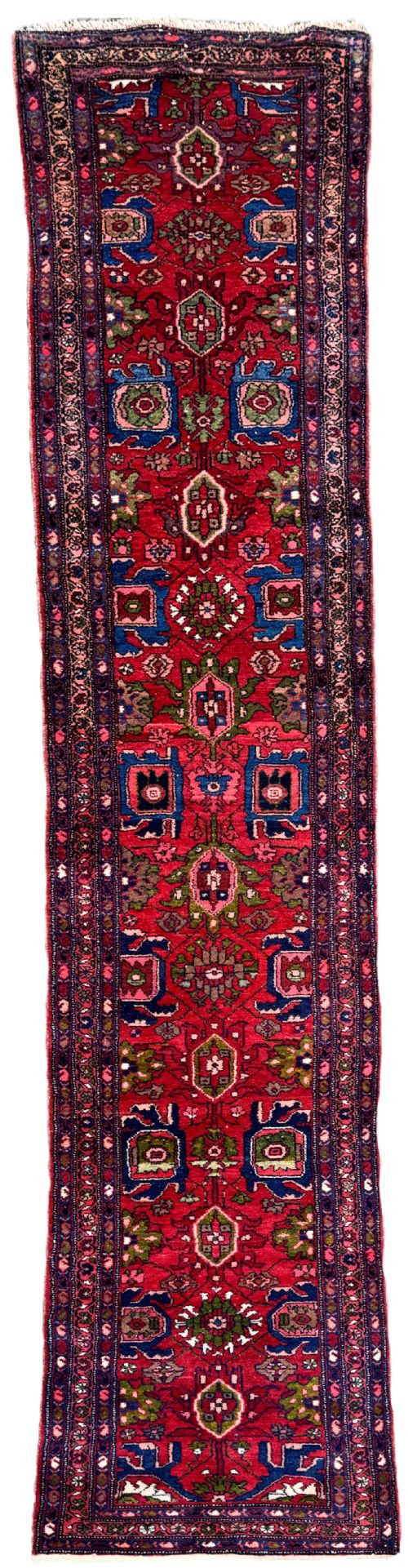


Hamadan Long Runner
These hamadan long runner examples are durable Persian village and region floor coverings offering striking traditional patterns suited for corridors.

Hamadan Long Runner
A hamadan long runner provides a narrow, extended format designed specifically for corridors, hallways, and large country house spaces. These antique pieces originate from Western Persia and carry distinct traditional and tribal motifs.
The version most commonly met on this page is the narrow antique runner dating from the late nineteenth century up to the 1930s. Examples range from modest lengths to exceptionally long formats exceeding six metres.
Makers in the region employed traditional village weaving methods to produce durable formats that withstand heavy foot traffic. Each piece reflects the functional requirements of Persian households adapted for long rooms.
What varies in quality
Quality separates across the fineness of the weave and the precision of the traditional motifs executed by the village weavers. Tightly packed wool pile significantly improves longevity under daily foot traffic in busy hallways.
The balance of proportion between length and width dictates visual harmony in a long corridor setting. Superior examples maintain crisp geometric or floral patterns across exceptional lengths without distortion.
Hamadan Long Runner Retail Price Guide 2026
Typical asking prices for hamadan long runner among the pieces listed under this phrase on Sellingantiques today, from the lower quarter to the upper quarter. They describe what is for sale here now, not the wider market.
Some runners stretch beyond nineteen feet, requiring a very long hallway indeed.
The Hamadan Long Runner Glossary
- Hamadan
- A major trading hub and region in Western Persia where numerous surrounding villages brought their hand-knotted rugs to market. These pieces often share robust wool structures and varied traditional designs.
- Runner
- A long, narrow carpet format traditionally utilised in hallways, corridors, and alongside larger beds. Their dimensions prioritise length over width to fit restricted floor spaces.
- Kelleh
- A large-sized Persian rug format that sits between standard runner proportions and full room-size carpets. They offer expanded decorative fields for wider spaces.
- Mina Khani
- A repeating traditional floral lattice design frequently found in Persian weaving. This pattern creates an ordered grid of stylized blossoms across the field.
- Serab
- A weaving origin associated with fine runner production in the region. Pieces from this area often exhibit distinctive narrow proportions and specific village palettes.
Hamadan Long Runner: Frequently Asked Questions
Where should I place a long runner?
These pieces suit narrow hallways, long corridors, and country house entryways where extended floor coverings provide warmth and visual interest.
Their elongated proportions bridge open spaces while protecting high-traffic wooden floors from daily wear.
How do I care for antique wool runners?
Regular gentle vacuuming without a rotating brush roll helps remove embedded dust from the wool pile safely.
Professional cleaning tailored for antique textiles preserves the natural lanolin and structural integrity of the cotton foundations.
Are these runners durable for hallways?
The combination of dense wool pile and sturdy cotton foundations creates a robust surface built for heavy foot traffic.
Traditional village weaving methods in Western Persia specifically prioritised longevity for everyday domestic use.
How can I tell the age of a runner?
Dating relies on examining the specific wool texture, natural dye variations, and structural wear patterns typical of late nineteenth and early twentieth-century production.
Design motifs and regional attribution markers also help narrow the period of manufacture.