





Half Hunter Timepiece
These half hunter timepiece pieces are pocket watches with protective glazed outer cases, offering quick time checks without opening.
Half Hunter Timepiece
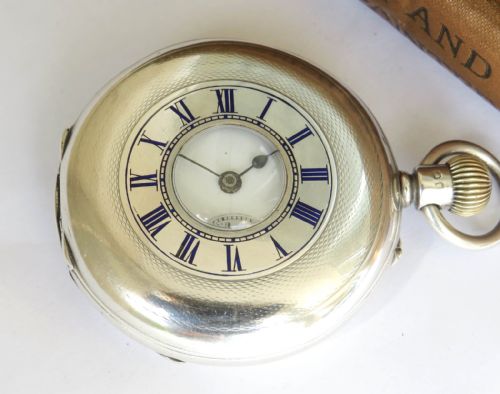
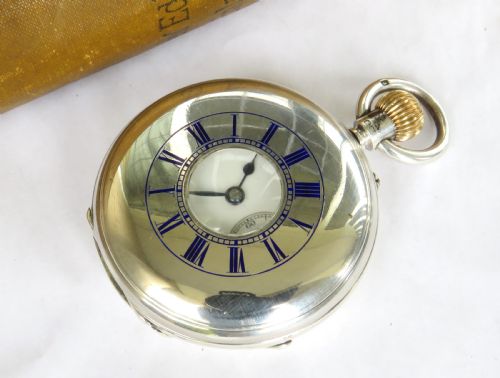
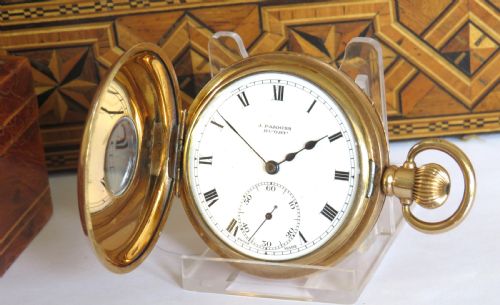
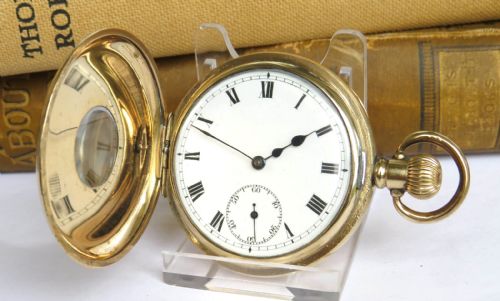
A half hunter timepiece is a pocket watch designed with a small glass window in the front cover that reveals the hands. This configuration allows the wearer to tell the time at a glance whilst keeping the dial protected from scratches and knocks.
You are most likely to meet examples spanning the late Victorian and Edwardian eras, alongside Interwar and 1920s Art Deco pieces. These pocket watches appear in materials ranging from sterling silver and gold plate to solid nine-carat and fourteen-carat gold.
The objects listed display various forms including standard pocket watches housing enamel dials and Roman numerals. Makers and firms such as JW Benson, Revue, Record, Cyma, Baume and Co, and Eastern Watch Case Co appear across the selection.
How they were made
Movements incorporate jewelled bearings, such as fifteen-jewel and eight-jewel configurations, to reduce friction in the gear train. Casemakers constructed these robust housings to shield the delicate internal timekeeping components.
Half Hunter Timepiece Retail Price Guide 2026
Typical asking prices for half hunter timepiece among the pieces listed under this phrase on Sellingantiques today, from the lower quarter to the upper quarter. They describe what is for sale here now, not the wider market.
Periods represented span from the nineteenth century through the Edwardian era and into 1930s Art Deco.
What varies in quality
The grade of the metal case creates a distinct separation, moving from gold-plated brass up to solid gold housings. Heavier precious metal cases offer greater durability and intrinsic substance compared to thinner alternatives.
Movement sophistication also dictates the grade, with higher jewel counts providing better longevity for the internal mechanism. The crispness of the enamel dial and the precision of the case closure further separate standard examples from finer ones.
JW Benson·Eastern Watch Case Co·Baume and Co·L Roberts Geneve
The Half Hunter Timepiece Glossary
- Half hunter
- A pocket watch featuring a protective outer lid with a central glass aperture. This design lets you check the hours without opening the case.
- Enamel
- A glassy substance fused to a metal dial substrate through firing. It provides a bright, durable white surface for painted numerals.
- Jewel
- A small synthetic or natural bearing stone placed at pivot friction points within the movement. Higher numbers typically indicate a more refined calibre.
- Sterling silver
- An alloy consisting of silver and other metals to increase hardness. It serves as a primary casing material for Victorian and Edwardian pieces.
- Roman numeral
- A numeric system utilising combinations of letters from the Latin alphabet. These appear frequently on the chapter rings of early watch faces.
Half Hunter Timepiece: Frequently Asked Questions
How do I read a half hunter watch?
You view the hours and minutes through the glazed aperture in the front cover. For a precise reading of the seconds or to set the time, you press the crown to release the spring-loaded lid.
The exterior chapter ring often displays enamel markers corresponding to the hidden dial positions beneath the bezel. This dual system lets you calculate the time even when the cover remains shut.
What is the difference between a hunter and a half hunter?
A standard hunter watch possesses a solid metal front lid that must be opened fully to see the hands. This completely shields the glass dial face from any direct impact.
A half hunter incorporates a glass-centred porthole in that same outer lid. This specific modification trades total dial protection for immediate visibility during daily wear.
How do I wind a vintage pocket watch?
You wind the watch by turning the crown at the top clockwise until you feel gentle resistance. Care must be taken not to force the mainspring past its limit.
Most Interwar and Victorian movements require winding daily to maintain consistent operation. Regular handling ensures the mechanical components remain lubricated and active.
How can I tell the period of my watch?
Assay marks and hallmarks stamped inside the precious metal cases provide official dating evidence for silver and gold pieces. These stamps record the assay office, metal purity, and year letter.
Stylistic details such as Art Deco geometric numerals or Victorian floral engraving offer further chronological clues. Movement signatures and maker stamps help narrow down the decade of manufacture.