


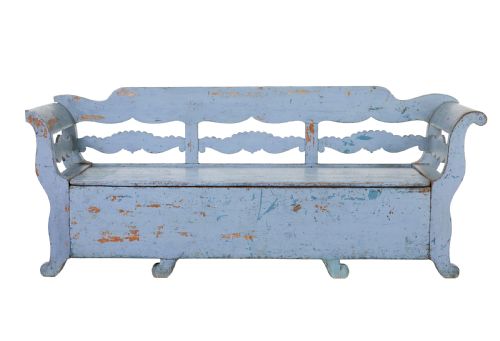


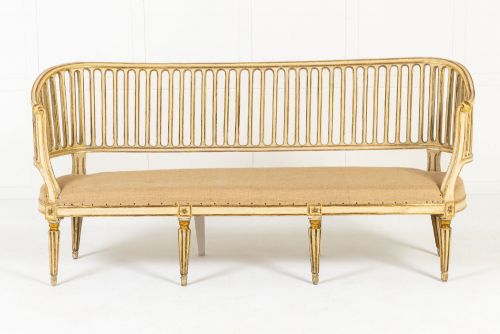


Gustavian Sofa
These gustavian sofa pieces combine painted wood and clean neoclassical lines to bring understated Scandinavian light into a room.
Gustavian Sofa
A gustavian sofa sits within the wider family of Scandinavian country and neoclassical seating, defined by pale painted finishes and restrained classical proportions. The versions most commonly encountered on this page date from the eighteenth and nineteenth centuries, originating from Swedish workshops.
The form spans straightforward benches and settle benches alongside more formal settees and sofas. Makers drew on French provincial and Swedish rococo lines, softening heavy baroque shapes into lighter, rectilinear furniture.
Beyond standard sofas, the search listings include related seating and console tables that share the same painted wood vocabulary. These pieces offer a uniform palette of pale tones suited to period and modern interiors alike.
How they were made
Construction relies primarily on pine carcassing, shaped and joined before receiving multiple coats of paint. This painted wood surface is fundamental to the aesthetic, often layered over time.
Upholstery traditionally employs natural textiles such as linen and hessian underneath top covers of fabric. Caning also appears on specific frame sections, providing texture alongside the solid timber elements.
Gustavian Sofa Retail Price Guide 2026
Typical asking prices for gustavian sofa among the pieces listed under this phrase on Sellingantiques today, from the lower quarter to the upper quarter. They describe what is for sale here now, not the wider market.
Many an eighteenth-century settle bench spent its early life keeping draughts away from people sitting by the hearth in a Swedish farmhouse.
What varies in quality
Quality rests in the harmony of the carved proportions and the depth of the painted surface. Earlier eighteenth-century examples display finer neoclassical detailing on the crest rails and arm supports than later nineteenth-century interpretations.
The integrity of the original pine frame and the survival of early painted layers distinguish superior examples. Pieces retaining their untouched decorative skin hold greater interest than those subjected to heavy modern repainting.
The Gustavian Sofa Glossary
- Gustavian
- The Swedish neoclassical style spanning the late eighteenth and early nineteenth centuries. It takes its name from King Gustav III and favours light colours and restrained symmetry.
- Settle
- A wooden bench featuring high backs and solid arms designed to keep out draughts. These often incorporate storage beneath the seat.
- Giltwood
- Timber treated with gold leaf or gold paint to highlight carved decorative details. This finish appears on more formal neoclassical seating.
- Neoclassical
- The decorative movement drawing inspiration from classical antiquity. It introduces straight lines, urn motifs and symmetry to furniture design.
Gustavian Sofa: Frequently Asked Questions
What is a gustavian sofa?
A gustavian sofa is a period wooden seat from Sweden influenced by neoclassical design. These pieces feature pale painted finishes and straight, elegant lines.
They serve as functional seating while introducing a bright, architectural element to interior spaces.
How do I date a painted sofa?
Dating relies on examining the construction methods of the pine frame and the wear patterns on the painted surface. Eighteenth-century examples show hand-carving and layered historical paint.
Later nineteenth-century pieces often feature simpler turnings and different joinery techniques that reveal their period of origin.
How do I care for painted wood?
Painted wood requires gentle cleaning with a dry or barely damp cloth to protect the historic surface. Avoid harsh chemical cleaners that can strip original pigment.
Keeping the furniture away from direct heat sources prevents the pine timber from warping and the paint from cracking.