

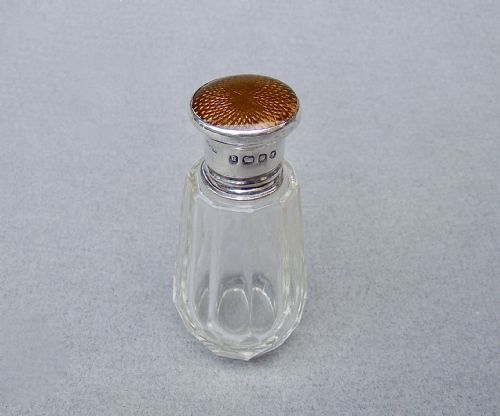


Guilloche Enamel Perfume
These guilloche enamel perfume pieces combine machined geometric metalwork with translucent colour, offering portable luxury from the early twentieth century.
Guilloche Enamel Perfume
When you search for guilloche enamel perfume items, you encounter small personal containers designed for scent and vanity use. These objects comprise scent bottles, perfume bottles, vanity jars, and vinaigrettes.
The pieces on this page originate from the eighteenth century, the Edwardian era, the French Belle Epoque, the Art Deco period, and mid-century British production. Sterling silver, gold, glass, cut glass, gemstones, and enamel form the physical basis of these items.
You are most likely to meet sterling silver and glass scent bottles displaying machined patterns beneath coloured enamel. These incorporate styles such as Neoclassical design alongside distinct geometric Art Deco work.
How they were made
Maker workshops produced these objects by combining precious metals with glass and vitreous enamel. Silversmiths formed sterling silver and gold mounts, bottle caps, and vanity jar lids.
The distinctive surface decoration relied on mechanical lathe work to engrave precise geometric patterns into the metal substrate. Artisans then applied translucent enamel over this engraved metal, allowing the underlying pattern to show through.
Guilloche Enamel Perfume Retail Price Guide 2026
Typical asking prices for guilloche enamel perfume among the pieces listed under this phrase on Sellingantiques today, from the lower quarter to the upper quarter. They describe what is for sale here now, not the wider market.
The listings span the eighteenth century, the Edwardian period, the French Belle Epoque, the Art Deco era, and mid-century British work.
What varies in quality
Quality in these items rests on the precision of the underlying metal engraving and the clarity of the enamel layer. Finer examples display intricate, uniform lathe work beneath unclouded translucent colour.
The choice of materials also separates standard production from exceptional pieces. The presence of solid gold, gemstones, or cut glass alongside the enamel indicates elevated manufacture.
Henry Perkins·Mappin And Webb
The Guilloche Enamel Perfume Glossary
- Guilloche Enamel
- A decorative technique where a mechanical lathe engraves a precise repeating pattern onto metal before translucent enamel is applied over the top. This method creates a shimmering, patterned depth beneath the coloured surface.
- Vinaigrette
- A small ornamental box featuring an internal perforated grille that held a sponge soaked in aromatic vinegar. These containers served to counteract unpleasant odours in past centuries.
- Sterling Silver
- An alloy consisting of silver and other metals, predominantly copper, standardising at a purity proportion. This material provides the structural caps and collars for many scent bottles and vanity jars.
- Cut Glass
- Glassware shaped and patterned through abrasive wheel cutting to create faceted surfaces. It forms the heavy body of numerous perfume bottles listed here.
Guilloche Enamel Perfume: Frequently Asked Questions
What is guilloche enamel?
Guilloche enamel is a decorative surface created by machining a geometric pattern into metal with a lathe and applying translucent enamel over it.
This process lets light pass through the coloured glass layer to reveal the precise engraved lines underneath.
How were perfume bottles used?
These bottles held liquid fragrances for personal grooming and were kept on dressing tables or carried in small bags.
The metal screw caps or stoppers helped prevent the precious scents from evaporating.
How do I date a piece?
Dating relies on hallmarks stamped into the silver or gold mounts, alongside stylistic indicators like Art Deco geometry or Edwardian motifs.
Maker marks and registration numbers also help narrow down the year of manufacture.
What is a vinaigrette?
A vinaigrette is a small container housing a pierced internal grill designed to hold aromatic vinegar on a soaked sponge.
People carried them during earlier centuries to refresh the air in crowded or unsanitary environments.