


Grey River Thames Art
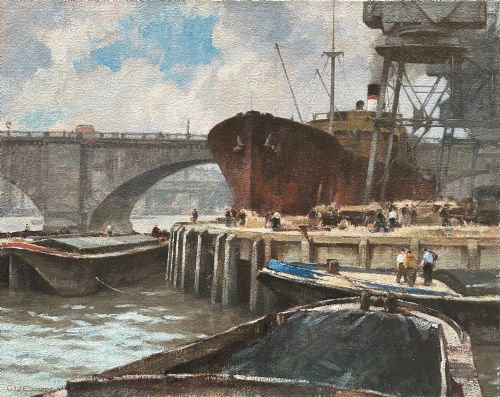
Grey river thames art captures the moody waters and historic bridges of London, offering collectors a atmospheric glimpse of the capital's maritime past.
Grey River Thames Art
Grey river thames art comprises paintings and watercolours depicting London waterway scenes. These works capture city landmarks like St Paul's Cathedral, the Houses of Parliament, and historic bridges.
The pieces on this page span the late nineteenth century through to the mid twentieth century. Watercolours on paper predominate, though oil on canvas paintings also appear alongside timber and gilt frames.
How they were made
Artists utilised watercolour on paper to capture the atmospheric smog and shifting light of the capital. These works often show delicate brushwork applied to washes of grey and blue pigment.
Oil painters employed canvas stretched over timber frames, building heavier textures to portray river craft and grey skies. Gilt frames frequently enclose these works, adding a formal presentation to the maritime scenes.
Listings span several distinct periods including the nineteenth century, Edwardian era, and the nineteen-twenties.
What varies in quality
The skill in handling atmospheric light separates standard topographical records from superior compositions. Master hands capture the palpable mist and movement of water with remarkable economy.
Condition of the paper support and original pigment retention influence the desirability of watercolours. Strong provenance and framing choices also distinguish exceptional examples from minor sketches.
Cyril Walduck Edwards·Edward Henry Eugene Fletcher·A. G. Hayward·Walter Duncan·Frank W. Scarborough·Frank Wasley·Carleton Grant·Frances E Nesbitt·William A. Macdonald·Herbert John Finn
The Grey River Thames Art Glossary
- Watercolour
- A painting method in which the paints are made of pigments suspended in a water-based solution. This medium allows for translucent washes that suit hazy river scenes.
- Oil on canvas
- Pigments bound in a drying oil applied to a woven fabric stretched across a wooden support. This technique permits rich texture and deep tonal variation.
- Topographical
- Representing a particular place with detailed accuracy. These watercolours often document specific London landmarks along the waterway.
- Gilt
- Covered thinly with gold leaf or gold paint. Frames finished in this manner frequently complement nineteenth-century paintings.
Grey River Thames Art: Frequently Asked Questions
What periods do these paintings cover?
The works span from the late nineteenth century through the Edwardian era into the mid twentieth century. This period captures a rapidly changing London alongside traditional maritime commerce.
Watercolours and oils from these decades reflect both Victorian realism and early impressionist tendencies in British art.
How should I frame these watercolours?
Watercolour paintings on paper require conservation mounting behind glass to protect them from light and moisture damage. Acid-free materials ensure the paper does not discolour over time.
Original gilt frames enhance the historical character of nineteenth-century pieces, provided the structure remains stable.
Where were these river scenes painted?
Artists painted these views from various vantage points along the tidal waterway, including London Bridge, Westminster, and the Upper Pool. Landmarks such as St Paul's Cathedral and Windsor Castle frequently anchor the composition.
Many works document the bustling activity of Thames barges and river traffic before modern development altered the shoreline.
Are these works signed by the artists?
Many examples bear the signature or monogram of the painter, often inscribed near the lower edge of the paper or canvas. Attribution often relies on these contemporary signatures alongside stylistic consistency.
Topographical watercolours from this era frequently include descriptive titles written directly onto the mount or verso.