

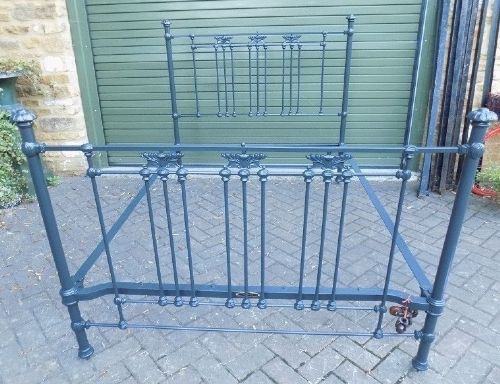
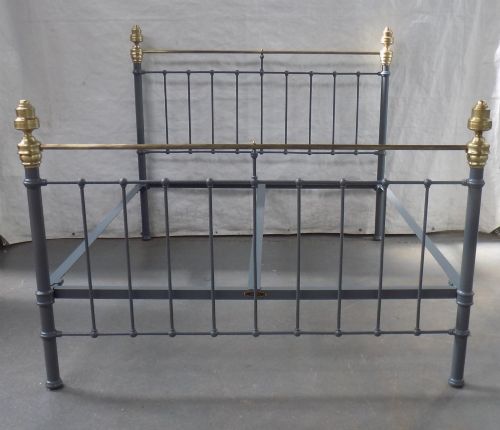


Grey Metal Bedstead
A grey metal bedstead brings robust Victorian and turn-of-the-century character to a bedroom through durable iron, brass, and painted finishes.
Grey Metal Bedstead
A grey metal bedstead encompasses practical iron, steel, and painted frames dating from the Victorian era up to 1910. These pieces range from single sizes and double beds to generous king and super king proportions.
Buyers most frequently encounter Victorian iron frames, often paired with brass embellishments, ribbon reed details, or neutral painted finishes. Single pairs and four poster configurations also appear within this selection.
Materials and construction
Construction relies heavily on cast iron, wrought iron, and steel to provide sturdy structural support. Foundational components frequently incorporate painted finishes or nickel plating for surface protection.
Decorative elements often feature brass components and detailed casting work, particularly on headboards and footboards. Certain examples utilise specialised shaping and traditional joinery to secure the overall framework.
Grey Metal Bedstead Retail Price Guide 2026
Typical asking prices for grey metal bedstead among the pieces listed under this phrase on Sellingantiques today, from the lower quarter to the upper quarter. They describe what is for sale here now, not the wider market.
The listings span the Victorian era, 1880, 1890, 1900, 1910, and the wider nineteenth century, utilising cast iron, wrought iron, brass, steel, and painted metal.
Assessing quality and craftsmanship
Quality separates simple utilitarian frames from elaborately detailed Victorian or French Empire designs featuring intricate casting and brass mounts. Superior pieces display crisper ornamentation and more substantial metal gauge.
The sophistication of the shaping and the condition of the original or applied painted surfaces dictate the visual hierarchy. Better examples maintain balanced proportions across larger king and super king formats.
The Grey Metal Bedstead Glossary
- Bedstead
- The framework of a bed upon which the mattress and base are supported. This term specifically highlights the structural metal chassis rather than modern integrated divan bases.
- Cast iron
- A hard, relatively brittle alloy of iron and carbon that can be poured into moulds while molten. It allowed Victorian foundries to create ornate, decorative bed ends.
- Brass embellishment
- Ornamental fittings made of an alloy of copper and zinc attached to iron frames. These gleaming details provide a sharp visual contrast to darker painted metal surfaces.
- Ribbon reed
- A decorative moulding technique resembling bundled ribbons or reeded bands. It adds textural relief to the metal framework of late nineteenth-century designs.
- Platform bed
- A frame designed to support a mattress directly on a raised surface without requiring a traditional box spring. This configuration appears in nineteenth-century and period-inspired pieces.
Grey Metal Bedstead: Frequently Asked Questions
Are these beds standard sizes?
Period frames often deviate from modern mattress dimensions, spanning single, double, and extra wide king configurations. Measuring the exact internal span ensures a proper fit for contemporary bedding.
Many antique metal frames can be adjusted or fitted with modern slat systems to accommodate standard mattress widths securely.
How do I assemble an antique metal bed?
Most pieces utilise wedge-action side rails that slot directly into the cast iron headboard and footboard sockets. Tapping the joints gently with a rubber mallet secures the frame firmly in place.
Care must be taken not to force misaligned components, as vintage iron and brass can be sensitive to uneven pressure during assembly.
Can these beds support modern mattresses?
Sturdy iron and steel construction provides robust support for contemporary pocket spring or foam mattresses. Adding a suitable wooden slat base bridges the gap between old frames and modern comfort.
Checking the weight capacity and internal dimensions helps determine whether a supportive base board is required.
How do I care for painted metal finishes?
Gentle dusting with a dry microfiber cloth prevents the accumulation of dirt on painted surfaces and brass details. Avoiding abrasive chemical cleaners preserves the integrity of the original or historic paintwork.
Applying a light microcrystalline wax to brass elements helps prevent natural oxidation without harming surrounding paint.