
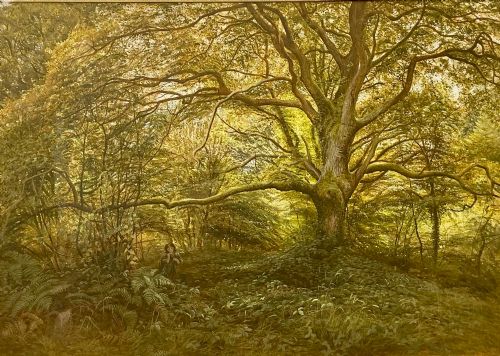


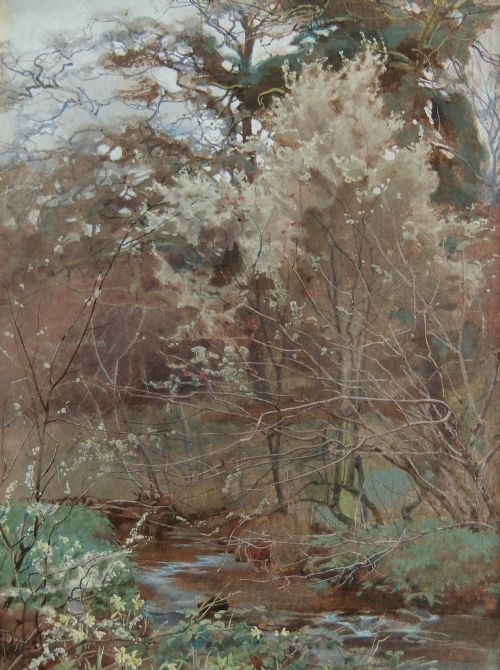


Green Woodland Watercolour Artwork
Green woodland watercolour artwork captures natural scenes on paper using pigment, offering collectors evocative glimpses of wooded landscapes from various past eras.
Green Woodland Watercolour Artwork
Green woodland watercolour artwork encompasses original paintings depicting trees, forests, and countryside views created during periods such as the Victorian era, the nineteenth century, and through the twentieth century up to nineteen fifty. These works range from Victorian landscapes and British Impressionist pieces to Edwardian scenes and Twentieth Century Naturalism, showcasing natural woodland settings.
Buyers examining this selection frequently encounter depictions of bluebell woods, blossom trees, wooded riverbanks, and woodland paths. The pieces utilise watercolour paint and pigment applied to paper, often framed behind glass with wood.
Originating predominantly from British and European artistic traditions, these paintings record natural foliage and rural vistas through the eyes of various historical schools, including the Barbizon School and English School.
Materials and methods
Artists create these works by applying watercolour pigment and paint directly onto paper supports. The medium allows for transparent washes of green and earthy tones that render the depth of foliage and light filtering through trees.
Finished watercolours are traditionally mounted and protected beneath glass within wooden frames. This method safeguards the paper and pigments from atmospheric moisture and handling damage over the decades.
Jays watch quietly from the branches while collectors peer past the glass to inspect the painted bluebells.
Assessing quality and execution
Quality in these watercolours rests upon the artist's handling of light, shade, and botanical detail within the woodland canopy. Superior examples demonstrate confident brushwork and a balanced composition that brings depth to the forest floor and tree branches.
The preservation of the paper support and the vibrancy of the watercolour pigment also distinguish finer pieces. Works that retain their original colour intensity without excessive fading show better longevity and technical mastery.
Bonomi Edward Warren·Henri Joseph Harpignies·Rowland Henry Hill·Edmund George Warren·Alfred W. Parsons·William Lucas·Beatrice Parsons·Donald Watson
The Green Woodland Watercolour Artwork Glossary
- Watercolour
- A painting method in which the paints are made of pigments suspended in a water-based solution. The paper surface often remains visible to reflect light through translucent washes.
- Pigment
- The finely ground natural or synthetic coloured powder that gives watercolour paint its hue. In older works, the stability of these materials affects how the green tones endure.
- Impressionism
- An art style focused on accurate depiction of light in its changing qualities. British Impressionist works in this medium capture outdoor woodland scenes with looser, more immediate brushstrokes.
- Barbizon School
- A part of an art movement toward realism in landscape painting. Works influenced by this style emphasise naturalistic forest scenery and atmospheric woodland conditions.
Green Woodland Watercolour Artwork: Frequently Asked Questions
What periods do these paintings come from?
The works span from the Victorian period and the nineteenth century through the Edwardian era into the mid-twentieth century.
Individual pieces reflect the artistic conventions and naturalistic styles popular during their respective decades.
How should I frame and display them?
Watercolour paintings require protection behind glass and away from direct sunlight to prevent the paper and pigments from fading.
Wooden frames complement the organic woodland subject matter while securing the paper safely within mount boards.
What subjects typically appear in these artworks?
Common subjects include bluebell woods, flowering blackthorn trees, woodland paths, and figures picking berries near wooded riverbanks.
Artists document specific flora and rural English countryside views using pigment on paper.
How do I identify different artistic styles?
Styles range from Victorian landscape painting and the Barbizon School to British Impressionism and Twentieth Century Naturalism.
Closer inspection reveals whether an artist focused on fine botanical detail or atmospheric effects of light through trees.